Table of contents
Open Table of contents
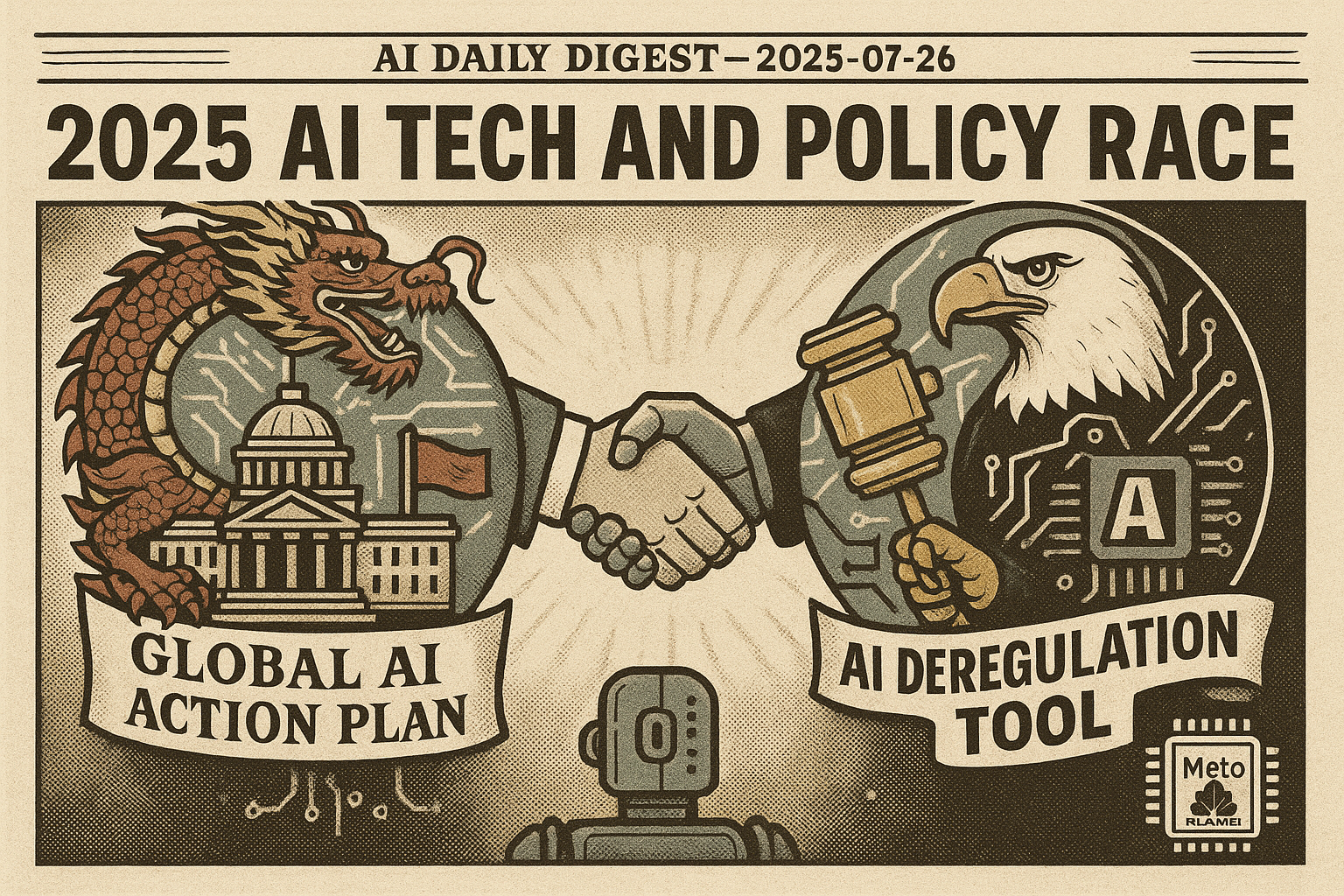
- DOGE AI Tool Ushers in Aggressive Federal Deregulation Push
- China Unveils Ambitious Global AI Action Plan, Calls for International Governance
- Meta Appoints Former OpenAI Scientist Shengjia Zhao to Lead Superintelligence Lab
- Huawei Publicly Launches CloudMatrix 384, Its Answer to Nvidia’s AI Clusters
- Anthropic Eyes $150 Billion Valuation in New Funding Round
- Briefs & Notable Mentions
- Other Developments & Community Highlights
- Short Summaries: Additional News & Insights
DOGE AI Tool Ushers in Aggressive Federal Deregulation Push
Category: Regulation and Policy
Source: newsweek.com
The Trump administration is accelerating its high-stakes regulatory overhaul with the reported deployment of the “DOGE AI Deregulation Decision Tool.” Internal documents and official sources reveal that the Department of Government Efficiency (DOGE) is leveraging this AI-powered system to review and help eliminate up to 100,000 existing federal rules—half of all current regulations—by the president’s first anniversary in office.
Originally conceived to increase governmental efficiency and reduce bureaucracy, DOGE’s tactic involves scanning some 200,000 federal rules, rapidly flagging outdated or unnecessary ones for repeal across agencies. HUD and other departments are already piloting the tool, with reports of AI reviewing and recommending cuts to major regulatory sections within mere days.
However, the aggressive move raises significant legal and ethical questions. Civil servants and legal experts warn that using AI for interpreting intricate statutory language can lead to oversights or errors, potentially misclassifying essential rules as dispensable. Concerns also persist about whether such AI-driven deregulation can withstand judicial scrutiny under established administrative law.
White House officials emphasize that all options to achieve regulatory rollback are still being considered, with final implementation details subject to ongoing review. In any scenario, this marks one of the most substantial attempts in history to automate U.S. government policy change.
China Unveils Ambitious Global AI Action Plan, Calls for International Governance
Category: Regulation and Policy
Source: cnbc.com
China unveiled a wide-reaching global AI action plan at the World Artificial Intelligence Conference (WAIC) in Shanghai, mere days after the U.S. released its own regulatory strategy. Premier Li Qiang proposed the creation of a new international AI cooperation organization, advocating for multilateral oversight, knowledge exchange, and a global governance framework that ensures AI does not become “an exclusive game” for a few countries and corporations.
With tensions rising between the U.S. and China over chip sanctions and AI leadership, China’s new blueprint emphasizes open-source development and support for developing nations—especially in the Global South. The plan aims to promote equitable access to AI benefits while managing security, ethical, and talent-related risks. China’s leadership invited participation from an array of countries and research organizations, proposing to headquarter the new body in Shanghai.
The initiative positions China at the forefront of global AI rule-making, offering a collaborative vision in contrast to the U.S.’s more unilateral, deregulation-focused policies. World leaders and industry heavyweights, including representatives from major Western technology companies, attended the event as China showcased rapid advancements in both software and hardware AI innovation.
Meta Appoints Former OpenAI Scientist Shengjia Zhao to Lead Superintelligence Lab
Category: Enterprise and Adoption
Source: cnbc.com
Meta has made a high-profile hire by naming Shengjia Zhao—co-creator of OpenAI’s ChatGPT and a renowned AI researcher—as Chief Scientist of the Meta Superintelligence Labs. Under Mark Zuckerberg’s direct oversight, and building on Meta’s recent $14 billion AI push, Zhao will drive the development of foundational models (including the Llama series), products, and fundamental research in the lab.
Zhao brings deep expertise from projects like GPT-4 and synthetic data initiatives, and joins Alexandr Wang (formerly CEO of Scale AI) who now serves as Meta’s chief AI officer. The company’s move is part of a larger commitment to invest heavily—reportedly “hundreds of billions” of dollars—in AI compute and research infrastructure. The Superintelligence Labs will spearhead next-generation AI innovations for Meta’s platforms as the technology race among global giants intensifies.
Huawei Publicly Launches CloudMatrix 384, Its Answer to Nvidia’s AI Clusters
Category: Infrastructure and Hardware
Source: huaweicentral.com
At the WAIC 2025 conference, Huawei officially launched its CloudMatrix 384 AI chip cluster, dubbed the Atlas 900 A3 SuperPoD. This hardware platform positions itself as a direct rival to Nvidia’s GB200 NVL72 system, offering double the BF16 compute performance (up to 300 PFLOPs), and significantly higher memory capacity and bandwidth.
Built on Huawei’s Ascend AI chip architecture, CloudMatrix 384 features 384 interconnected NPUs with low-latency communication, engineered for stability, resource optimization, and large-scale AI training. The launch is a clear signal of China’s determination to reduce reliance on foreign hardware and to assert technological leadership through domestic AI infrastructure solutions.
Anthropic Eyes $150 Billion Valuation in New Funding Round
Category: Startups and Funding
Source: pymnts.com
Anthropic, a fast-rising AI startup known for the Claude model family, is reportedly seeking a jaw-dropping $150 billion valuation—more than doubling its previous worth—in a fresh funding round expected to raise up to $5 billion. The company’s annualized recurring revenue has quadrupled in 2025, helped by strong business adoption of Claude for coding, finance, and enterprise AI needs.
Backed by significant investments from firms like Amazon, Anthropic’s push could set new records for AI startup funding and further intensify competition with rivals such as OpenAI and Google DeepMind.
Briefs & Notable Mentions
China Calls for Global AI Consensus—International Coverage
China’s “AI action plan” and push for a global AI governance organization received extensive attention (see coverage in Reuters, The Guardian, DW). All highlight Premier Li Qiang’s warnings that AI risks becoming the “exclusive game” of a few countries, and the critical need for balanced global development and regulation.
Meta Recruits ChatGPT Co-Creator for Superintelligence Push
Complementing CNBC’s scoop, Reuters echoed Meta’s strategic leadership hire, cementing their serious AI R&D ambitions.
Huawei Showcases China’s Cutting-Edge AI Hardware
Direct competitor to NVIDIA, Huawei’s CloudMatrix cluster received similarly detailed coverage in wccftech.com.
LeBron James’ Lawyers Threaten Legal Action Over Deepfake AI Video
FlickUp, an AI generative platform, received a cease-and-desist from LeBron James’ legal team after non-consensual, explicit deepfakes of NBA stars went viral (sfgate.com). This case highlights intensifying legal scrutiny around AI content generation and celebrity rights.
AI Industry Highlights – July 26
- Microsoft’s Copilot prepares for GPT-5 (TestingCatalog, source)
- Google introduces Opal mini-app builder and unveils a new deepfake detector (Science Daily, source)
- Lawmakers rebuke Delta’s AI-driven dynamic pricing (Ars Technica, source)
Opinion & Commentary
- “The Mythical Machine-Month Paradox” by Joshua Pearson examines the realities and myths around AI-dominated software development, legacy system maintenance, and workforce displacement (tucson-josh.com).
- Eisenhower’s famous warning is revived in the AI era: Don Wood discusses the emergence of the “AI-Industrial Complex”, centralized power, and the hopeful rise of decentralized, open-source models (open.substack.com).
Other Developments & Community Highlights
- DOGE AI Tool and Dogecoin Volatility: Unverified reports of an official DOGE AI tool for deregulation led to speculative discussions and a sharp 40% drop in Dogecoin price—though no concrete policy impact has been detected (ainvest.com).
- AI Tools for Productivity: New services such as “Image to Draw.io Converter” allow users to transform screenshots/diagrams into fully editable formats, demonstrating practical AI deployment in business and documentation (imagetodrawio.com).
- Microsoft Copilot Gets a Personality Makeover: The new “Appearance” feature debuts, bringing an animated persona to Microsoft’s digital assistant, drawing mixed reactions and memories of Clippy (techradar.com).
- Anecdotes & Experiments:
- Agents demonstrate unexpected capabilities, from clicking captcha “I am not a robot” buttons to playing simple browser games and even autonomously placing pizza orders.
- OpenAI’s new “Lobster” model impresses in code generation tasks, with users reporting unprecedented long outputs and one-shot full Minecraft clone generations.
- Community plugin projects tackle longstanding frustrations with ChatGPT’s memory limitations.
Short Summaries: Additional News & Insights
- Anthropic mulls $150B valuation in new funding round, with revenue quadrupling year-to-date.
- Next-gen OpenAI model (“Lobster”, presumed GPT-5) repeatedly outperforms existing models in complex WebDev challenges.
- Opinion: The myth of AI replacing most software engineers is dissected; real-world code maintenance remains deeply human (tucson-josh.com).
- AI certifications by cloud vendors spark debate over their real-world utility and accessibility for non-experts.
- Discussions on the value of Artificial General Intelligence (AGI) and the ongoing prevalence of narrow AI models.
- Further speculation and debate around the ethics and efficacy of AI-generated content, deepfakes, and the future of regulation.
- User experiments and tools continue to blur lines between automation and human tasks, often with humorous or unintended consequences.
For in-depth articles and source links, please visit the referenced publications above.