Table of contents
Open Table of contents
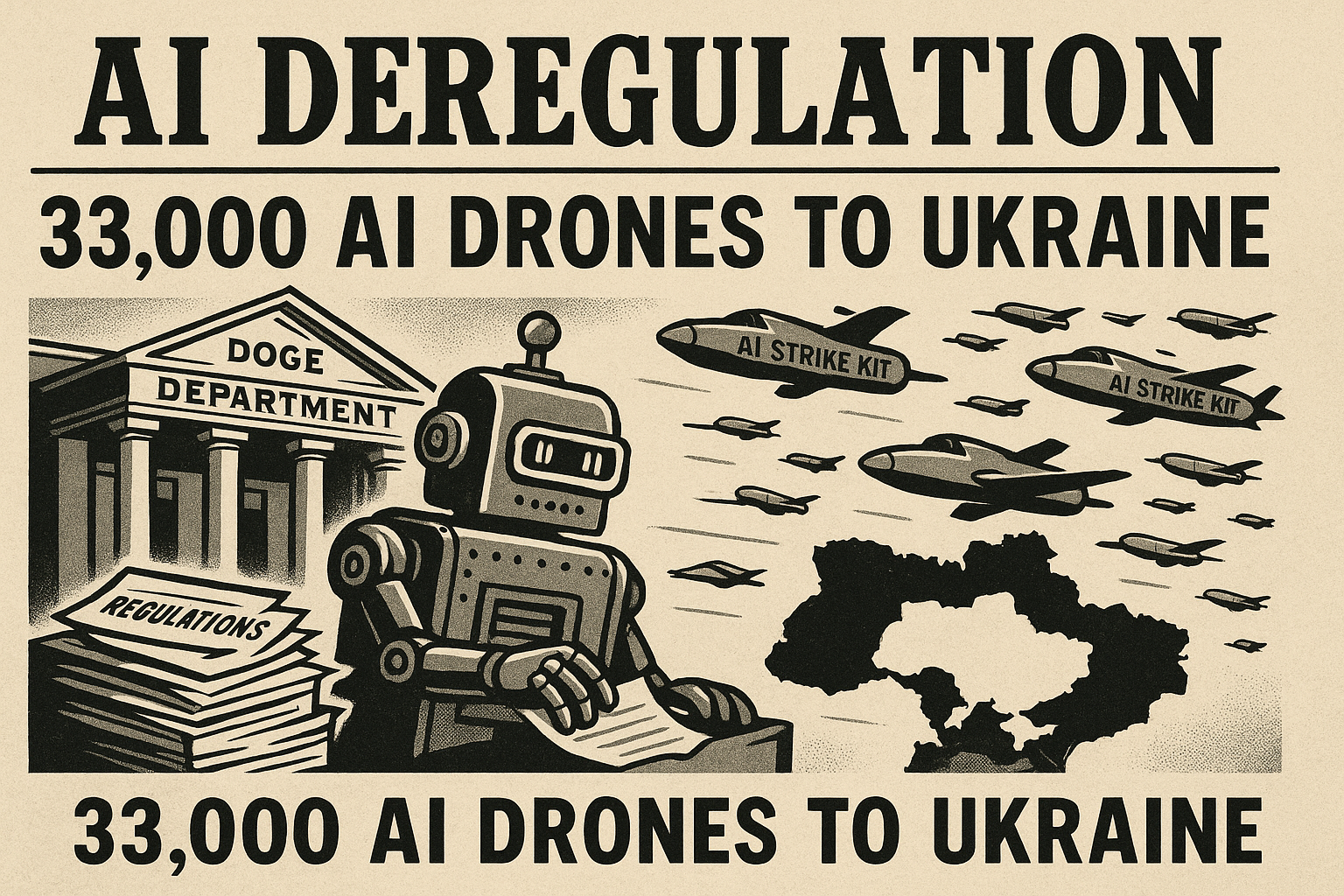
- US Government Deploys AI to Slash Federal Regulations
- 33,000 AI-Driven Strike Drones Headed to Ukraine in US-Backed Deal
- Bollywood Faces “Ethical Abyss” as Raanjhanaa’s AI-Edited Re-Release Sparks Artist Outcry
- Amazon VS Code Extension Hacked: Malicious AI Prompt Endangered Cloud Users
- New Brain-Inspired AI Model Delivers 100x Faster Reasoning Than LLMs
- AI’s Growing Role and Risks in Healthcare Advice
- Spanish Schoolboy Arrested for AI-Generated Deepfake Images of Classmates
- Short Summaries: Other Noteworthy News
US Government Deploys AI to Slash Federal Regulations
Category: Regulation and Policy
Source: TechCrunch
The Department of Government Efficiency (DOGE) has rolled out an artificial intelligence-powered Deregulation Decision Tool with the ambitious goal of eliminating half of all federal regulatory mandates—approximately 100,000 rules—by the next anniversary of President Donald Trump’s return to office. According to The Washington Post, the AI is already in use, reviewing regulations at the Department of Housing and Urban Development and automating the drafting of deregulation submissions.
The White House, while noting no single plan has been fully approved, praised the DOGE team as the “best and brightest.” However, government staff have voiced concerns over the tool’s accuracy, with reports emerging that the AI has made errors in legal interpretation. Legal experts warn that automating regulatory rollbacks may raise significant procedural and authority questions, and there are worries about the tool’s oversight since it was developed rapidly by engineers, reportedly those recruited by Elon Musk (who is no longer with DOGE).
This initiative highlights a transformative—and controversial—moment in the use of AI for policymaking, promising unprecedented efficiency but also ushering in legal, ethical, and practical risks that are likely to dominate Washington debates for months ahead.
33,000 AI-Driven Strike Drones Headed to Ukraine in US-Backed Deal
Category: Autonomous Systems and Robotics
Source: Euromaidan Press
American-German software company Auterion announced it will deliver 33,000 AI-powered drone “strike kits” to Ukraine by year’s end under a $50 million contract with the US Department of Defense. The unprecedented scale, as detailed by CEO Lorenz Meier, marks a tenfold increase over previous deliveries and arrives amid reports of intensified Russian drone assaults overwhelming Ukraine’s defenses.
Auterion’s “Skynode” strike kits transform regular drones into AI-driven weapons platforms resistant to electronic jamming and capable of tracking moving targets from one kilometer away. Ukraine’s President Zelenskyy underscored the urgent need for such tools as domestic production struggles to meet demand, estimating upscaling efforts at $6 billion.
This evolution signifies both Ukraine’s frontline status as a proving ground for warfare innovation and the global race to integrate AI into military hardware. Auterion’s tech, focused on AI-based targeting and swarming behaviors, could shape future defense strategies for NATO and beyond.
Bollywood Faces “Ethical Abyss” as Raanjhanaa’s AI-Edited Re-Release Sparks Artist Outcry
Category: Ethics and Governance
Source: The Guardian
Creative integrity is under fierce debate after Indian film company Eros International re-edited the classic 2013 film Raanjhanaa using AI to create a “happy ending”—without informing the film’s director Aanand L Rai or writer Himanshu Sharma. The Tamil re-release, Ambikapathy, replaces the original tragic climax and is described by Eros as a “respectful creative reinterpretation.” Director Rai, unaware of the AI-altered version until news broke, condemned the move as a violation of artistic intent and trust.
The controversy has resonated across India’s film community and drawn international attention, with legal experts highlighting that older contracts may not have provisions for AI-driven modifications. The incident amplifies urgent questions about consent, copyright, and the boundaries of technology in creative works—issues already at the forefront of the Hollywood strikes in recent years.
As AI tools become more pervasive, this episode could set a precedent for how studios manage (and communicate about) AI augmentation or modification of creative content globally.
Amazon VS Code Extension Hacked: Malicious AI Prompt Endangered Cloud Users
Category: Security and Privacy
Source: The Register
An official Amazon Q extension for Visual Studio Code was briefly compromised, introducing a script that prompted the AI to delete the user’s home directory and all AWS resources when specific commands were run. The extension, which was live for two days before being replaced, appeared to be targeted more at exposing AWS’s security weaknesses than at widespread sabotage.
AWS responded promptly by revoking the relevant credentials and releasing a fixed version. The breach, however, has reignited debate over the rush to AI-driven coding automation and whether such efficiency is outpacing responsible security practice.
New Brain-Inspired AI Model Delivers 100x Faster Reasoning Than LLMs
Category: Research and Innovation
Source: VentureBeat
Singapore-based startup Sapient Intelligence has unveiled a Hierarchical Reasoning Model (HRM) that outperforms leading large language models (LLMs) on complex reasoning tasks, with vastly reduced data needs. Inspired by human brain architecture, HRM conducts “latent reasoning” within internal representations rather than verbose chain-of-thought prompting, achieving feats like solving top-tier Sudoku and maze problems after just 1,000 training samples.
This innovative approach promises not only greater speed (reportedly 100x faster on some tasks) but also significant implications for edge computing, enterprise adoption, and specialized domains where data and compute resources are limited. Researchers anticipate HRM’s architecture will influence next-generation AI in fields from industrial systems to robotics.
AI’s Growing Role and Risks in Healthcare Advice
Category: Healthcare and Life Sciences
Source: Reddit
A growing trend has emerged among major AI companies—including OpenAI and Grok—who are no longer routinely including warnings or disclaimers when chatbots dispense health-related advice. New research indicates that these AIs not only answer medical questions freely but also offer follow-up diagnoses, raising the risk that users may treat unverified responses as expert medical guidance. The decline of in-chat disclaimers comes as more people turn to AI chatbots for sensitive topics, sparking concern among health professionals and privacy advocates about user safety and potentially dangerous reliance on unchecked AI “advice.”
Spanish Schoolboy Arrested for AI-Generated Deepfake Images of Classmates
Category: Ethics and Governance
Source: The Independent
Spanish authorities have arrested a 17-year-old boy accused of using AI to create fake nude images of female classmates, which were circulated online. Sixteen minors from an institute in Valencia filed complaints about the AI-generated content. The incident has intensified calls for legislative action in Spain, where lawmakers are considering a bill to criminalize the non-consensual creation of AI-generated sexual images. The case underscores growing global challenges around AI-powered deepfakes, digital consent, and youth safety.
Short Summaries: Other Noteworthy News
-
AI Model in Vogue Triggers Beauty Standards Debate
The first AI-generated model featured in Vogue via a Guess ad has sparked debate over fashion industry standards, diversity, and the future role of AI avatars in advertising. (BBC) -
ChatGPT Privacy Warning for Therapy Users
OpenAI CEO Sam Altman explained that ChatGPT therapy sessions lack legal protections, making them liable to subpoena in legal cases—raising major privacy and data retention concerns. (Business Insider) -
Awkward Corporate Privacy Breaches from Shared ChatGPT Accounts
French media reported cases of employees unintentionally accessing private, sensitive, or incriminating requests made by colleagues on shared company ChatGPT accounts—including personnel issues and disciplinary plans. (BFMTV) -
China and UN Leaders Call for Global AI Regulation Body
International calls intensified for global frameworks to govern AI, with the UN and China each advocating coordinated regulatory approaches. -
Auterion Case Spotlighted as Microfactories Gain Momentum
New reports highlight a surge in shippable, on-site robotic microfactories reshaping construction economics, as automation, AI, and “factory-as-a-service” models drive decentralization. (Thesis Driven) -
Meta Appoints Shengjia Zhao Chief Scientist for Superintelligence Labs
Meta has elevated Shengjia Zhao, OpenAI’s former lead scientist, while clarifying that Yann LeCun remains head of its core research arm—underscoring the intensifying AI talent war. (Business Insider) -
Reddit & Community Notes:
- Users discuss risks and possible resistance strategies as ChatGPT Agents ignore robots.txt blocking websites.
- Ongoing debate about whether AI tools will render most senior developers redundant as workflows become more automated.
- A university case study reveals students’ heavy academic and emotional reliance on AI—raising concerns about potential erosion of self-directed learning and judgment. (The Guardian)