Table of contents
Open Table of contents
Tesla’s Dojo Supercomputer Shutdown Signals Strategic Shift in AI Ambitions
Category: Infrastructure and Hardware
Source: TechCrunch
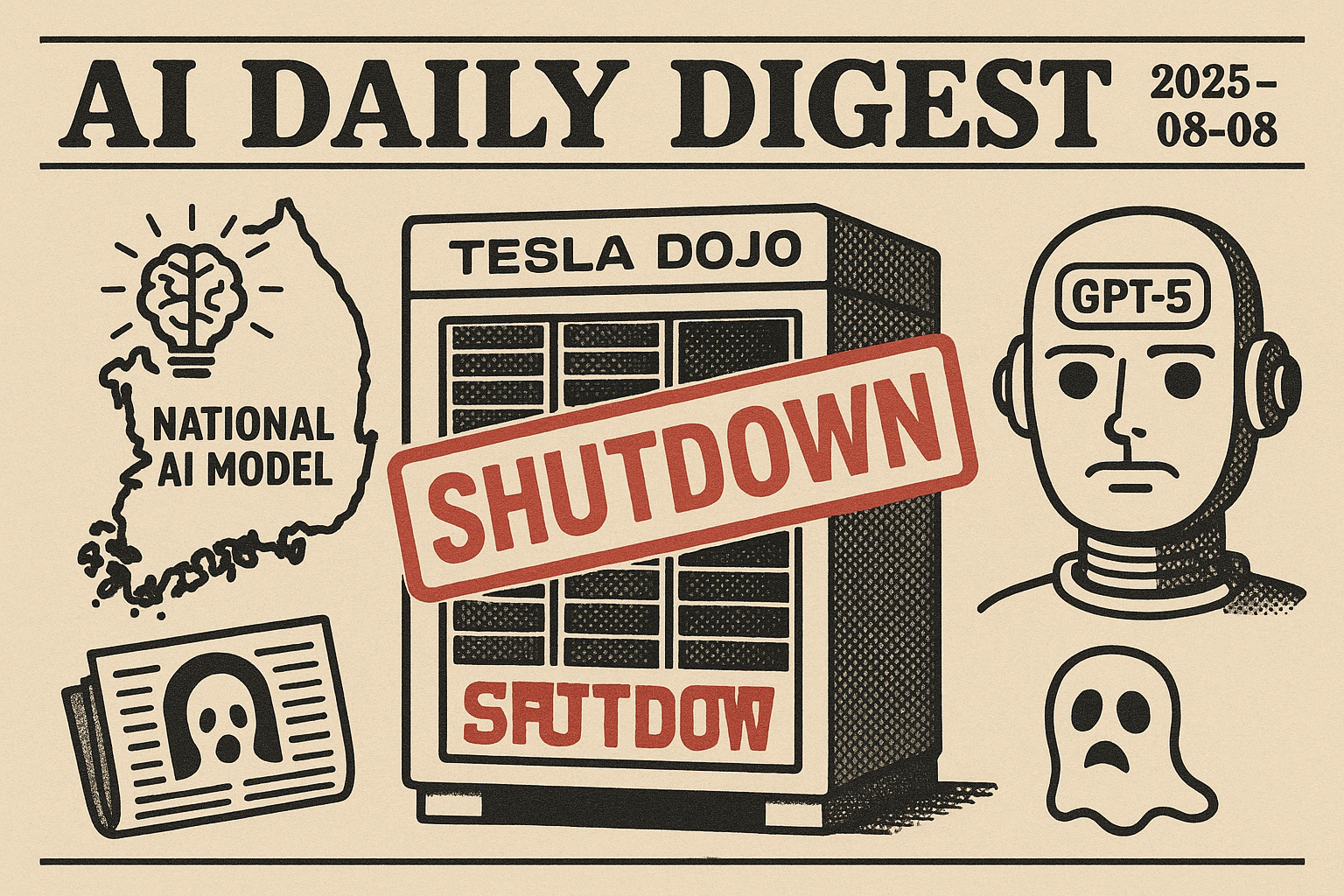
Tesla has officially disbanded its Dojo supercomputer team, marking a drastic pullback from its ambitious self-driving AI training endeavor. Dojo aimed to revolutionize autonomous driving by processing vast amounts of video data, touted by Elon Musk as a pivotal cornerstone of Tesla’s AI goals. However, the departure of key talent—many of whom have left to establish DensityAI—combined with Tesla’s strategic shift to rely more on external partners like Nvidia, AMD, and Samsung for computing and chip manufacturing, highlights significant internal challenges. While Dojo once promised a $500 billion valuation boost to Tesla, its dissolution underscores the complexities of scaling proprietary AI hardware in competitive industries.
For Tesla, the focus now shifts toward inference chips to power real-time AI models in conjunction with its burgeoning ride-hailing services.
Read more: TechCrunch
South Korea Challenges AI Giants With National AI Model Initiative
Category: Regulation and Policy
Source: CNBC
South Korea has unveiled plans for developing its own national AI foundation model, aiming to position itself as a powerhouse between U.S. and Chinese AI dominance. Leveraging its technological expertise across semiconductors and data centers, the initiative is being spearheaded by leading corporations such as SK Telecom, LG, and Naver. The project seeks to unify the country’s infrastructure and software capabilities while providing open-source AI models to bolster global accessibility. With ambitions of rivaling OpenAI and Anthropic, South Korea’s move signals a growing desire for sovereign AI systems amidst geopolitical competition.
Read more: CNBC
OpenAI’s Controversial Launch of GPT-5 Sparks Mixed Reactions
Category: Tools and Platforms
Source: Ars Technica
OpenAI’s GPT-5 made a splash this week, boasting improved reasoning and coding capabilities, but the community response indicates a mix of excitement and frustration. Long-term ChatGPT users lament the loss of older models like GPT-4o, describing GPT-5 as less creative and overly sterile in tone. While OpenAI has touted the model’s “PhD-level expertise,” some users feel it fails to offer the emotional engagement of its predecessors.
On one side, GPT-5 demonstrates enhanced accuracy for advanced applications, but it has yet to meet expectations for being a fully customizable digital assistant. OpenAI remains committed to improving user accessibility and workflows.
Read more: Ars Technica
Ethical Concerns Mount Over Use of AI to Simulate Deceased Individuals
Category: Ethics and Governance
Source: The Guardian
The use of AI to replicate deceased individuals—highlighted by a recent AI-generated interview with a Parkland shooting victim—has ignited ethical debates. Former CNN journalist Jim Acosta’s segment featuring the AI avatar of Joaquin Oliver has been widely criticized as exploitative. Though the victim’s parents supported its use as a means of advocacy and grief coping, experts warn that such practices blur boundaries between reality and fiction. They raise concerns about how AI could amplify misinformation and perpetuate emotional exploitation in journalism and media.
Read more: The Guardian
Short Summaries
Google Finance Gets AI Makeover
Google Finance has integrated AI features such as market chatbots and advanced charting tools for personalized financial analysis. This redesign aims to enhance user interactivity while also including cryptocurrency tracking.
Read more
Meta Acquires WaveForms for Speech AI Research
Meta strengthened its AI audio capabilities by acquiring WaveForms. The startup specializes in emotionally intelligent speech technology, promising advancements for Meta’s AI Labs.
Read more
Microsoft Teams With Partners for AI Workforce Training
California has partnered with Adobe, Google, IBM, and Microsoft to launch initiatives aimed at cultivating AI skills within its workforce. Focus areas include ethical AI development and tech sustainability.
Read more