Table of contents
Open Table of contents
Trump’s Deal with Nvidia and AMD Sparks National Security Concerns
Category: Regulation and Policy
Source: Financial Times
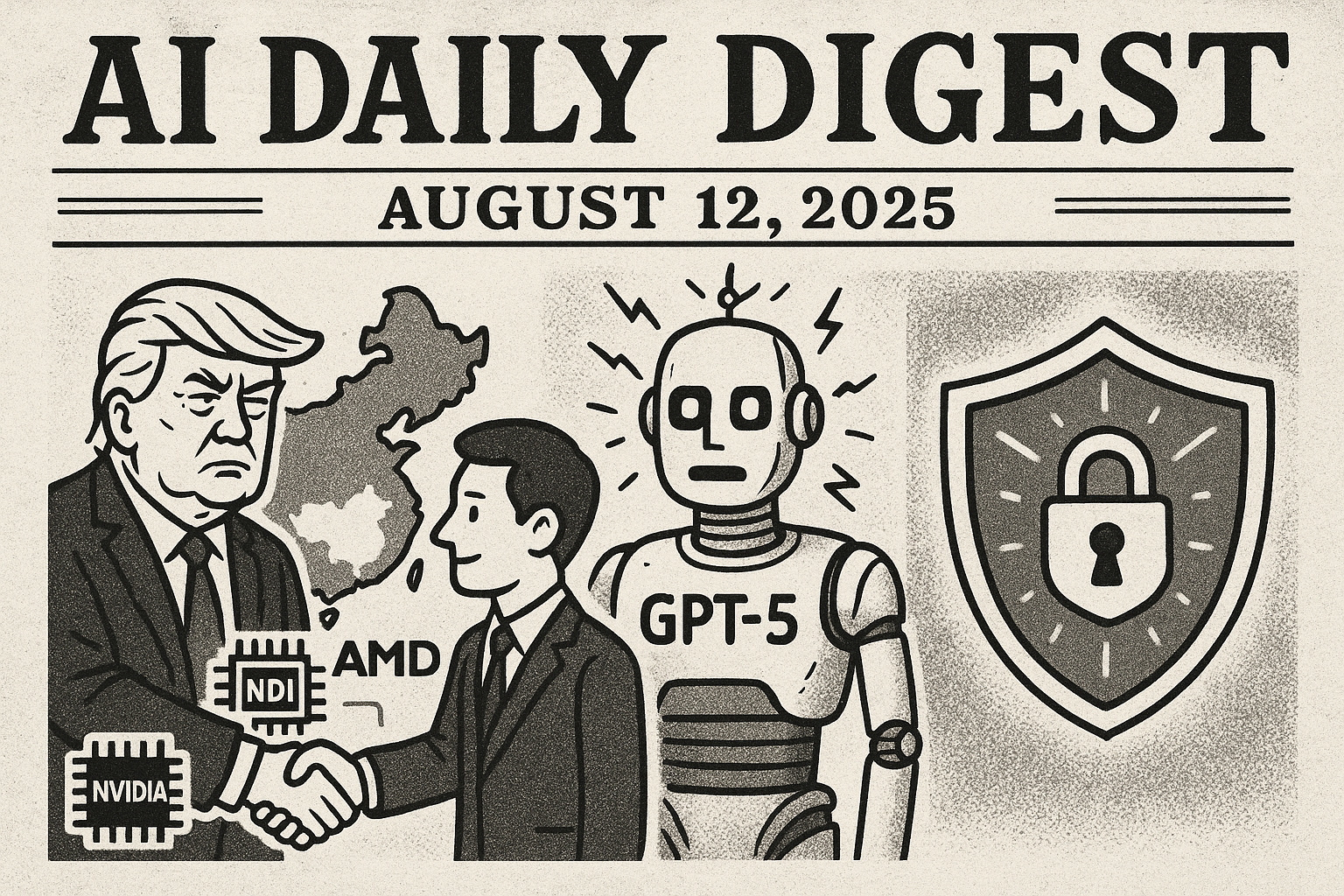
Donald Trump has struck a controversial deal allowing Nvidia and AMD to sell advanced AI chips to China in exchange for a 15% revenue share directed to the U.S. government. This decision has drawn bipartisan criticism, with lawmakers and tech experts warning such agreements risk undermining national security by accelerating China’s access to AI technologies. NVIDIA CEO Jensen Huang has been lobbying heavily for access to the Chinese market, and the deal could unlock billions in revenue for U.S. chipmakers.
Trump has also hinted at discussing additional deals to sell downgraded versions of Nvidia’s Blackwell chips to China. Experts fear that advanced computing power from these sales could enable Beijing to build frontier-scale AI supercomputers. National security officials are reportedly considering resigning over these decisions.
OpenAI’s GPT-5 Rollout Faces Mixed Reactions
Category: Research and Innovation
Source: The Guardian
OpenAI’s GPT-5 was launched amid much fanfare, but the rollout has been controversial. GPT-5 showcases major improvements over its predecessor in areas such as reasoning, coding, and text generation. However, users have reported ongoing issues including accuracy in basic logical tasks and inconsistent outcomes.
Notably, GPT-5’s energy usage has sparked environmental impact debates, as experts predict its daily operations consume power equivalent to 1.5 million U.S. households. OpenAI acknowledged GPT-5 as a significant step toward AGI, though CEO Sam Altman admits the model still lacks many critical capabilities.
AI and Entry-Level Jobs: The Vanishing Ladder
Category: Skills and Workforce
Source: Final Round AI
The automation provided by AI is rapidly eating into entry-level job opportunities, traditionally seen as vital steppingstones to skilled careers. These roles—often focusing on routine tasks such as data entry, basic coding, and customer service—are being swiftly replaced by GPT models and other AI systems.
Goldman Sachs estimates that AI’s adoption could affect up to 300 million jobs globally. In sectors such as marketing and HR, entry-level hiring has dropped by as much as 75%. Experts warn that eliminating these positions without reimagining how humans and AI can collaborate risks wasting young talent and damaging long-term workforce development.
Anthropic Strengthens Safeguards for Claude AI
Category: Ethics and Governance
Source: Anthropic
Anthropic has ramped up efforts to make its Claude AI system safer and more reliable through a combination of policy development, real-time content monitoring, and collaboration with external experts. The safeguards—including robust classifiers to detect policy violations—are designed to prevent harmful misuse and enhance user trust.
Key pre-deployment evaluations now include bias testing, risk assessments, and stress-testing Claude against diverse scenarios. Despite these improvements, the company acknowledges the need for collective action among researchers, policymakers, and civil society to ensure ethical AI deployment.
Sloppy AI Defenses Raise Cybersecurity Alarms
Category: Security and Privacy
Source: SC World
Inadequate security practices around AI systems have cybersecurity experts likening the state of defenses to the 1990s era of rampant vulnerabilities. Large language models and AI-agent platforms are increasingly showing significant exploitable weaknesses, including susceptibility to prompt injection and the misuse of MCPs (Model Context Protocols).
Experts emphasize the need for enhanced safeguards, urging developers to adopt stricter input sanitization and predictive risk assessments. As critical systems adopt AI, companies are urged to stress-test their platforms against emerging threats.
Short News Summaries
-
Vercel Innovates with v0.app
AI tool v0.app promises to democratize app development, enabling non-tech professionals to design and deploy software autonomously.
Source -
Perplexity AI Bids $34.5B for Google Chrome
The AI startup Perplexity continues its bold expansion with this unsolicited bid, signaling major ambitions in the browser and AI markets.
Source -
Elon Musk Threatens to Sue Apple over App Rankings
Musk alleges anti-competitiveness after Apple excluded his apps from its “Must-Have” apps section.
Source