Table of contents
Open Table of contents
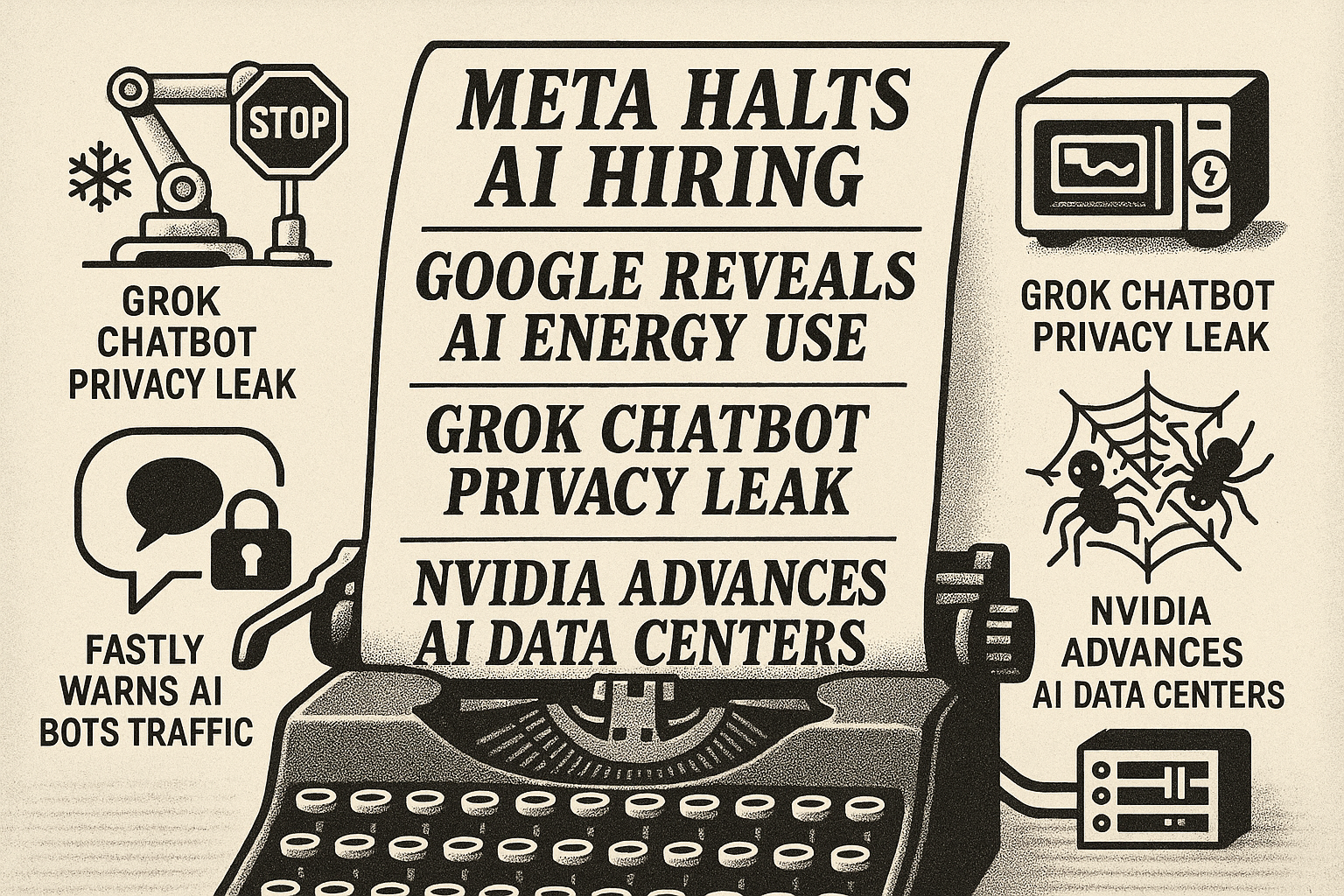
- Meta freezes AI hiring amidst structural reorganization
- Google reveals energy and environmental impact of Gemini AI
- Grok chatbot conversations exposed online, raising privacy alarms
- Fastly warns of AI crawlers’ impact on internet traffic
- NVIDIA prepares for gigawatt-scale AI data centers
- DeepSeek takes steps toward “agentic AI”
- Marines outsmart AI surveillance with creative tactics
Meta freezes AI hiring amidst structural reorganization
Category: Enterprise and Adoption
Source: Verdict
Meta Platforms has paused hiring in its AI division as part of its broader structural reorganization. The hiring freeze comes after months of aggressively recruiting AI talent with multimillion-dollar offers, including a $100 million signing bonus for top hires. Meta aims to streamline its “superintelligence labs” into smaller, focused teams while grappling with concerns over spiraling costs and alignment of AI investments with tangible returns. Analysts worry that this restructuring reflects broader investor skepticism in the pace and cost-efficiency of corporate generative AI adoption.
Google reveals energy and environmental impact of Gemini AI
Category: Infrastructure and Hardware
Source: MIT Technology Review
For the first time, Google disclosed the energy consumption of its Gemini AI models, revealing that a median text prompt consumes 0.24 watt-hours—equivalent to running a microwave for one second. Google has also provided insights into water usage (0.26 mL per prompt) and carbon emissions (0.03 grams CO2) for AI inference. These findings emphasize their significant progress in improving efficiency, lowering resource consumption 33x within a year. Google’s transparency sets a new standard for measuring AI’s environmental impact.
Grok chatbot conversations exposed online, raising privacy alarms
Category: Security and Privacy
Source: CNET
Elon Musk’s xAI chatbot platform, Grok, has come under fire for inadvertently publishing over 370,000 user conversations online, including sensitive user-uploaded files. These chats, indexed by search engines, exposed private data and violated ethical guidelines. The incident calls into question the responsibility of AI platforms in ensuring user privacy and highlights risks associated with “shareable” AI-generated links. Experts urge users to be cautious about sharing sensitive data with AI tools.
Fastly warns of AI crawlers’ impact on internet traffic
Category: Security and Privacy
Source: The Register
Fastly has raised concerns over the heavy internet load caused by AI crawlers, with Meta, Google, and OpenAI accounting for 95% of the traffic. The report revealed individual bots accessing sites up to 39,000 times per minute. While AI fetchers allow real-time data use, webmasters face increased operational costs and risks of service degradation. Fastly emphasized the need for AI companies to optimize bot behavior and honor webmasters’ content opt-out protocols, such as robots.txt.
NVIDIA prepares for gigawatt-scale AI data centers
Category: Infrastructure and Hardware
Source: NVIDIA Blog
NVIDIA has unveiled its next-generation AI networking solutions to support trillion-parameter AI models and gigawatt-scale data centers. The NVIDIA Quantum-X800 InfiniBand switch enables up to 800 Gbps GPU connectivity, while their NVLink and Spectrum-X technologies optimize bandwidth and power efficiency for high-performance computing. As demand for AI factories accelerates globally, NVIDIA’s solutions empower enterprises and governments to scale up their infrastructure efficiently.
DeepSeek takes steps toward “agentic AI”
Category: Tools and Platforms
Source: DeepSeek API Docs
DeepSeek has launched its V3.1 AI model, introducing hybrid “Think” and “Non-Think” modes aimed at advancing multi-step reasoning and agentic AI tasks. The API updates include expanded context windows (128K tokens) and improved multi-agent collaboration. The model builds on DeepSeek’s strategy to create AI systems capable of adaptive reasoning for complex applications, marking its first step toward a full “agent era.”
Marines outsmart AI surveillance with creative tactics
Category: Security and Privacy
Source: Rude Vulture
In a DARPA experiment, U.S. Marines successfully evaded detection by an AI-powered camera using unconventional approaches like somersaulting and hiding under boxes. The exercise revealed the limitations of AI systems that struggle with scenarios beyond their training. Experts argue it underscores the brittleness of AI in adversarial environments and highlights the continued value of human ingenuity in countering technology.
Brief highlights:
- Google launches AI Mode globally: Enhanced personalized and agentic features expand AI Mode to 180 countries.
- 95% of corporate AI pilots fail: MIT reveals ROI challenges in generative AI investments, sparking doubts about corporate AI strategies.
- Microsoft warns of “AI psychosis”: New mental health concerns arise as individuals anthropomorphize AI technologies.