Table of contents
Open Table of contents
- Meta Unveils $799 Ray-Ban Display Glasses: A Leap in Wearable Technology
- Nvidia and Intel Join Forces: A $5 Billion Collaboration for AI’s Future
- Huawei Challenges Nvidia with Advanced AI Chip Plans
- Microsoft Announces ‘Most Powerful’ AI Data Center in Wisconsin
- Claude Memory Feature Transforms AI Interaction
- Other Noteworthy Mentions
Meta Unveils $799 Ray-Ban Display Glasses: A Leap in Wearable Technology
Category: Infrastructure and Hardware
Source: CNN
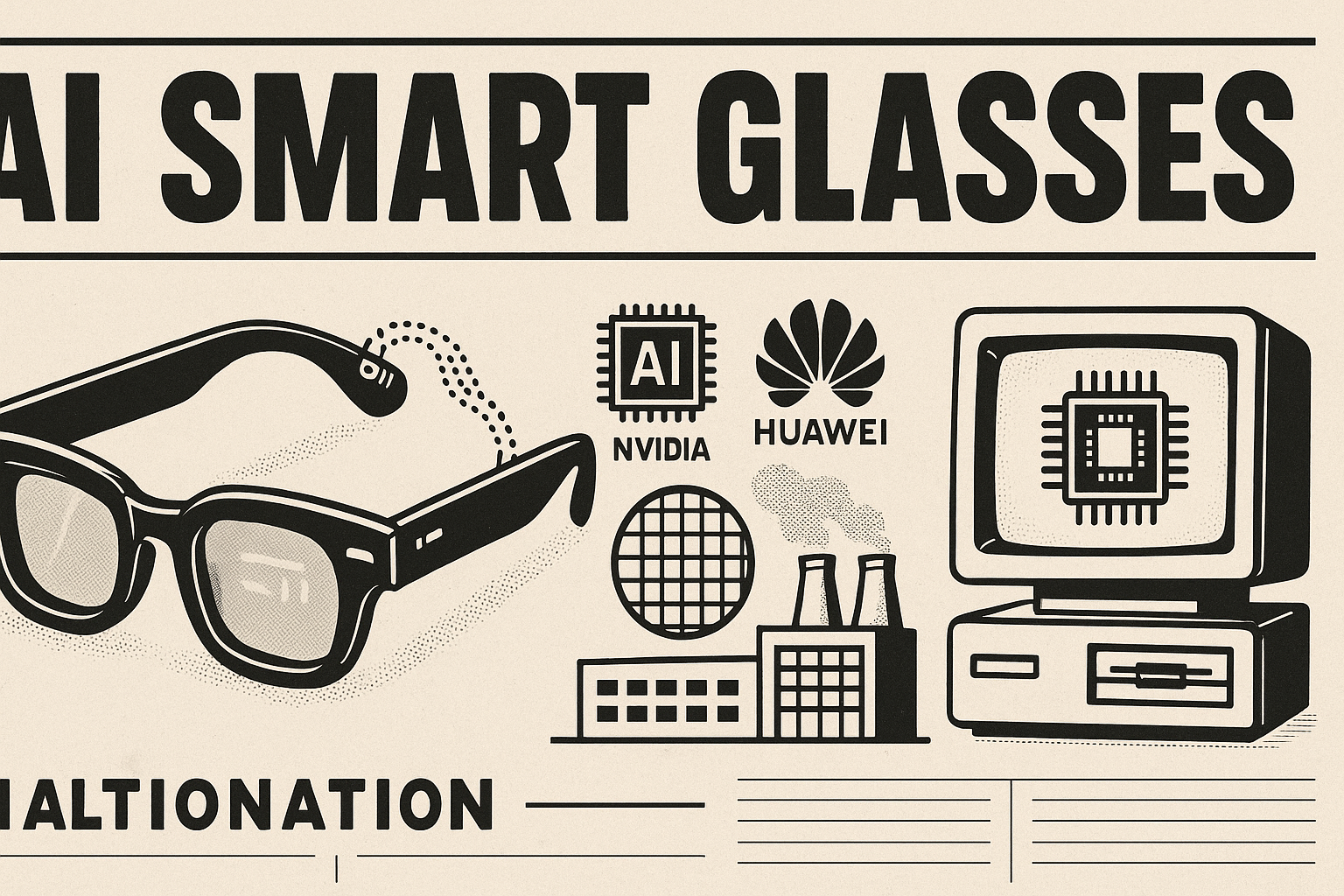
Meta premiered its high-tech Ray-Ban Display glasses at the Meta Connect conference, aiming to merge style and functionality within wearable AI. The glasses, controlled via hand gestures through the Meta Neural Band, feature a high-resolution display that lets users handle messages, videos, navigation, and even live translations seamlessly.
Additionally, Zuckerberg emphasized the glasses’ potential to minimize reliance on smartphones while providing intuitive interactions. Analysts suggest Meta’s focus is part of an effort to secure leadership in AR technology amid growing competition from Apple and Google. The glasses are available from September 30 across select regions.
Nvidia and Intel Join Forces: A $5 Billion Collaboration for AI’s Future
Category: Infrastructure and Hardware
Source: CNBC
Nvidia announced a $5 billion investment in Intel, focusing on co-developing AI and data center hardware. The collaboration also includes integrating Intel’s x86 CPUs with Nvidia’s AI and GPU technology. Both firms aim to innovate in data center chips and explore possibilities for integrating Nvidia GPUs across Intel’s PC products.
This partnership underscores a changing dynamic in the semiconductor industry, with Intel benefitting from Nvidia’s validation in AI leadership, while Nvidia secures deeper access to Intel’s architecture expertise.
Huawei Challenges Nvidia with Advanced AI Chip Plans
Category: Infrastructure and Hardware
Source: Bloomberg
Huawei unveiled its ambitious roadmap to rival Nvidia’s dominance by developing AI chip clusters boasting over a million Ascend chips. With its innovative SuperPod systems, Huawei’s computing power could become a cost-effective alternative to Nvidia’s GPUs. The AI giant announced plans for commercial deployment by 2027, marking a significant leap in the global AI hardware race.
Huawei’s advancements align with China’s push for technological independence as it counters geopolitical challenges affecting chip supply chains.
Microsoft Announces ‘Most Powerful’ AI Data Center in Wisconsin
Category: Infrastructure and Hardware
Source: Microsoft Blog
Microsoft has launched the Fairwater Project, its largest AI data center to date, located in Wisconsin. Designed to optimize large-scale AI model training, the facility will feature over 315 acres of advanced cooling and GPU resources, including NVIDIA Blackwell GPUs. This data center aims to process workloads at groundbreaking efficiency, reinforcing Microsoft’s ambition to dominate cloud-based AI infrastructure.
Claude Memory Feature Transforms AI Interaction
Category: Tools and Platforms
Source: Futurepedia
Anthropic’s AI, Claude, introduced long-term memory capabilities, allowing it to retain user preferences and project data across sessions. Users can control what Claude remembers, ensuring privacy through an incognito mode. The feature advances personalization in enterprise applications, making Claude a stronger competitor against ChatGPT.
Other Noteworthy Mentions
- DeepMind and OpenAI win gold at ICPC World Finals: AI models outperform human teams in competitive programming. Read more at The Neuron.
- VaultGemma for Privacy-Preserving Models: Google launches advancements in secure language model training. Check it out on AI Observer.
- AI Hardware Accelerates: NVIDIA Blackwell sets the bar for extreme-scale AI inference. Details at NVIDIA Blog.
Stay tuned for tomorrow’s updates!