Table of contents
Open Table of contents
- OpenAI Expands Stargate With Five New Data Center Sites Across the U.S.
- MIT’s New AI Revolutionizes Material Discovery
- Ukraine’s Zelenskyy Warns of AI-Driven Warfare
- Mustafa Suleyman on the Dangers of “Seemingly Conscious AI”
- Google’s Mixboard Brings AI to Visual Creativity
- Zed Shifts to Token-Based Pricing for AI Models
- Shorter Stories
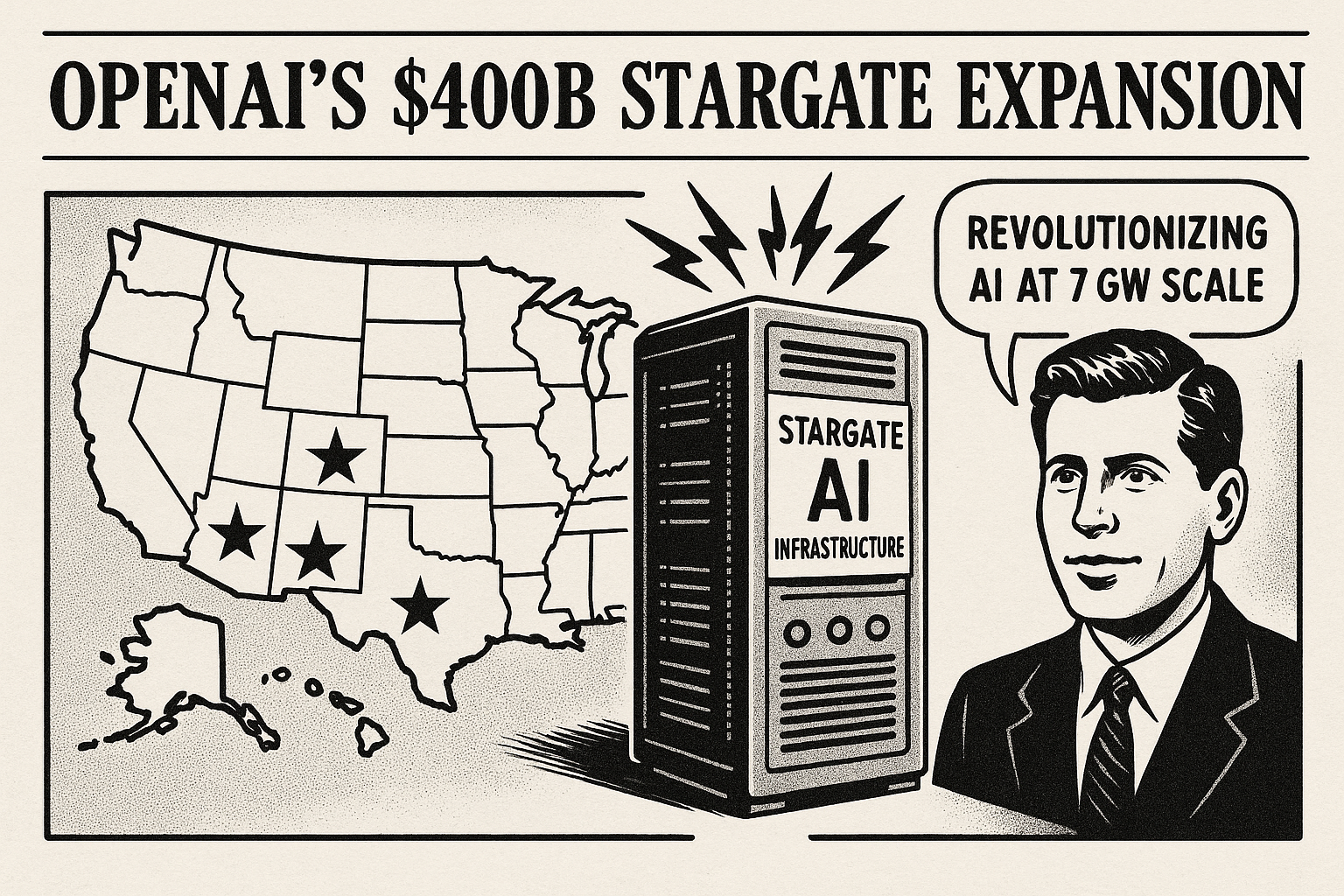
OpenAI Expands Stargate With Five New Data Center Sites Across the U.S.
Category: Infrastructure and Hardware
Source: CNBC
OpenAI is set to invest $400 billion in five new data center locations as part of its Stargate initiative. These facilities are spread across Texas, New Mexico, and Ohio, aiming to deliver a staggering 7-gigawatt capacity to support advanced AI operations like ChatGPT, which now has over 700 million weekly users. Partnering with Oracle and SoftBank, this infrastructure expansion represents one of the largest AI investments in U.S. history.
The first site in Abilene, Texas, is already operational, marking the beginning of this ambitious project. OpenAI CEO Sam Altman emphasized the importance of scaling infrastructure to deliver revolutionary AI tools. However, investors have expressed concerns about sustainability, citing massive energy needs comparable to 17 nuclear plants. This build-out is part of the broader $500 billion Stargate commitment to bring cutting-edge AI capabilities to fruition.
MIT’s New AI Revolutionizes Material Discovery
Category: Research and Innovation
Source: Chronicle Journal
MIT has unveiled SCIGEN, a groundbreaking AI capable of discovering novel and stable materials in mere days rather than decades. By combining generative models with stringent physical constraints, this system could revolutionize sectors such as energy, computing, and medicine.
SCIGEN demonstrates AI’s potential in accelerating research, lowering R&D costs, and unlocking breakthroughs. Its early focus on creating advanced catalysts and alloys suggests it could redefine industrial standards across numerous domains.
Ukraine’s Zelenskyy Warns of AI-Driven Warfare
Category: Ethics and Governance
Source: The Independent
Speaking at the UN General Assembly, Ukrainian President Volodymyr Zelenskyy warned of an “AI arms race,” citing Russia’s use of drones and the transformative risks posed by autonomous weapons systems. Zelenskyy called for international cooperation to regulate AI weaponry, comparing its urgency to nuclear disarmament.
He highlighted that the proliferation of AI-driven defense technologies could trigger the most destructive military era in human history, underscoring the need for unified global action to prevent unintended catastrophic consequences.
Mustafa Suleyman on the Dangers of “Seemingly Conscious AI”
Category: Ethics and Governance
Source: The Neuron Daily
Microsoft AI CEO Mustafa Suleyman warned about the risks of AI mimicking consciousness without genuine sentience. In a podcast, Suleyman argued that society’s tendency to anthropomorphize AI could lead to misplaced empathy and dangerous use cases. He emphasized that while AI systems like ChatGPT simulate intelligence effectively, they lack true emotions and consciousness, making ethical oversight and societal education critical.
Google’s Mixboard Brings AI to Visual Creativity
Category: Creative Technologies
Source: TechCrunch
Google has launched Mixboard, an AI-powered tool for creating dynamic and fully customizable mood boards. Built using Google’s Nano Banana AI model, Mixboard generates images, suggests layouts, and provides iterative refinement through simple text prompts. Targeting designers, marketers, and creative professionals, the tool integrates seamlessly with various Google services.
Already in public beta, Mixboard takes inspiration from tools like Pinterest, with applications in home décor, branding, and content ideation.
Zed Shifts to Token-Based Pricing for AI Models
Category: Tools and Platforms
Source: Zed Blog
Zed Industries has transitioned its AI usage pricing model from prompt-based billing to token-based costs. This adjustment seeks to align pricing with actual computational expenses, offering more transparency. Customers will benefit from expanded access to premium AI tools like GPT-5 and Gemini 2.5 Pro at a reduced base subscription price of $10 per month.
Zed’s move reflects broader changes in the AI ecosystem aimed at both cost-efficiency and sustainable model access for users.
Shorter Stories
-
HunyuanVideo’s One-Click Deployment: A hands-on review of Octaspace’s cloud GPU service reveals a seamless experience deploying text-to-video AI models. Reddit
-
SAP Warns of AI Workforce Impacts: SAP CFO Dominik Asam highlights how AI could reduce its headcount by automating tasks, emphasizing the need for careful implementation to avoid negative outcomes. Fortune
-
Canada’s Sovereign AI Vision: NVIDIA collaborates with Canadian leaders to build localized AI tools at TELUS’s AI factory, ensuring data sovereignty. NVIDIA Blog