Table of contents
Open Table of contents
Breakthrough in Healthcare: AI-designed Viruses Target Antibiotic-resistant Bacteria
Category: Healthcare and Life Sciences
Source: Technology Review
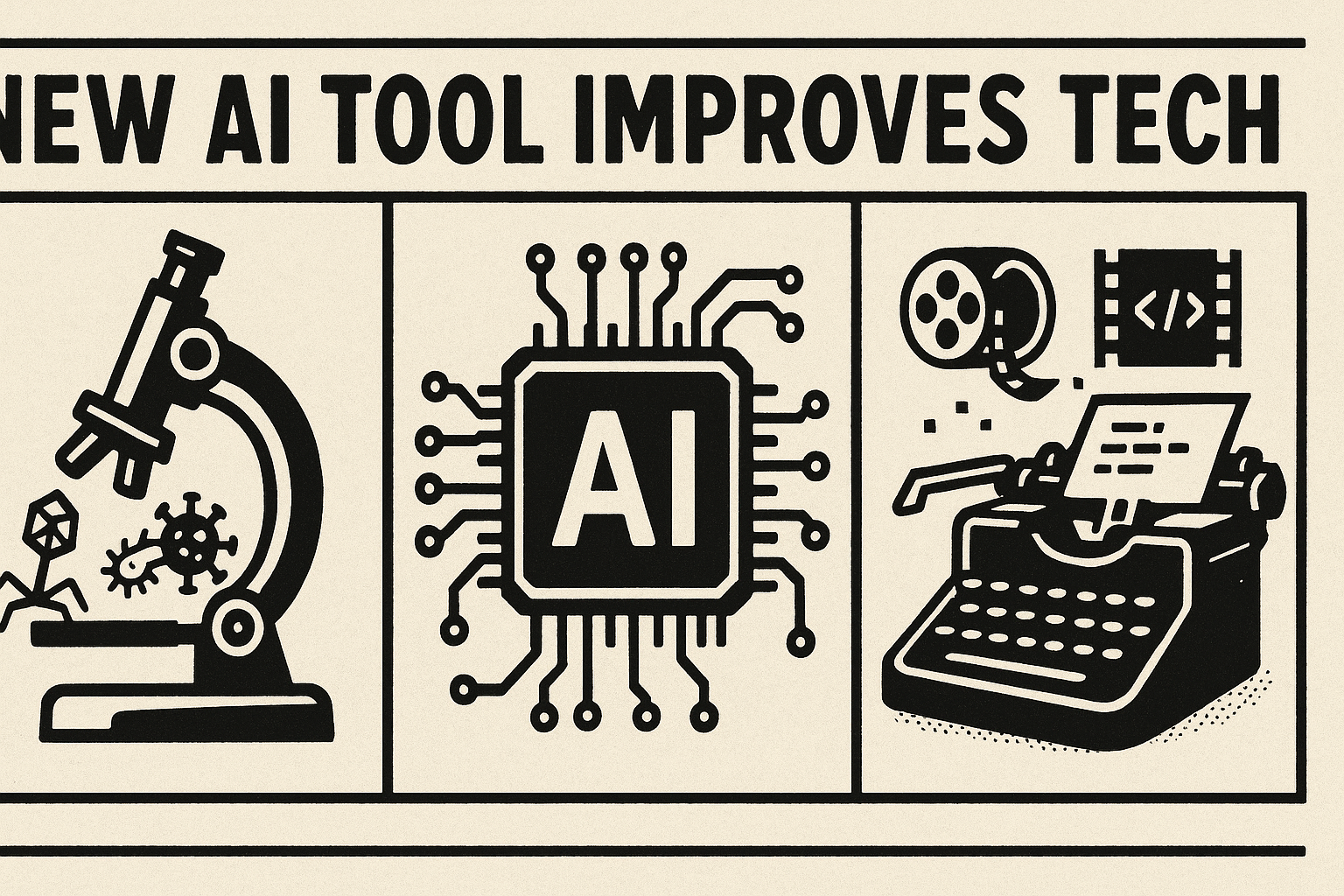
Stanford scientists have reached a monumental milestone by using AI to design working viruses that can kill bacteria. As the world battles growing antibiotic resistance—where a staggering 1 in 6 bacterial infections are no longer treatable—this innovation opens new frontiers in healthcare. By feeding genetic patterns of bacteriophages into a specialized AI model, researchers created 302 virus designs, with 16 successfully exterminating E. coli in laboratory tests. These AI-designed viruses could expedite phage therapy development to combat infections that resist antibiotics, offering hope against a global medical crisis. Liverpool’s £20M robotic labs further amplify research efforts, focused on safely advancing these groundbreaking treatments.
While safety concerns persist, especially regarding human-use viruses, this achievement provides a robust response to antibiotic-resistant microbes—a pressing threat that jeopardizes decades of medical progress.
OpenAI Partners with Broadcom to Develop Custom Chips
Category: Infrastructure and Hardware
Source: OpenAI
OpenAI has announced an ambitious partnership with Broadcom to develop 10-gigawatt custom AI chips, ensuring the tech giant is less reliant on NVIDIA’s chip monopoly. Aiming to deploy these accelerators by 2029, OpenAI’s own models played a critical role in optimizing design efficiency. This collaboration signifies a shift towards hyperscale resilience, empowering OpenAI’s infrastructure for greater scalability. Looking ahead, these chips are expected to power OpenAI’s transition to full-scale cloud infrastructure, heralding more cost-effective and autonomous computing solutions for users worldwide.
Notably, OpenAI’s growth trajectory includes plans to support billions of weekly users, representing energy consumption capacity akin to entire countries. As these advancements materialize, they showcase AI’s transformative potential not just for technology, but for economic and industrial frameworks.
New AI Models from Google and Anthropic
Category: Tools and Platforms
Source: Google AI Studio
Google and Anthropic are intensifying the competition in the AI model landscape. Google’s Veo 3.1 provides groundbreaking capabilities for video generation, including keyframe control, extended scene creation, and character consistency, all available via Gemini API and Flow. Meanwhile, Anthropic’s Claude Haiku 4.5 sets new benchmarks in coding performance with a third lower cost and double the processing speed, empowering developers worldwide.
These landmark updates reflect a race among AI giants to offer innovative, affordable tools that cater to independent creators and smaller teams, driving adoption and redefining production across industries such as visual content creation and technical coding.
Brief Summaries and Updates
NVIDIA Expands Beyond GPUs
Category: Open-Source AI
NVIDIA continues its push to democratize AI, releasing open-weight models, datasets, and tools freely accessible to developers globally. This transparency fosters innovation and breaks traditional dependence on proprietary systems. From Hugging Face-hosted foundational models like “Gr00t” and “Nemotron” to real-time agent-building demonstrations, NVIDIA is shaping the future of accessible AI.
Source: The Neuron
Prompt Optimization Guide: ChatGPT Tweaks
Category: Prompt Engineering
Futurepedia illustrates actionable strategies for crafting effective AI prompts, enabling sharper, faster responses tailored to user needs. This guide amplifies productivity for entrepreneurs leveraging AI across domains.
Source: Futurepedia
Creative AI Tools Propel Google and OpenAI
Category: Creative Technologies
Google’s Nano Banana advances image editing, while Veo’s updated audio technologies redefine cinematic quality. OpenAI’s Sora 2 empowers creators with expanded copyright controls for likeness generation, addressing ethical concerns over deepfake misuse.
Source: Futurepedia
Today’s developments mark significant strides in healthcare, hardware, and creative technologies, as AI continues to redefine innovation across diverse sectors.