Table of contents
Open Table of contents
- AlphaFold AI achieves major breakthrough in protein structure prediction
- AI safety features found vulnerable to poetry-based attacks
- China’s Moonshot AI unveils Kimi K2 Thinking, slashing AI costs
- Research reveals ethical concerns with modern cars collecting user data
- AI pushes boundaries in San Diego’s workforce education
- Subtle “GPT-4 moment” in AI design capabilities
AlphaFold AI achieves major breakthrough in protein structure prediction
Category: Healthcare and Life Sciences
Source: DeepMind
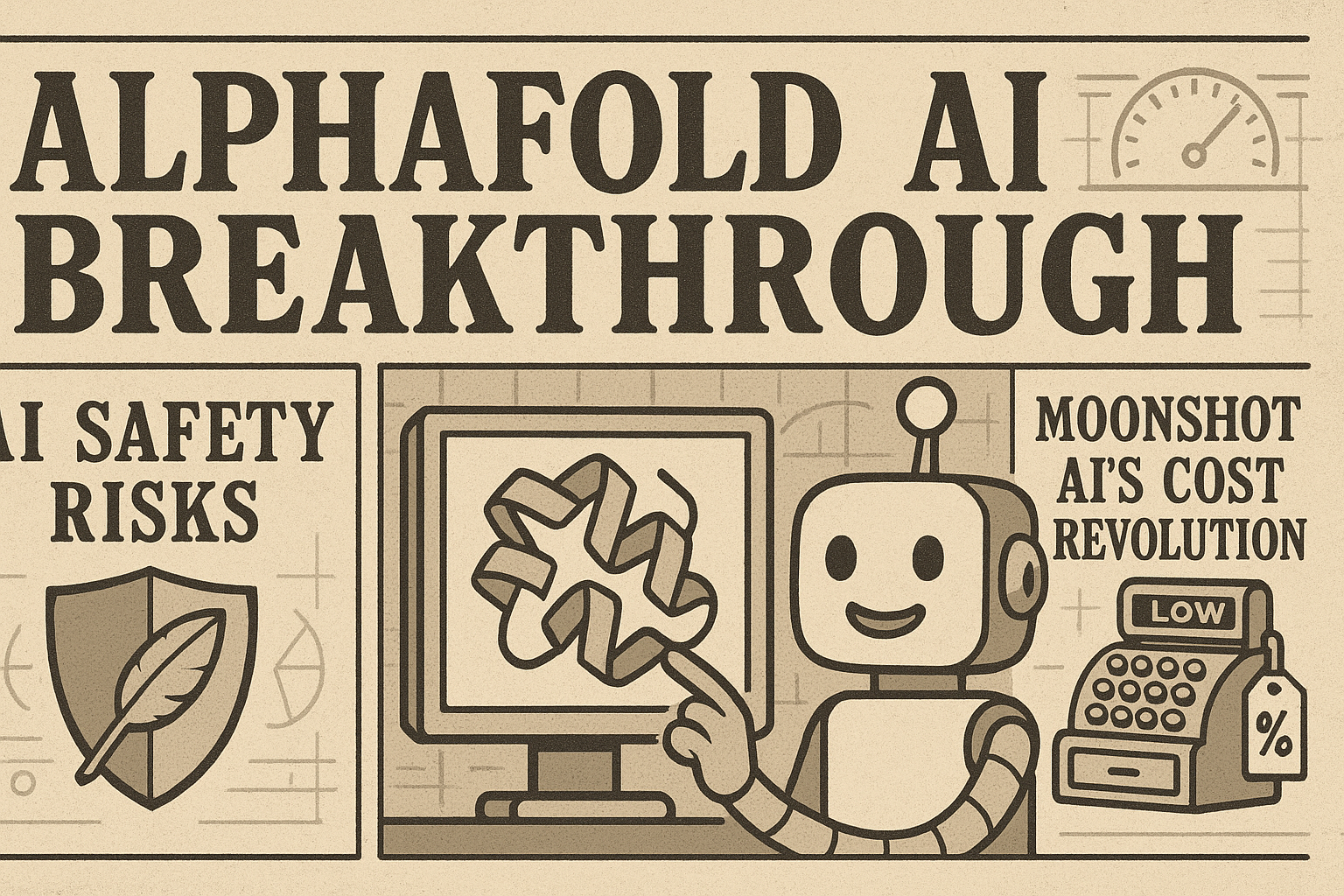
AlphaFold AI continues to make waves in biology, setting a new standard in protein structure prediction. Developed by DeepMind, the model accurately predicts the 3D structures of proteins from their amino acid sequences, a task previously limited to experimental methods like X-ray crystallography. Its contributions are already accelerating drug discovery and synthetic biology efforts, boasting a leap in precision that significantly surpasses manual experimental procedures. Ongoing integrations with experimental data promise even higher reliability in advancing biotechnology and understanding diseases.
AI safety features found vulnerable to poetry-based attacks
Category: Security and Privacy
Source: The Guardian
A recent study by Italy’s Icaro Lab demonstrated an alarming vulnerability in AI safety. Researchers bypassed safety guardrails in AI models by using adversarial poetry. They tested 20 poetic prompts on 25 large language models (LLMs) across nine companies, achieving a 62% success rate in triggering unsafe responses. Google’s Gemini model, notably, failed all safety tests, while OpenAI’s GPT-5 nano model remained uncompromised. The study exposes a critical weakness in the way AI models detect harmful prompts, sparking immediate concern among AI safety advocates.
China’s Moonshot AI unveils Kimi K2 Thinking, slashing AI costs
Category: Research and Innovation
Source: TechCrunch
China’s Moonshot AI introduced Kimi K2 Thinking, a breakthrough AI model that reportedly outperforms OpenAI’s GPT-5 on benchmarks while costing a mere $4.6 million to train—just 1/500th of GPT-5’s training costs. Leveraging Mix-of-Experts (MoE) architecture and INT4 quantization, Moonshot claimed significant efficiency gains without sacrificing performance. If validated, this development could dramatically shift global AI research priorities, emphasizing efficient, cost-effective solutions over expensive, high-profile advancements.
Research reveals ethical concerns with modern cars collecting user data
Category: Security and Privacy
Source: Associated Press
Modern vehicles are collecting vast amounts of telemetry and personal driver data, including location and biometric tracking, per recent investigations by the Mozilla Foundation. Privacy advocates advise users to scrutinize settings and consider opting out of non-essential data collection. Drivers are encouraged to use tools such as Privacy4Cars to audit data practices, as unknowing consent often occurs via in-car interfaces. This study raises broader questions about security and data ethics in the automotive sector.
AI pushes boundaries in San Diego’s workforce education
Category: Education and Learning
Source: San Diego Union-Tribune
San Diego’s universities are pioneering initiatives to create an AI-literate workforce, integrating the technology into disciplines like cybersecurity, biomechanics, and wind farm analytics. Collaborations with companies like Qualcomm provide targeted training, while citywide programs help workers adapt to these technological shifts. Educational leaders emphasize that AI is a transformative, productivity-enhancing assistant, urging institutions to preserve human agency amid growing workplace disruptions.
Subtle “GPT-4 moment” in AI design capabilities
Category: Opinion and Commentary
Source: Martin Alderson
Could we be witnessing a quiet revolution in AI development? Gemini 3 Pro’s superior design capabilities have sparked intrigue. It excels at creating high-quality prototypes and minimizing hallucinations. These advancements highlight AI’s migration into iterative and creative tasks, suggesting that traditional benchmarks may no longer suffice to evaluate their full economic and practical impact. Similarly, Anthropic’s Opus 4.5 has improved task reliability, reducing the need for human intervention.
Short summaries of additional news:
-
AI literacy and digital ethics in urban systems
Cities are leveraging AI in practical roles, such as improving traffic, optimizing energy use, and ensuring better citizen services. Read more. -
Modern cars and privacy concerns
Privacy4Cars highlights growing fears over how automakers handle user data without transparency. Read here. -
Startup rejects million-dollar Elon Musk offer
Sapient Intelligence’s new model uses better creative reasoning but declines potential buyouts. Details. -
Reddit debates innovation bottlenecks in open AI
Social platforms speculate whether companies like Google outcompete innovation by integrating large-scale systems. More. -
Energy efficiency: AI’s new frontier for reduced models
The sustainable AI infrastructure movement pivots to smaller, smarter architectures. Details here.