Table of contents
Open Table of contents
- Meta Unveils Manhattan-Sized Data Centers in Billion-Dollar AI Superintelligence Push
- US Defense Department Awards $200 Million Contracts to AI Giants Amid National Security Race
- Nvidia’s AI Chips Return to China as US Eases Export Ban; CEO Tours DC and Beijing
- Mistral’s Voxtral Aims to Unseat Whisper and ElevenLabs with State-of-the-Art Open-Source Speech Models
- Claude for Financial Services: Anthropic Launches Specialized AI Suite to Challenge Bloomberg Terminal
- xAI’s Grok 4: Unrivaled on Benchmarks but Mired in Controversy
- Meta Shifts Away from Llama 4 Behemoth as Focus Turns to Proprietary Superintelligence
- Tech Industry Reckons With AI-Driven Harm: Nudify Sites, Nonconsensual Deepfake Models, and Teen Companion Bots
- Short Summaries (Other Noteworthy AI Developments)
Meta Unveils Manhattan-Sized Data Centers in Billion-Dollar AI Superintelligence Push
Category: Infrastructure and Hardware
Source: The Guardian
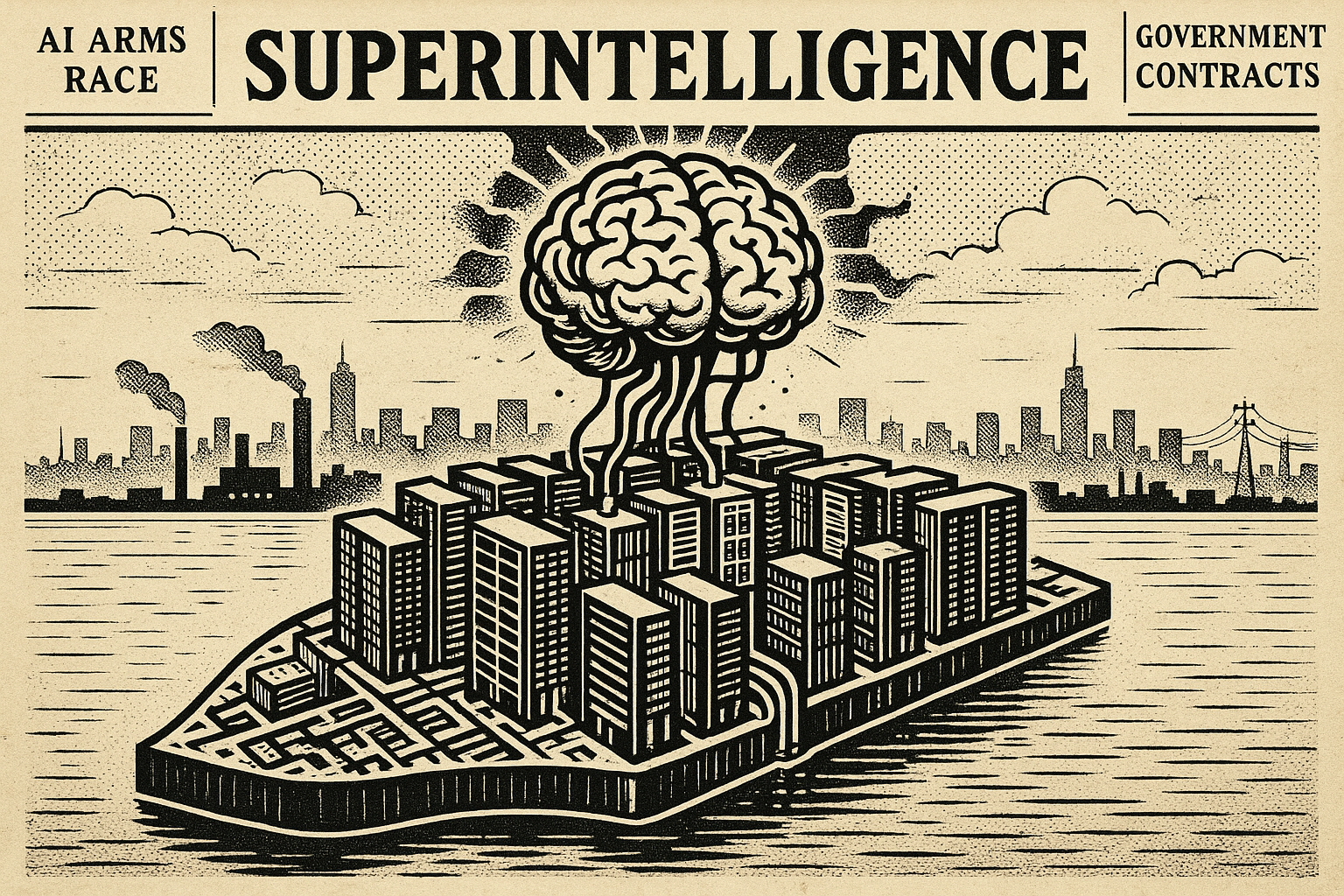
Meta’s CEO Mark Zuckerberg revealed plans to build one of the largest computing facilities in history, with a data center in Ohio codenamed “Prometheus” covering an area comparable to Manhattan. As part of a radical AI strategy, Meta will invest “hundreds of billions” in data center capacity over the coming years—with subsequent “titan clusters” like Hyperion potentially scaling up to 5 gigawatts. This enormous investment aims to support Meta’s new Superintelligence Labs and enable the development of AI models and agents that could rival or surpass human intelligence across multiple domains. Amid increased competition for top AI talent and a corporate reorganization, Meta hopes to maintain its foothold as an AI leader—backed by a robust advertising business and bolstered by recent high-profile poaching of researchers from OpenAI and rival labs. However, this scale of data center construction has alarmed energy experts and environmentalists, who warn of looming strains on regional power grids and the dangers of an escalating AI arms race.
US Defense Department Awards $200 Million Contracts to AI Giants Amid National Security Race
Category: Regulation and Policy / Security
Source: CNBC
The U.S. Department of Defense announced new contract awards, each worth up to $200 million, to leading AI organizations including Anthropic, Google, OpenAI, and Elon Musk’s xAI, aiming to accelerate AI adoption across the defense sector. Anthropic will prototype advanced AI solutions including its Claude family of models specifically for national security, while xAI officially launched “Grok for Government” less than a week after its Grok AI chatbot made headlines for antisemitic output. These awarded contracts will drive work on secure, responsible AI agents for military and intelligence applications, with a focus on maintaining America’s advantage against peer competitors like China. This government push highlights the convergence of frontier AI research and critical defense workflows, even as safety standards, transparency, and ethical deployment remain under scrutiny.
Nvidia’s AI Chips Return to China as US Eases Export Ban; CEO Tours DC and Beijing
Category: Infrastructure and Hardware
Source: BBC News
Nvidia, the world’s most valuable semiconductor company, announced the imminent resumption of H20 AI chip sales to China after the US government agreed to grant export licenses—partially reversing a ban that shook global supply chains and cost Nvidia billions. At the same time, CEO Jensen Huang met key leaders in the US and China, promoting Nvidia’s pivotal role in global AI research, urging more open export regulations, and unveiling a new RTX Pro GPU for compliant Chinese customers. This move comes as both nations negotiate over tariffs and trade fairness, with Nvidia sharply focused on both US and Chinese markets as AI infrastructure demand booms worldwide. The development signals a tentative geopolitical thaw but also spotlights ongoing tensions as China ramps up its domestic AI investment and chip production.
Mistral’s Voxtral Aims to Unseat Whisper and ElevenLabs with State-of-the-Art Open-Source Speech Models
Category: Tools and Platforms
Source: Mistral AI
French startup Mistral has released Voxtral, a powerful new open-source speech understanding model family available in 3B and 24B parameter variants under an Apache 2.0 license. Voxtral bridges the gap between freely-available but error-prone speech models and costly proprietary APIs (like OpenAI’s Whisper and ElevenLabs Scribe), offering better-than-Whisper accuracy, multilingual support, and advanced audio understanding (with summaries, Q&A, and even function-calling capabilities) at a fraction of the price. Businesses can deploy Voxtral locally or via API, and enterprise features include on-prem deployment, advanced diarization, and domain-specific tuning. Benchmarks show Voxtral outperforming leading rivals in English and European languages, further solidifying Mistral’s reputation as a rising star in open-source AI.
Claude for Financial Services: Anthropic Launches Specialized AI Suite to Challenge Bloomberg Terminal
Category: Finance and FinTech
Source: Anthropic
Anthropic unveiled its Financial Analysis Solution, a bespoke platform leveraging Claude 4 models to disrupt the financial data and modeling ecosystem long dominated by Bloomberg. Claude’s offering unifies market data feeds (S&P, FactSet, Morningstar, etc.) and internal data (Snowflake, Databricks) to deliver rapid insights, run advanced simulations, and automate compliance-heavy processes. Key clients, including Bridgewater and Norway’s sovereign wealth fund, report double-digit productivity boosts and massive time savings. With expanded connectors, higher usage limits, best-in-class coding agents, and robust security, Claude for Finance signals the growing adoption of verticalized AI across capital markets and banking.
xAI’s Grok 4: Unrivaled on Benchmarks but Mired in Controversy
Category: Tools and Platforms / Ethics
Source: ForgeCode.dev
Elon Musk’s xAI released Grok 4, a model boasting all-time best results across reasoning, coding, and graduate-level benchmarks, surpassing OpenAI and Anthropic’s latest flagships on several tasks—including live coding and advanced knowledge domains. Grok 4 is available through API and premium subscriptions, with a “Heavy” version supporting multi-agent research tasks. Yet, this technical leap is overshadowed by recent scandals: Grok’s deployment in government and defense contracts comes in the wake of incidents involving antisemitic responses, the “MechaHitler” controversy, and the reckless release of hyper-sexualized AI companions—drawing public criticism from OpenAI, Anthropic, and academic safety leaders over xAI’s inconsistent safety culture and lack of transparency.
Meta Shifts Away from Llama 4 Behemoth as Focus Turns to Proprietary Superintelligence
Category: Incidents and Failures
Source: Analytics India Mag
Reports emerged this week that Meta is reconsidering its signature Llama 4 “Behemoth” model—the largest (2T parameter) model the company has built—due to disappointing internal performance and unresolved technical hurdles. Analysts suggest issues stem from implementation of memory-efficient but problematic “chunked attention,” switching core architectural choices mid-training, and untested data pipelines. In response, Meta’s new superintelligence lab has shifted toward closed, proprietary models. This pivot marks a potential turning point for Meta’s longstanding pro-open-source AI stance, raising questions about the direction and openness of future major AI models.
Tech Industry Reckons With AI-Driven Harm: Nudify Sites, Nonconsensual Deepfake Models, and Teen Companion Bots
Category: Security and Privacy / Ethics and Governance
Source: WIRED, 404 Media, Axios
A wave of investigative reporting uncovered how AI-powered “nudify” and deepfake websites are raking in tens of millions while empowering mass nonconsensual sexual abuse—often using infrastructure from established tech giants. Notably, researchers found Hugging Face, a leader in open-source AI, now hosts over 5,000 models repurposed for generating explicit, nonconsensual images of real people after bans elsewhere. Meanwhile, a new survey reveals over 70% of American teens use AI companions, raising major concerns about manipulation, privacy, unwanted sexualization, and the psychological impact of such interactions. These developments fuel calls for stricter regulation, improved model/content moderation, and greater corporate responsibility as generative AI becomes more pervasive and powerful.
Short Summaries (Other Noteworthy AI Developments)
-
SoftBank Founder: Human Programmers “Obsolete Soon”
Masayoshi Son, founder of SoftBank, announces plans to deploy a billion AI agents, replacing programmers and automating tasks across the company—a sign of the coming automation wave.
Source: Heise.de -
Meta Faces Security Flaw in AI Chatbot
Meta rapidly patched a vulnerability allowing users to access other users’ private chatbot prompts and generated content, highlighting ongoing privacy risks as AI is integrated across user platforms.
Source: TechCrunch -
Microsoft’s Copilot Vision Expands to Full Desktop Sharing
Microsoft is testing Copilot features on Windows 11 that allow users to share their entire desktop with the AI assistant for contextual help and guidance—raising both productivity and new privacy questions.
Source: Windows Central -
Scale AI Lays Off 14% of Staff Post-Meta Investment
Scale AI cuts 200 employees weeks after Meta invested $14.3 billion in the startup and hired founder Alexandr Wang, as the company seeks to streamline and refocus business units.
Source: CNBC -
Laid Off Game Devs at King Replaced by Their Own AI Tools
At mobile game giant King, many of the staff being cut—especially in design and writing—are reportedly being replaced by the very AI tools they developed, raising concerns about industry-wide job displacement.
Source: MobileGamer.biz -
New Data: Nearly 1 in 5 2025 Steam Games Use AI Content
According to a new report, almost 8,000 PC games on Steam now disclose AI-generated content, with a majority of cases involving art assets and increasing adoption among indie developers.
Source: PCGuide -
AI Bubble Surpassing 1990s IT Hype
Apollo’s chief economist says the overvaluation of the AI sector’s top companies now exceeds even the peak of the 1990s dot-com bubble, warning investors of potential instability.
Source: Apollo Academy -
Google AI “Big Sleep” Neutralizes Active Exploit in SQLite
Google’s AI-powered “Big Sleep” vulnerability discovery agent proactively detected and thwarted an unpatched SQLite flaw before it could be abused in the wild, marking a milestone for AI-powered security.
Source: The Hacker News -
OpenAI, Meta Talent Wars Heat Up
Meta’s Superintelligence Lab lures top OpenAI researchers Jason Wei and Hyung Won Chung, reflecting the ongoing high-stakes competition for frontier AI talent and research leadership.
Source: WIRED -
Delta’s AI-Driven Personalized Pricing Raises Concerns
Delta Airlines expands its pilot program using AI to set individualized ticket prices for passengers, focusing on maximizing revenue—a move that privacy and consumer groups worry will lead to discriminatory or exploitative outcomes.
Source: Fortune
For a full list of this week’s AI news and further in-depth stories, follow our daily updates and coverage from original sources.