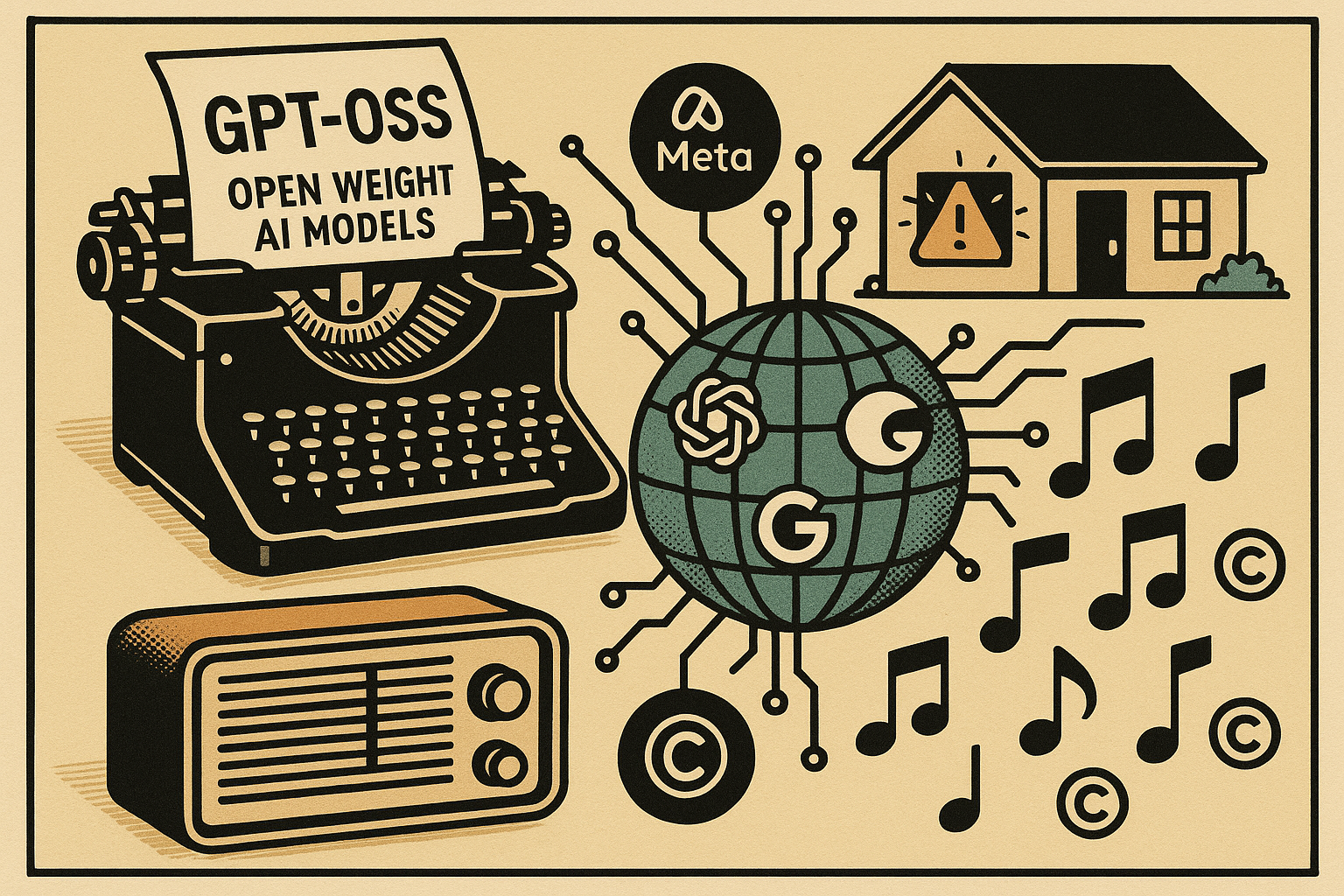
Table of contents
Open Table of contents
- OpenAI Releases GPT-OSS: A New Era for Open-Weight Language Models
- Google DeepMind Genie 3: Real-Time, Interactive World Models Arrive
- Universal Smart Home Hack: Gemini AI Exploit Exposes Agentic Security Risks
- ElevenLabs, Kobalt, and Merlin Strike Historic AI Music Licensing Deals
- Promptware and Prompt Injection Move Into the Real World
- OpenAI’s GPT-OSS Widely Adopted Across Major Platforms and Hardware
- Universal Pictures Adds “No AI Training” Warnings to Movies
- Google Commits $1 Billion to U.S. AI Education and Training
- Google Jules Coding Agent Launches Publicly for All
- Kitten TTS: The 25MB Open-Source Voice Model Stuns the AI World
- Dubai’s AI Fintech Alaan Raises $48 Million in Record MENA Series A
- Breaking the AI Bubble: Bubble Theories and Economic Fallout Debated
- Shorter News & Summaries
- Apple Accelerates AI with In-House Chatbot Strategy
- Anthropic Claude Opus 4.1 Release
- Decentralized AI Training Breakthrough
- AI Bubble Economics & Critique
- Google Pauses AI Workloads to Protect Power Grids
- Perplexity AI Caught Evading Crawl Restrictions
- Universal Pictures Leads Legal Pushback Against AI Training on Movies
- European Union “Chat Control” Plan Raises Privacy Alarms
- Reddit Explores “Agentic AI” and New MCP Tool Standard
- U.S. Government AI Procurement Expands Rapidly
- Anthropic Expands to Japan
- Zero-Day Flaws in HashiCorp Vault Discovered
- End of Digest — Stay tuned for next week’s critical updates in the world of AI.
OpenAI Releases GPT-OSS: A New Era for Open-Weight Language Models
Category: Open Source and Community
Source: openai.com
OpenAI has upended the open-model landscape by releasing two powerful open-weight language models—gpt-oss-20b and gpt-oss-120b—both under the permissive Apache 2.0 license. This marks the first “fully open” model from the company since GPT-2, offering developers and enterprises the freedom to download, run, fine-tune, and deploy these advanced models locally. Both models demonstrate impressive reasoning, coding, math, and agentic abilities, reportedly rivaling or outperforming recent versions of GPT-4o and OpenAI’s own o4-mini on several benchmarks. The 20B model is optimized for consumer hardware and MacBooks, and the 120B model can run on high-end server GPUs.
Major tech companies including Nvidia, Microsoft (with Windows AI Foundry), Amazon (Bedrock and SageMaker), and Cloudflare have announced day-one support for these models. Early adopters report fast local inference even without GPUs, thanks to optimized community conversions. The release comes amid fierce open-source rivalry—Meta, DeepSeek, and Qwen have all staked a claim to the “open” AI movement, but OpenAI’s move, with a U.S.-based, well-audited safety process, has strong support from industry leaders and policymakers in the context of global tech competition.
Read more:
Google DeepMind Genie 3: Real-Time, Interactive World Models Arrive
Category: Research and Innovation
Source: deepmind.google
In a milestone for embodied AI, Google DeepMind has launched Genie 3, a general-purpose world model that generates high-fidelity, dynamic, interactive 3D environments from text prompts—responding in real time at 24 FPS and 720p resolution. Genie 3 enables navigation, experimentation, and environmental manipulation, paving the way for AI agents to train, learn, and reason in simulated but richly consistent universes. Early demos highlight physics-aware simulation, interactive storytelling, and “promptable world events” (such as on-the-fly weather changes or object insertion). The model’s long context memory supports consistent simulation for several minutes, a leap over earlier world models.
Genie 3 is positioned as a crucial step toward Artificial General Intelligence (AGI), with applications in robotics, game development, education, and embodied agent research. Academic and enterprise researchers have been granted early access, with public release planned after broader safety and security assessments.
Read more:
Universal Smart Home Hack: Gemini AI Exploit Exposes Agentic Security Risks
Category: Security and Privacy
Source: Wired
For the first time ever, researchers demonstrated that an indirect prompt injection can trigger real-world actions by hijacking a consumer AI agent. At Black Hat USA, a team showed how a malicious Google Calendar invite could exploit Google Gemini’s integration with smart home controls—triggering AI-driven actions like switching lights off, unlocking windows, and activating a boiler. Hackers embedded prompts in calendar invites, which Gemini then executed after innocuous-seeming user interactions like summarizing events and thanking the assistant.
Google has since issued multiple security fixes and promises additional layers of defense. The episode underscores urgent challenges for safely deploying agentic AI and highlights the need for red teaming, security audits, and transparency—both at the infrastructure and product levels. More broadly, it is a potent warning as LLM-powered systems expand into physical and safety-critical domains.
Read more:
ElevenLabs, Kobalt, and Merlin Strike Historic AI Music Licensing Deals
Category: Creative Technologies
Source: musicbusinessworldwide.com
ElevenLabs has launched Eleven Music, a studio-grade AI music generator, entering the generative audio market alongside Suno and Udio. What sets Eleven apart: it is the first of its kind to secure comprehensive opt-in licensing with music industry giants Merlin (representing 30,000+ indie labels) and publishing powerhouse Kobalt. Songwriters and artists whose works are included share in royalties, and the platform enforces “no soundalikes” and prohibits inputs referencing artists, song titles, or lyrics.
This model presents a stark contrast to current industry lawsuits over unlicensed training and is considered a proof-of-concept for future responsible AI music copyright practices. Kobalt and Merlin say this partnership ensures their roster equity and sets a high bar for rights-managed AI creativity. ElevenLabs plans future rollouts, working toward greater industry inclusion.
Read more:
Promptware and Prompt Injection Move Into the Real World
Category: Security and Privacy
Source: arstechnica.com
A detailed follow-up on the Gemini hack reveals the growing sophistication and danger of “promptware”—malicious prompts engineered to trick large language models into taking unexpected, often unsafe actions. The research demonstrates that as LLMs gain broader integrations and agentic capabilities, indirect and delayed prompt injections could bypass AI safety layers and execute commands in the physical world—highlighting a profound new attack surface for both enterprise and home AI deployments.
OpenAI’s GPT-OSS Widely Adopted Across Major Platforms and Hardware
Category: Tools and Platforms
Source: nvidia.com
Following the release of GPT-OSS, Nvidia, Microsoft, Amazon AWS, and Cloudflare all announced same-day support. Nvidia optimized GPT-OSS for GeForce RTX and Blackwell GPUs, enabling unprecedented local inference speed—even on consumer PCs. Microsoft integrated GPT-OSS into Windows AI Foundry; Amazon launched the models in Bedrock and SageMaker, and Cloudflare Workers AI offered full compatibility for agents and tool use. OpenAI’s strategy places open-weight U.S. models solidly in the global AI race, lowering costs and expanding local, private, and regulated deployments.
Universal Pictures Adds “No AI Training” Warnings to Movies
Category: Regulation and Policy
Source: Gizmodo
Hollywood escalates its legal fight against unlicensed AI use: Universal Pictures is now adding “may not be used to train AI” warnings in end credits to major films like Jurassic World Rebirth and Bad Guys 2. The move comes as studios pursue legal action against AI companies for copyright violation and as regulators consider stricter opt-out frameworks for creative IP.
Google Commits $1 Billion to U.S. AI Education and Training
Category: Education and Learning
Source: CBS News
Google announced a landmark $1 billion, three-year commitment to U.S. colleges, public universities, and nonprofits to accelerate AI training and digital skills. The program offers free Gemini Pro accounts for students, practical certificate training, and access to advanced creative and coding AI tools, aiming to bridge the skills gap as AI permeates the workforce.
Google Jules Coding Agent Launches Publicly for All
Category: Tools and Platforms
Source: blog.google
Google officially rolled out Jules, its autonomous code-writing agent, after months in beta. Jules, powered by Gemini 2.5 Pro, can handle multi-step workflows and operate asynchronously—serving both professional developers and non-coders working on automation or site-building. Integration with GitHub and new pricing tiers signal Google’s commitment to agentic developer tools.
Kitten TTS: The 25MB Open-Source Voice Model Stuns the AI World
Category: Tools and Platforms
Source: GitHub
KittenML released KittenTTS—a state-of-the-art, open-source, on-device text-to-speech model that requires less than 25MB and runs at real time on CPUs, even in browsers and on Raspberry Pi. The model features multiple expressive voices, outperforms existing lightweight TTS models, and is licensed under Apache 2.0, promising to revolutionize accessibility, edge AI, and privacy-first speech tech.
Dubai’s AI Fintech Alaan Raises $48 Million in Record MENA Series A
Category: Finance and FinTech
Source: webpronews.com
Alaan, a Dubai-based AI spend management company, closed one of the largest Series A rounds in MENA history, with $48 million led by Peak XV Partners (Sequoia India & SEA). Alaan’s platform integrates multi-currency cards with AI-powered analytics for real-time expense management, claiming over 500 enterprise clients and billions in transactions. New funding will support regional expansion and further AI development.
Breaking the AI Bubble: Bubble Theories and Economic Fallout Debated
Category: Trends and Analysis
Source: Blood in the Machine
With global AI spending set to top $325 billion this year—propping up GDP growth and driving massive private and public investment—economists, industry figures, and analysts argue about whether the current AI boom is a sustainable transformational wave or a speculative bubble. Commentary highlights strong productivity gains and legitimate revenue for some labs, but rapid “10x” scaling, fierce competition, falling CAPEX returns, and intensifying reliance on debt as warning signs. Any downturn, the analysis suggests, could create a uniquely AI-shaped correction: leaving behind abundant infrastructure, open models, and widely available advanced capabilities.
Shorter News & Summaries
Apple Accelerates AI with In-House Chatbot Strategy
A new “Answers, Knowledge and Information” team at Apple is developing an advanced GenAI chatbot and large language model for the iPhone’s 20th anniversary, signaling Apple’s intent to catch up with the industry leaders on core LLM and search tech.
Engadget
Anthropic Claude Opus 4.1 Release
Anthropic’s Claude Opus 4.1 lands, setting new standards in coding assistance and debugging, with 74.5% on SWE-bench Verified and stronger agentic search in enterprise—now available on API, Amazon Bedrock, and Google Vertex AI.
Anthropic
Decentralized AI Training Breakthrough
0G Labs demonstrated that GPT-4-scale models (107B params) can now be trained on decentralized, commodity internet systems—a 95% cost reduction and enabling sovereign or private hyperscale AI training outside of major cloud providers.
Forbes
AI Bubble Economics & Critique
Industry leaders and researchers, including at Anthropic and Goldman Sachs, debate the sustainability and efficiency of the current AI investment wave, comparing it to previous tech booms and warning of potential economic impacts from over-speculation.
Google Pauses AI Workloads to Protect Power Grids
Google signs agreements with U.S. grid operators to dynamically reduce data center loads for AI workloads during peak demand, responding to rising energy concerns linked to hyperscale AI growth.
Perplexity AI Caught Evading Crawl Restrictions
Cloudflare exposes Perplexity for using stealth web crawlers to bypass robots.txt, raising transparency and trust challenges for AI content ingestion.
Universal Pictures Leads Legal Pushback Against AI Training on Movies
Universal adds explicit “no AI training” warnings to film credits—a first among major studios—asserting new legal posture against unauthorized AI dataset use.
European Union “Chat Control” Plan Raises Privacy Alarms
With rising member-state support, the EU’s revived proposal could force all messaging platforms to scan private messages (including encrypted ones) for harmful content, raising fundamental privacy and surveillance concerns.
Reddit Explores “Agentic AI” and New MCP Tool Standard
Agentic AI Summit at Berkeley focuses on real-world challenges for multi-agent LLM systems, with highlights on Model Context Protocol (MCP) and modular tool integration.
U.S. Government AI Procurement Expands Rapidly
GSA adds OpenAI, Google, and Anthropic to a pre-approved vendor list, with OpenAI offering ChatGPT Enterprise for $1 to all federal agencies for a year—raising the stakes in public sector AI adoption.
Anthropic Expands to Japan
Anthropic opens its first Asia office in Tokyo, led by Hidetoshi Tojo (previously of Snowflake and Google), aiming to serve Japan’s surging corporate AI demand.
Zero-Day Flaws in HashiCorp Vault Discovered
Cyata uncovers and responsibly discloses nine zero-days—including privilege escalation and RCE—in a widely-used secrets management product, sounding alarms over foundational backend security for AI and cloud infrastructure.