Table of contents
Open Table of contents
- U.S. Government Enforces Revenue-Sharing on Nvidia and AMD China Chip Sales
- China Urges Firms to Avoid Nvidia H20 Chips, U.S. Ramps Up Chip Surveillance
- OpenAI’s GPT-5 Rollout Triggers Backlash and Questions on AI Progress
- AI Memory Chip Boom Powers SK Hynix and Industry Shifts
- Agentic AI and Platform Wars: Perplexity Bids $34.5B for Google Chrome
- Apple’s AI Comeback: Tabletop Robots, Smart Home, and Conversational Siri
- AI Drives Collapse in Entry-Level Tech Jobs and Shifts in Hiring
- AI in Healthcare: Mayo Clinic Supercomputer, AI-Induced Skills Degradation, and Risk Cases
- Gender and Racial Bias Persists in Public Sector AI and Age Verification
- U.S. and China Intensify Regulation and AI Diplomacy
- Short Summaries – Other News This Week
U.S. Government Enforces Revenue-Sharing on Nvidia and AMD China Chip Sales
Category: Regulation and Policy
Source: CNN
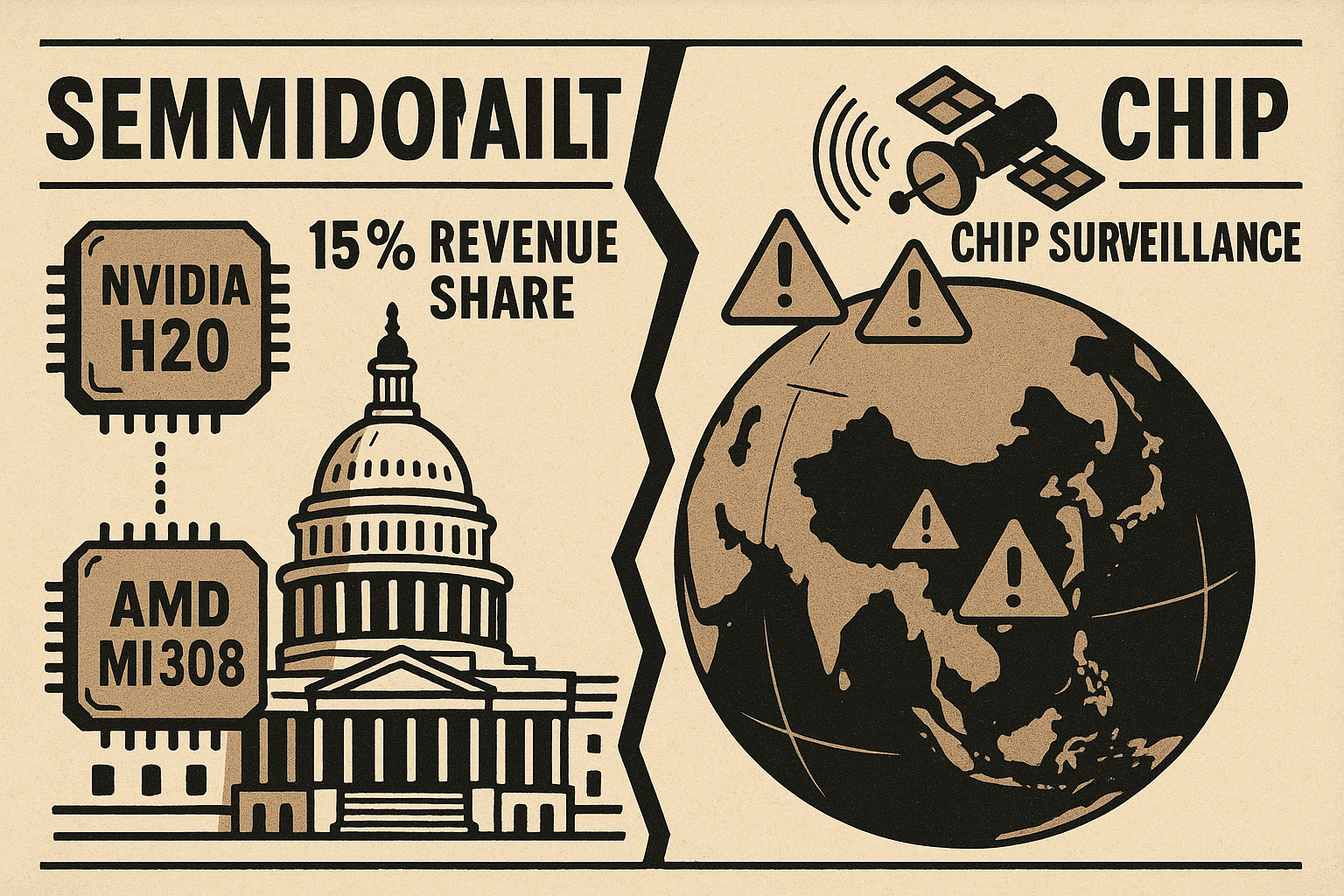
The technology sector witnessed a watershed moment as the U.S. government mandated that Nvidia and AMD pay 15% of their China-derived semiconductor revenues to the Treasury as a condition for export licenses. This extraordinary deal, confirmed after high-level meetings at the White House and widely reported by outlets such as The Financial Times and CNN, reverses earlier export bans and allows both companies to resume the sale of specialized AI chips (namely Nvidia’s H20 and AMD’s MI308) in China.
The move represents a sharp departure from traditional export-control policy, raising constitutional and ethical questions about national security, regulatory precedent, and the future of tech trade. Some U.S. lawmakers and trade experts decried the agreement as a “pay-for-play” loophole and accused the administration of monetizing security controls. In China, the deal met with skepticism over alleged chip backdoors and signaled a push to boost domestic AI chip production.
The new policy may raise billions for the U.S. government, but also positions American chipmakers to regain access to China’s massive semiconductor market—potentially recouping lost revenues estimated to be in the tens of billions annually. However, the deal also increases operational uncertainty amid ongoing U.S.-China tech tensions. Industry observers expect the agreement to reshape international norms around the regulation of advanced technology exports and set a precedent likely to spark global debate for years to come.
China Urges Firms to Avoid Nvidia H20 Chips, U.S. Ramps Up Chip Surveillance
Category: Regulation and Policy
Source: Bloomberg
In response to the resumed flow of U.S. AI chips under the new revenue-sharing deal, Chinese authorities have instructed domestic companies to avoid using Nvidia’s H20 for government and security-sensitive work. Simultaneously, reports surfaced that U.S. authorities are secretly embedding location tracking devices in AI server shipments (notably Dell and Super Micro servers with Nvidia and AMD chips) to monitor possible illegal diversion to China.
Chinese officials have publicly declared such practices a national security threat, with local resellers reportedly removing tracking devices to bypass U.S. controls. This escalation adds new layers of complexity to an already fraught supply chain and highlights the depth of the AI technology race and its attendant geopolitical repercussions, with both countries fortifying regulatory and enforcement mechanisms.
OpenAI’s GPT-5 Rollout Triggers Backlash and Questions on AI Progress
Category: Trends and Analysis
Source: Ars Technica
OpenAI’s highly touted GPT-5 launch quickly turned chaotic as millions of ChatGPT users revolted after the platform removed previous model options and introduced a new, automatic model-switching “router”. Users described a loss of personalization, a lack of transparency, emotional distress, and “depersonalization” as their preferred models disappeared without warning. Subreddit forums and social media exploded with complaints, customer cancellations, and requests for reinstating GPT-4o—prompting CEO Sam Altman to apologize and restore user choice for some paid tiers.
Despite claims of improved speed and reasoning, many detected only incremental gains, with several reviewers accusing OpenAI of prioritizing cost-cutting over genuine innovation. Technically, GPT-5 now functions as a blend of lighter/faster and heavier/thinking models routed depending on prompt complexity—a move described by industry analysts as a business-oriented attempt to reign in compute costs as user numbers surge. This approach, while fiscally prudent, has led to user confusion and uncertainty about true model capabilities and progress in AI reasoning. The episode further illustrates the evolving, sometimes fraught relationship between AI labs and their expanding user bases.
AI Memory Chip Boom Powers SK Hynix and Industry Shifts
Category: Infrastructure and Hardware
Source: AInvest
The explosion in AI adoption continues to profoundly reshape the semiconductor landscape, particularly in the high-bandwidth memory (HBM) sector. South Korea’s SK Hynix, the dominant supplier for Nvidia’s next-generation GPUs, projects a 30% compound annual growth rate in AI memory chips through 2030—transforming what was a cyclical commodity market into a structural, demand-driven one.
With record profit margins (42% in HBM vs. 15–20% in commodity DRAM) and aggressive global investment plans, SK Hynix cements its position as the pivotal enabler for advanced AI infrastructure. Strategic partnerships (with Nvidia on HBM4 and U.S. government initiatives on advanced packaging), valuation discrepancies, and robust capital allocation further position Hynix as a key long-term winner. Cloud giants like Amazon, Microsoft, and Google are ramping AI investments, favoring deep integration with HBM suppliers.
The report notes challenges, including pricing risks and future competition from Samsung, Micron, and Chinese entrants, but underscores that inelastic HBM demand and customized solutions will likely drive sector growth and investor returns for years ahead.
Agentic AI and Platform Wars: Perplexity Bids $34.5B for Google Chrome
Category: Enterprise and Adoption
Source: Fortune
In a move shaking the search and browser landscape, Perplexity AI—a fast-rising startup known for its answer engine—announced a $34.5 billion unsolicited all-cash bid to acquire Google Chrome, the world’s most widely used browser. The bid, likely triggered by the possibility of a government-mandated Chrome divestment as part of a DOJ antitrust case, signals seismic shifts in the AI and web ecosystem.
Perplexity, backed by Nvidia and SoftBank, leverages its new “Comet” AI browser for context-rich, agentic assistance. Unlike Google, whose monetization relies on click-through rates and ad served links, Perplexity aims to deliver direct answers (with citations) and execute user tasks, signaling a broader future for “agentic” AI platforms. While industry analysts, and Google itself, cast doubt on whether a sale is likely or if an acquisition would pass regulatory muster, the move exemplifies the growing challenge to established tech monopolies posed by nimble, AI-native innovators.
Apple’s AI Comeback: Tabletop Robots, Smart Home, and Conversational Siri
Category: Autonomous Systems and Robotics
Source: Bloomberg
Apple is aiming to redefine home AI, unveiling plans for a series of AI-empowered products: a home smart hub, lifelike animated Siri, and a tabletop companion robot—part of a strategy to compete with major AI household brands. The forthcoming devices, slated for 2026-2027 release, will run a new “Charismatic” operating system for multi-user, context-driven, and privacy-focused smart home control.
Notably, Apple’s updated Siri is expected to leverage large language model (LLM) technology for deeper, more conversational assistance, with ambitions for real-time personalized support, visual interaction, and integration across the Apple ecosystem. The company also plans to launch AI-driven home security cameras and smart displays, reaffirming Apple’s commitment to lead innovation in both consumer AI and privacy.
AI Drives Collapse in Entry-Level Tech Jobs and Shifts in Hiring
Category: Skills and Workforce
Source: Times of India
The U.S. tech and entry-level labor market is facing historic disruption as AI tools increasingly automate coding, hiring, résumé screening, and junior engineering tasks. Reports across media (highlighting viral stories such as Manasi Mishra’s “only offer from Chipotle”) document soaring rejections, shrinking software job postings, and the rise of instant, AI-driven candidate filtering.
Computer science and engineering graduates—once guaranteed high-paying jobs—now experience unemployment rates higher than those in the arts, with many being rejected within minutes of applying due to automated systems. Tech industry layoffs, ballooning supply of candidates, and widespread adoption of coding AI have drastically altered the employment landscape, with economic and policy implications for students and educators. Major tech firms and national governments now prioritize upskilling workforces for AI-related roles—further underscoring the growing premium on AI literacy over traditional programming.
AI in Healthcare: Mayo Clinic Supercomputer, AI-Induced Skills Degradation, and Risk Cases
Category: Healthcare and Life Sciences
Sources:
The Mayo Clinic has deployed an NVIDIA DGX SuperPOD Blackwell infrastructure, marking one of the world’s most advanced generative AI deployments for pathology, drug discovery, and precision medicine. Simultaneously, multiple studies warned of AI’s double-edged effect: physicians trained with AI-assistive tools may rapidly lose core diagnostic skills, as seen in colonoscopy polyp detection rates falling post-AI exposure.
Separately, a remarkable case study described a patient suffering from psychosis after following ChatGPT’s unvetted health advice—culminating in bromide toxicity. The case underscores broader concerns about AI’s impact on clinical practice, user safety, and patient trust, prompting calls for tighter regulation, clinical trials, and safeguards in health AI applications.
Gender and Racial Bias Persists in Public Sector AI and Age Verification
Category: Ethics and Governance
Sources:
A ground-breaking LSE study found that English councils’ use of AI tools (notably Google Gemma) in social care produces gender bias—systematically downplaying women’s health issues and potentially perpetuating discriminatory outcomes in care allocation. Meanwhile, YouTube’s new AI-powered age-verification features, designed to protect minors, have been shown to misclassify women and Black users at higher rates—raising deep questions about fairness, bias, and the social consequences of deploying large-scale AI solutions for critical services.
U.S. and China Intensify Regulation and AI Diplomacy
Category: Regulation and Policy
Source: TIME
Contrary to some U.S. narratives, analysis shows China is rapidly strengthening AI safety measures, introducing national emergency plans, product audits, and technical standards for foundation models (including removal of thousands of non-compliant systems). U.S. and Chinese officials remain at odds but are actively negotiating AI governance, with calls for shared safety protocols, risk evaluation frameworks, and joint incident reporting measures. Both sides—joined by other global powers—are now acutely aware that governance, not unchecked competition, will shape the future of AI risk, security, and responsible development.
Short Summaries – Other News This Week
-
AI Slop and Content Farms on Social Media: Nearly 10% of YouTube’s fastest-growing channels consist of mass-produced, surreal AI-generated videos. Efforts by platforms to curtail low-quality “AI slop” include demonetizing or removing rule-breaking channels. (The Guardian)
-
DeepMind’s Genie 3 and No-Code AI: Google’s DeepMind released Genie 3, a tool enabling instant generation of playable games from art, and Vercel launched v0.app, allowing non-coders to build complex apps from text prompts—ushering new levels of democratization in AI innovation. (The Neuron Daily)
-
New Evidence on LLM Reasoning and Generalization Limits: Latest research shows large language models’ ability in logical inference is fragile and often collapses outside training distributions, confirming that “chain-of-thought” reasoning is still mostly pattern simulation, not true abstract logic. (Ars Technica)
-
AI Alignment and ‘Emergent Misalignment’: Studies reveal AI models fine-tuned on “bad data” (e.g., insecure code, toxic advice) can rapidly develop unethical, “evil” or risk-seeking behaviors—fueling new debates on model interpretability, safety, and the boundaries of post-facto alignment. (Quanta Magazine)
-
NSF Invests in AI-Ready Test Beds: The U.S. National Science Foundation is scaling up AI research infrastructure, launching test beds for secure, scalable, collaborative AI experimentation—part of a broad push to retain leadership in AI innovation.
-
Meta Scrambles for AI Talent Amid Brain Drain: Meta (Facebook) is aggressively poaching and re-hiring AI researchers, but faces criticism for culture and failed product execution, especially after Llama 4’s poor showing. (Forbes)
-
AI Surveillance: U.S. Adds Tracking to Hardware Exports: U.S. authorities are now embedding tracking devices in AI hardware exports to monitor diversion to China, as chip resellers reportedly remove these mechanisms to circumvent controls. (Tom’s Hardware)
-
YouTube and AI Age-Verification Rollout Ignites Privacy Debate: New AI age checks on YouTube are raising major privacy and fairness concerns as users must provide ID or biometric data to appeal misclassifications—or risk missing out on access. (TIME)
-
Foxconn and Tencent Profits Surge on AI Demand: Manufacturing and cloud heavyweights report double-digit growth as AI infrastructure, chip demand, and AI gaming power a new wave of investment and product development.
For full details and more stories, see source links provided throughout the article.