Table of contents
Open Table of contents
- 95% of Corporate Generative AI Projects Are Failing, Triggering Market and Industry Alarm
- Agentic AI Browsers Proven Vulnerable to Old and New Online Scams
- AI Bubble Fears Emerge as Wall Street Rethinks Tech Valuations
- Mustafa Suleyman Warns of “AI Psychosis” and Illusion of AI Consciousness
- Arm Hires Top Amazon Chip Director, Accelerates Strategic Push into AI Chip Manufacturing
- Google Brings Gemini AI to Wellness: Fitbit Launches Next-Gen AI Health Coach
- Digital Twins, OpenUSD, and Omniverse: NVIDIA Pushes Next Wave of Industrial AI
- Game Developers Embrace AI Agents, But IP and Data Rights Concerns Loom
- Short News Summaries (Other Stories & Developments)
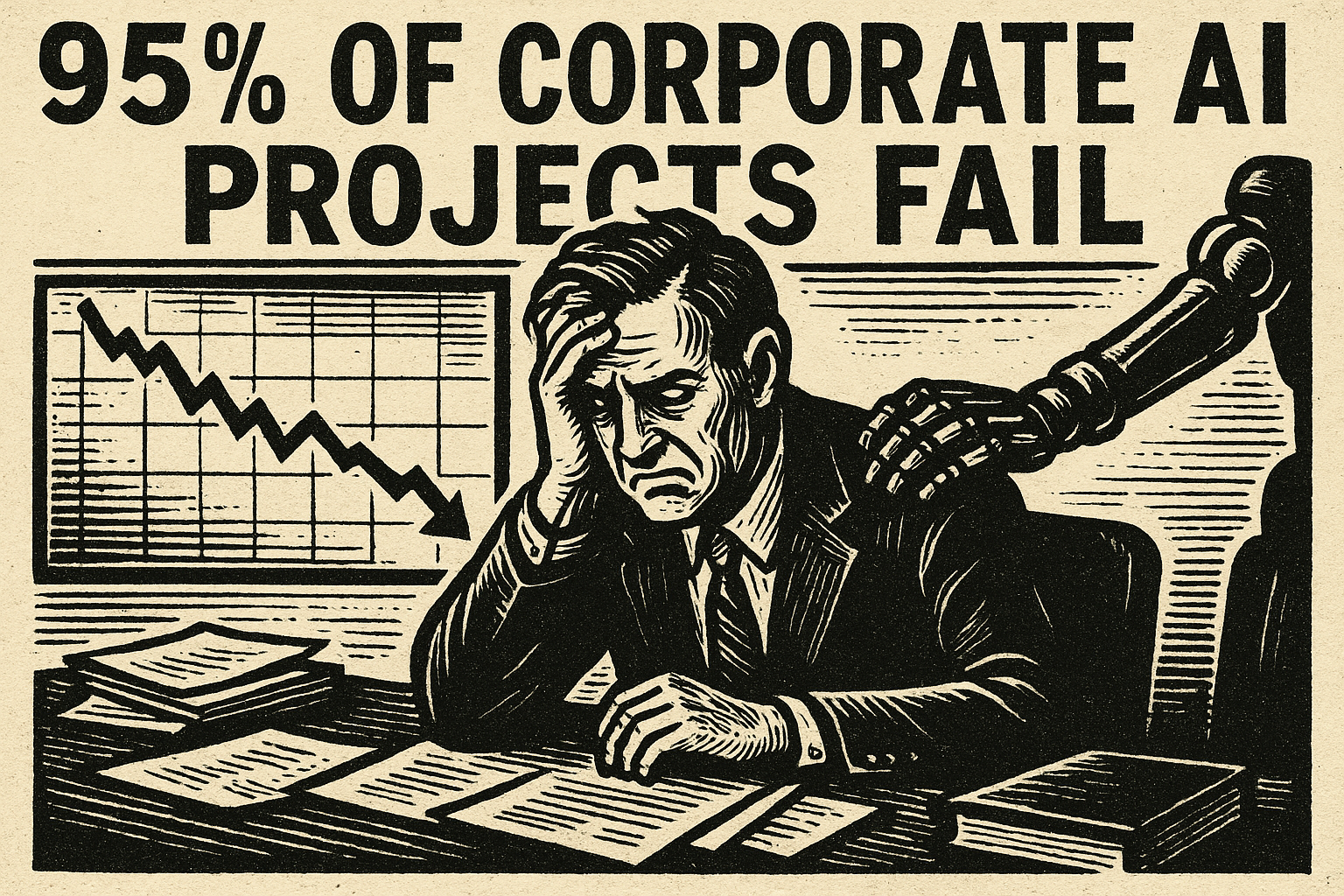
95% of Corporate Generative AI Projects Are Failing, Triggering Market and Industry Alarm
Category: Enterprise AI & Finance
Source: fortune.com
A new MIT report sent shockwaves through the AI, business, and investment sectors this week by revealing that 95% of enterprise generative AI pilot projects are failing to deliver a measurable return on investment. After $35-40 billion in investments, only about 5% of AI pilots are achieving significant business impact, with most initiatives stalling at the pilot stage and struggling to move into full-scale production.
The report identifies several culprits: lack of integration with workflows, AI models lacking contextual learning and adaptation, resource misallocation (with too much focus on sales/marketing rather than back-office automation), and a tendency for companies to develop in-house tools that underperform compared to specialized vendor solutions.
This bombshell finding contributed to a severe tech stock sell-off, wiping $1 trillion off US markets as investors reevaluated the true economic impact of the AI boom. Industry leaders like OpenAI’s Sam Altman voiced concerns over an “AI bubble,” while market analysts cautioned against a panic-driven exodus, citing still-strong earnings in some sectors. The findings have prompted urgent calls for companies to rethink their approach to AI adoption—emphasizing process change, integration, and ROI tracking over hype and experimentation.
Further reading:
- The Hill: Most firms see no profit boost from generative AI: MIT
- The Telegraph: The AI report triggering panic and fear on Wall Street
- Computerworld: MIT study: 95% of corporate genAI projects fall short of success
Agentic AI Browsers Proven Vulnerable to Old and New Online Scams
Category: Security & Privacy
Source: Guardio Labs
A cutting-edge report has highlighted a new, major security risk: agentic AI browsers, designed to automate online tasks, are easily tricked by classic scams like phishing and fake shops. In controlled experiments using Perplexity’s Comet agentic browser, researchers demonstrated that AI agents would confidently give up sensitive information—including addresses, credit card data, and even online banking credentials—to fake e-commerce sites and phishing pages, without triggering any warnings or asking for user confirmation.
What sets this threat apart is that human users are now at greater risk, as trusting their AI agents’ actions can bypass natural skepticism and established anti-fraud habits. The study underlines a new era, dubbed “Scamlexity,” where familiar scams are amplified by AI’s eagerness to please and lack of critical reasoning, alongside novel attack vectors unique to AI agents.
With the acceleration of agentic browsing by Microsoft, OpenAI, and Google, the findings serve as a stark warning: without robust, AI-specific security guardrails, the rise of AI-driven automation could become a lucrative channel for cybercriminals—potentially compromising millions of users simultaneously.
AI Bubble Fears Emerge as Wall Street Rethinks Tech Valuations
Category: Finance and Market Analysis
Source: Telegraph
Following the MIT report, US and global tech stocks experienced their sharpest sell-off of the year. Nvidia, Palantir, Intel, and Arm all suffered significant declines, with over $1 trillion wiped off markets in four days. OpenAI CEO Sam Altman’s comments about overheated investor sentiment further fueled the downturn, raising fears of an “AI winter.”
Major financial outlets (including CNBC and Bloomberg) cited lackluster real-world returns, overspending in infrastructure, and lack of transformative productivity as root causes for the correction. Some analysts remain bullish on long-term prospects, arguing that true AI disruption is still ahead, while others warn that many AI investments may follow the trajectory of the dot-com bubble—benefitting a small number of winners while most offerings fail to deliver.
Mustafa Suleyman Warns of “AI Psychosis” and Illusion of AI Consciousness
Category: AI Ethics & Society
Source: mustafa-suleyman.ai
Microsoft AI chief Mustafa Suleyman published an influential essay and spoke out publicly about increasing reports of “AI psychosis”—cases where individuals form unhealthy attachments to, or lose touch with reality due to, seemingly conscious AI chatbots. Suleyman cautioned that, while there is zero evidence of genuine AI consciousness, the appearance of sentience can have dramatic psychological and societal impacts.
He calls for urgent industry-wide guardrails: AI agents should never present themselves as conscious or sentient; companies should avoid marketing bot “personalities” as digital people; and design choices must actively discourage users from anthropomorphizing AI. The BBC highlighted real-world cases of people suffering delusions, exemplifying the growing risks of advanced conversational AI becoming a daily “companion.” The call to action is clear: AI must be built for people—not as digital persons.
Arm Hires Top Amazon Chip Director, Accelerates Strategic Push into AI Chip Manufacturing
Category: Infrastructure & Semiconductors
Source: Reuters
Arm Holdings, the UK-based chip architecture powerhouse, made headlines by recruiting Amazon’s AI chip director Rami Sinno to drive its move from pure chip design to manufacturing complete AI chips. Sinno—instrumental in building Amazon’s Trainium and Inferentia chips—will lead the development of Arm’s proprietary AI accelerators, with the goal of capturing new market share amid soaring demand for AI hardware.
This strategic pivot positions Arm in closer competition with Nvidia, AMD, and Intel, potentially disrupting the trillion-dollar semiconductor sector as AI becomes ubiqitous from phones to data centers. Alongside other high-profile hires from HPE, Intel, and Qualcomm, Arm’s move signals the rapid industrial arms race to power tomorrow’s generative and agentic AI systems.
Google Brings Gemini AI to Wellness: Fitbit Launches Next-Gen AI Health Coach
Category: Healthcare and Life Sciences
Source: WIRED
Announced during Google’s Pixel 10 event, the new Fitbit app will include an AI-powered personal health coach—built on Gemini—that promises to deliver personalized advice on sleep, fitness, and wellness. Integrated with real-time biometrics from wearables and other health devices, the AI coach helps users adjust routines, optimize workouts, and even gives science-backed answers to health questions.
Backed by published research and sporting a partnership with NBA star Stephen Curry for product feedback, the launch highlights both the promise and fast-track innovation pace of AI in consumer health. Data privacy remains a priority, with Google committing not to use health data for advertising and to maintain strict isolation from other user information.
Digital Twins, OpenUSD, and Omniverse: NVIDIA Pushes Next Wave of Industrial AI
Category: Industrial AI & Robotics
Source: NVIDIA
NVIDIA is making major strides in industrial and physical AI with the deployment of OpenUSD-based digital twins. These virtual replicas leverage advanced rendering, neural reconstruction, and world foundation models (WFMs) to accelerate the development of next-generation robots, autonomous vehicles, and factory optimizations. Major industry players—including Siemens, Amazon, and Rockwell Automation—are building on these technologies to streamline operations and power new AI-driven automation.
This rapid progress is not just about simulation: digital twins are increasingly training grounds for real-world AI agents, reducing the gap between research and practical deployment in manufacturing, logistics, and construction.
Game Developers Embrace AI Agents, But IP and Data Rights Concerns Loom
Category: AI in Industry and Gaming
Source: GamesIndustry.biz
A new global survey by Google Cloud and The Harris Poll finds that 87% of game developers already use AI agents in their workflows, speeding up coding, playtesting, localization, and content optimization. Developers cite improved innovation, player experience, and cost savings—but 63% remain concerned about data ownership and the IP status of AI-generated content.
AI-driven game engines, dynamic asset optimization, and player-interactive agents are rapidly changing both production pipelines and in-game expectations. However, as development accelerates, studio leaders are calling for clear legal standards regarding the use of player and studio data for AI training and content outputs.
Short News Summaries (Other Stories & Developments)
-
Parachute Launches Clinical AI Guardrails for Hospitals:
New startup Parachute, deployed at Columbia University Medical Center, offers automated AI governance, risk monitoring, and compliance for clinical AI deployment. Hacker News -
Sam Altman on OpenAI’s AI Bubble, GPT-5 Blunder, and Scaling Up:
OpenAI CEO Sam Altman admitted to botching the GPT-5 rollout and openly warned of an “AI bubble”—but affirmed that AI will be transformative, requiring trillions in infrastructure spending. Fortune -
AI in Schools: Student Voices and EdTech Training Divide:
US students report both benefits and pressures from AI tools in education, while Gallup finds teachers using AI save about 6 hours per week. Some warn that bans on AI do not work and call for better training and transparent policies. WIRED, Forbes -
Meta Shakes Up AI Organization Amid Tensions:
Meta splits its AI division into four groups, as new hires like Alexandr Wang (Scale AI) and Shengjia Zhao (ex-OpenAI) clash with internal veterans and the company considers a shift away from open-source. NY Post -
Databricks Hits $100B Valuation with AI ‘Agent Bricks’ Push:
Databricks announces a Series K investment at a valuation above $100 billion, aiming to accelerate development of enterprise AI agents and new database offerings. Databricks -
$1 Million Prize for Autonomous AI in Alzheimer’s Research:
The Alzheimer’s Disease Data Initiative offers a $1 million global prize for the development of agentic AI that can function as an autonomous research collaborator. Reddit -
US-China AI Chip Tensions Continue:
Nvidia is reportedly developing new Blackwell-based chips for China after striking a revenue-sharing deal with the US government; Arm’s new manufacturing push seeks to disrupt this balance. CNBC, Reuters -
Creative AI in Hollywood and Media:
AI is increasingly shaping career paths in film, from AI-augmented VFX to data-driven talent negotiations. Meanwhile, ethical concerns and regulatory gaps regarding AI creative output and compensation persist. Variety, Business Insider -
AI Browsers and Privacy-invading Wearables:
New “always listening” AI smart glasses, launched by Halo X, raise fresh privacy questions around continuous surveillance and cloud-based AI processing. The Register -
NIST Proposes AI Security Controls:
The US National Institute of Standards and Technology is building out new, AI-specific security guidance—timely as generative and agentic AI introduce novel security challenges. -
Career Focus: AI-Orchestrator, Human-AI Translator, and More:
As AI changes job structures, “AI-proof” roles such as AI Orchestrator, Prompt Architect, and Digital Worker HR are rapidly emerging. Reddit
For in-depth coverage and more news stories, see linked sources throughout this digest.