Table of contents
Open Table of contents
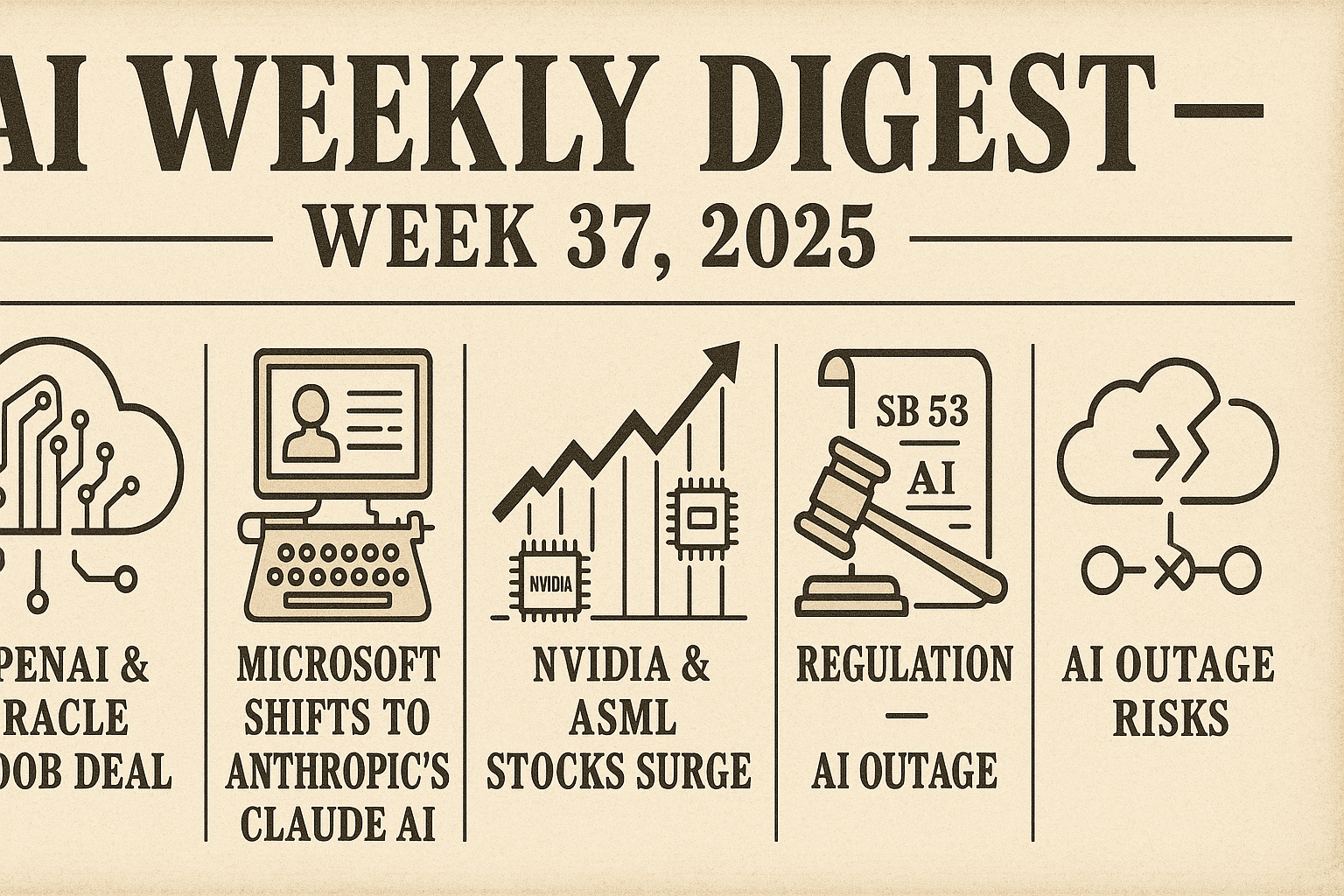
- OpenAI and Oracle Strike Historic $300 Billion Cloud Deal for AI Compute
- Microsoft Picks Anthropic’s Claude for Office Suite, Diversifying Beyond OpenAI
- AI Infrastructure Arms Race: Nebius, Microsoft, and Oracle Send Markets Soaring
- Mistral AI Lands €1.7 Billion Investment from ASML, Doubling Valuation
- California’s SB 53 AI Safety Bill Gains Traction with Anthropic’s Endorsement
- OpenAI Reveals the Root Cause of Hallucinations in AI Models—And How to Fix Them
- Claude AI Outage Highlights Overreliance on Centralized AI Tools
- AI and the Disappearance of Entry-Level Jobs: The Career Ladder Debate
- The Women in Love with AI Chatbots: The Rise of Synthetic Companionship
- Short Summaries — Other Notable Developments
OpenAI and Oracle Strike Historic $300 Billion Cloud Deal for AI Compute
Category: Infrastructure and Hardware
Source: SiliconANGLE
In a landmark for artificial intelligence and cloud infrastructure, OpenAI has signed a massive $300 billion agreement with Oracle to procure 4.5 gigawatts of datacenter compute capacity over five years. This deal forms the backbone of OpenAI’s Project Stargate initiative, aiming to construct world-leading data centers in the U.S. and internationally. Notably, the scale dwarfs OpenAI’s current revenue ($10B annually), highlighting the frenetic investment race among Big Tech to secure next-generation AI training and inference resources. The undertaking ties up both firms’ futures—OpenAI will add immense capacity to push the boundaries of models like GPT-5, while Oracle is staking a substantial portion of its infrastructure business on AI growth. Construction has already started in Texas, with additional sites planned. The huge investment underscores just how foundational large-scale compute has become to AI progress.
Microsoft Picks Anthropic’s Claude for Office Suite, Diversifying Beyond OpenAI
Category: Enterprise and Adoption
Source: The Neuron Daily
Microsoft is shifting its AI strategy for Office applications, integrating Anthropic’s Claude model into Office 365 tools like Word, Excel, and PowerPoint, and reducing its reliance on OpenAI’s GPT models. According to The Information, internal tests showed Anthropic’s Claude outperforms OpenAI in certain workflows (notably presentations and finance tasks). The move comes as Microsoft negotiates new terms with OpenAI and follows OpenAI’s pivot toward independence with its own infrastructure and career platform. Alongside this, Anthropic revealed new productivity features—Claude can now create and edit full Excel sheets, PowerPoint decks, documents, and PDFs directly within the Claude.ai interface. This highlights both the growing competition among top AI labs and the rapid evolution of consumer-facing AI tools.
AI Infrastructure Arms Race: Nebius, Microsoft, and Oracle Send Markets Soaring
Category: Infrastructure and Hardware
Source: CNBC
AI infrastructure provider Nebius Group made headlines by sealing a multi-year, $19.4 billion deal with Microsoft to provide GPU-based compute for AI workloads. The announcement sent Nebius shares up by over 50% and sparked a rally among other “neo-cloud” and chip stocks such as Nvidia, Broadcom, and TSMC, following similar bullish projections from Oracle. The deal reflects the breakneck pace and intense competition for cloud and AI compute resources as demand for large model training soars. With both traditional and emerging cloud providers now locking in long-term, multi-billion-dollar contracts, the requirements for compute scale and energy are rewriting the data center industry.
Mistral AI Lands €1.7 Billion Investment from ASML, Doubling Valuation
Category: Startups and Funding
Source: CNBC
French generative AI company Mistral has secured a €1.7 billion (approx. $1.8B) Series C round led by Dutch chip-tech giant ASML, valuing it at over €11.7 billion (approx. $13.8B). ASML gains an 11% stake and a seat at Mistral’s strategy board, marking one of the most significant collaborations between European hardware and AI leaders. The strategic partnership will fuel Mistral’s development of frontier AI models and propel industrial innovation with advanced open-source AI. This investment represents Europe’s most ambitious move to date to position itself as a formidable contender against U.S. and Chinese AI players and to secure technological sovereignty.
California’s SB 53 AI Safety Bill Gains Traction with Anthropic’s Endorsement
Category: Regulation and Policy
Source: Anthropic
Anthropic has become the first leading AI developer to publicly back California’s SB 53, a pioneering bill proposing mandatory transparency, safety frameworks, and incident reporting for state-based “frontier” AI model labs. The bill, which builds on expert recommendations to Governor Newsom, would require leading companies to publish safety assessments and allow for whistleblower protections. Anthropic’s endorsement marks a stark split with most of Big Tech, which has opposed state-level regulation, and points to an emerging industry consensus that strong, well-designed safety requirements are necessary as models approach critical capability thresholds. The move increases the odds that California will become the first U.S. state to implement binding AI safety regulation.
OpenAI Reveals the Root Cause of Hallucinations in AI Models—And How to Fix Them
Category: Research and Innovation
Source: The Neuron Daily
OpenAI’s latest research tackles the persistent problem of “hallucinations” in large language models—when AI confidently invents incorrect information. The study reveals that current AI evaluation and training benchmarks unintentionally reward models for guessing instead of admitting uncertainty, due to the way AI “exams” are scored. OpenAI proposes new training incentives that penalize wrong answers more than “I don’t know” responses, encouraging AI systems to state uncertainty rather than bluff. This approach could dramatically reduce AI misinformation and improve trust, signaling a watershed moment in aligning generative AI output with reliability and honesty.
Claude AI Outage Highlights Overreliance on Centralized AI Tools
Category: Incidents and Failures
Source: WebProNews
Developers and businesses faced a “Stone Age” moment this week as Anthropic’s Claude services experienced a global outage, knocking out coding and productivity tools for half an hour. The incident sparked lighthearted memes and serious debate about dependency on central AI services, echoing similar disruptions from OpenAI’s ChatGPT earlier this year. As AI-driven workflows become more tightly integrated across the software industry, the demands for redundancy, hotswappable providers, and hybrid local-cloud solutions are rising. The episode vividly illustrates both the vulnerability and the accelerating centrality of AI in daily work.
AI and the Disappearance of Entry-Level Jobs: The Career Ladder Debate
Category: Skills and Workforce
Source: CNBC
A landmark analysis reveals a 35-50% reduction in U.S. entry-level job postings since 2023, especially among young and inexperienced workers—with AI adoption named as a leading driver. As major companies like PwC and Amazon publicly acknowledge the pullback in junior hires, concern grows over the viability of traditional corporate “career ladders.” Experts suggest that organizations are flattening and requiring new employees to arrive with higher-level skills, changing how talent is grown. Universities and corporations are scrambling to offer AI-centric training, while long-term labor impacts remain unpredictable. The debate now centers not just on lost jobs, but how to ensure upskilling and upward mobility are still possible in an age of automation.
The Women in Love with AI Chatbots: The Rise of Synthetic Companionship
Category: Ethics and Governance
Source: The Guardian
A nuanced, in-depth report uncovers the growing phenomenon of emotionally intimate (and at times, romantic) relationships between humans and AI chatbots. Drawing on real-life stories and expert concerns, The Guardian explores the psychological, ethical, and societal ramifications of “synthetic companionship.” While many users report positive experiences—finding emotional support, courage, or relief from isolation—experts warn about risks of dependency, unhealthy attachment, and the challenge of ensuring safety for vulnerable groups. As AI chatbots become increasingly sophisticated and personalized, society must grapple with boundaries around synthetic relationships and the ethics of AI “consent.”
Short Summaries — Other Notable Developments
- Oracle’s Stock Soars on AI Boom: After announcing $317B in future AI contracts—including a $300B deal with OpenAI—Oracle’s stock hit record highs, boosting the market confidence in big cloud AI infrastructure. Bloomberg
- HHS Mandates ChatGPT for U.S. Federal Employees: In another sign of AI’s normalization, the Department of Health and Human Services (HHS) ordered all staff to use ChatGPT for official tasks, underscoring the public sector’s rapid AI adoption. 404 Media
- Claude AI Code Interpreter & AI Office Features: Anthropic launched new Claude features enabling end-to-end editing of files, spreadsheets, and presentations inside its interface, giving users unprecedented office-like AI tooling. Anthropic
- Tech Giants Back Evals for AI Quality: Heated debates reignited around best practices for evaluating AI systems (aka “evals”), with experts warning against both too little and too much reliance on static benchmarks. Ben’s Bites
- Spotify User Data Monetization Sparks Legal Row: Over 10,000 Spotify users pooled their listening data to sell access for AI research, sparking warnings from Spotify and reigniting debates over data portability and digital rights. Ars Technica
- AI Darwin Awards Launched: A new “AI Darwin Awards” recognizes spectacularly bad and disastrous AI deployments, highlighting the risks and unintended consequences of ill-conceived automation. The Register
- AI in Healthcare Breakthroughs: New studies highlight AI’s promise in early detection of brain disorders and patient-led care, as users and scientists employ agentic AI to improve diagnosis and treatment coordination. Reddit /r/ArtificialInteligence
- OpenAI’s $50M People-First Fund for Nonprofits: OpenAI announced funding for U.S. nonprofits undertaking community-driven AI projects to expand literacy, innovation, and equitable benefit distribution. OpenAI
- Deterministic LLMs Research: Thinking Machines Lab introduced techniques for making large AI model inference deterministic—critical for reproducible research and safe deployment. Thinking Machines
- ComfyUI & Generative Content Workflows: NVIDIA and ComfyUI made major performance advances for on-device generative AI, with new models supporting state-of-the-art image, video, and 3D content creation. NVIDIA Blog
- Apple Sidesteps the AI Wars: Apple’s latest product event notably deemphasized AI despite industry hype, suggesting a more measured approach to AI “bloodsport” among Silicon Valley rivals. CNN
- Debate on AI Morality and Machine Consciousness: Microsoft’s AI chief Mustafa Suleyman publicly rejected the pursuit of conscious machines, calling it an “illusion” and arguing for practical, grounded AI development. Wired
End of Week 37, 2025 — Stay tuned for more AI breakthroughs and debates next week!