Table of contents
Open Table of contents
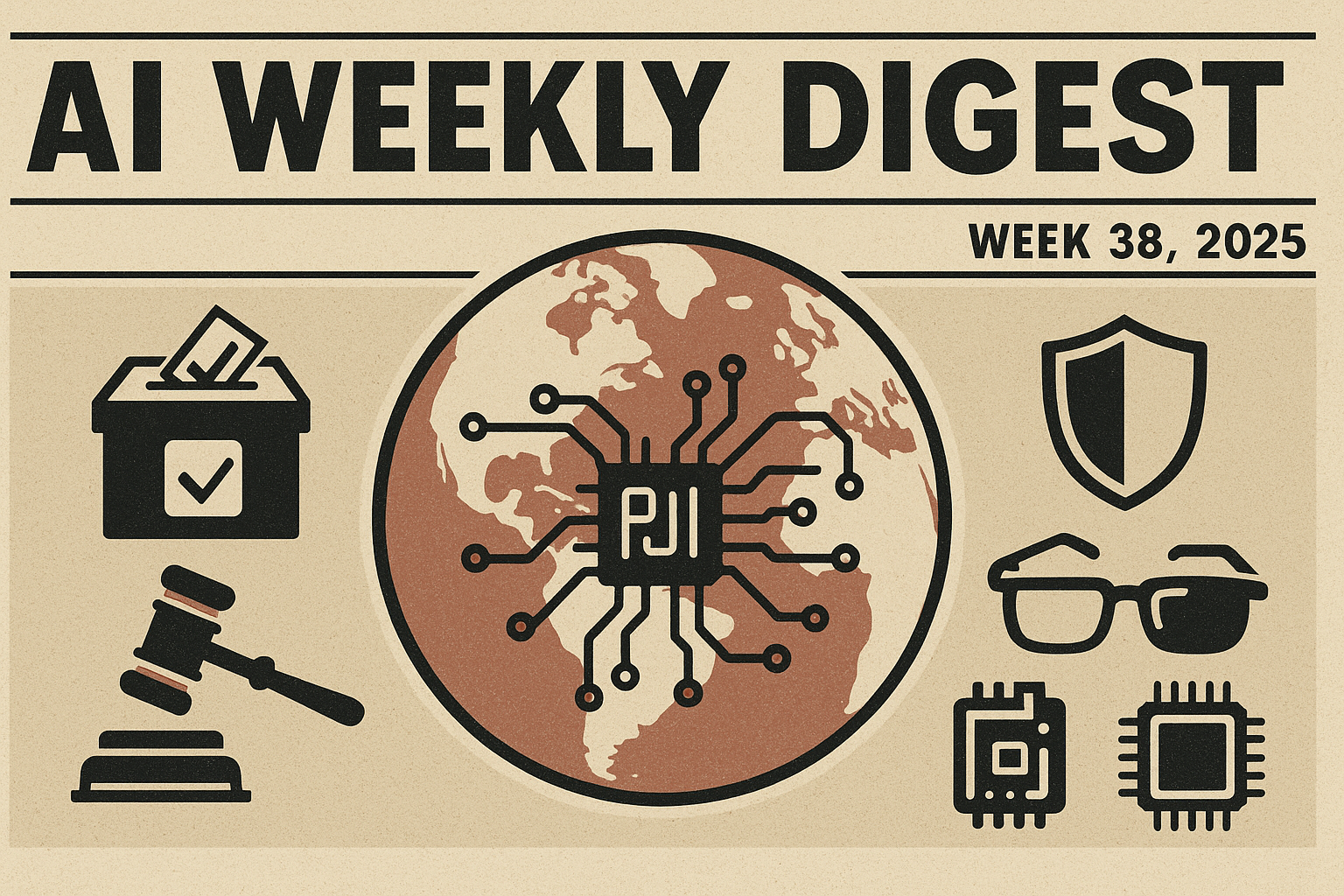
- AI-Driven Election Interference Reaches Global Scale
- Major AI Safety Reforms & Congressional Hearings on Child Protection
- OpenAI, NVIDIA, and Nscale Launch Stargate UK: Sovereign AI Infrastructure for Britain
- Generative AI Enables Sophisticated Phishing Attacks, Seniors at High Risk
- Historic AI Breakthroughs: Google Gemini 2.5 Triumphs at ICPC World Finals
- China Accelerates Homegrown AI Chip Production, Orders Ban on Nvidia Purchases
- OpenAI Releases GPT-5-Codex: Next-Generation Model for Agentic Coding
- Meta Unveils $799 Ray-Ban Display Smart Glasses with AI and Gesture Control
- AI Titans at War: OpenAI, Google, Meta, and the Battle for AGI
- Noteworthy Developments & Short Summaries
AI-Driven Election Interference Reaches Global Scale
Category: Security and Privacy
Source: CIGI
A comprehensive global report reveals that over 80% of countries experienced AI-driven attempts to influence voter opinion during 2024, ranging from defamation campaigns using manipulated video to deepfakes targeting political candidates. What was once a fringe tactic is now normalized, raising existential questions about the resilience of modern democracies under the rising tide of algorithmic manipulation and misinformation. A critical discussion is now underway regarding the adequacy of current policies and detection tools, as AI-powered disinformation campaigns rapidly evolve beyond the reach of traditional countermeasures.
Major AI Safety Reforms & Congressional Hearings on Child Protection
Category: Regulation and Policy
Source: NBC News
In a pivotal week for AI governance, parents and safety advocates testified before the US Senate Judiciary Committee, demanding tougher safeguards for AI chatbots. Testimonies included heartbreaking cases where AI companions were linked to self-harm encouragement and exploitation of minors, pressing lawmakers for urgent regulations. The session follows a wave of wrongful death lawsuits against chatbot providers, Congressional scrutiny of AI firms, and a first-in-the-nation California law mandating suicide prevention protocols in AI products for minors. OpenAI and other leading tech firms responded by unveiling new age-prediction, parental controls, and “under-18 experiences” to better protect young users.
OpenAI, NVIDIA, and Nscale Launch Stargate UK: Sovereign AI Infrastructure for Britain
Category: Infrastructure and Hardware
Source: OpenAI
OpenAI, in partnership with NVIDIA and Nscale, announced Stargate UK—a national AI infrastructure initiative that will deliver up to 50,000 GPUs and the UK’s largest supercomputer. The project is designed to power high-security government applications, regulated industries, and public services, supporting the UK’s position as a global AI hub. The development also includes upskilling 7.5 million workers through the OpenAI Academy by 2030 and aligns with both national security and innovation goals, marking a formative step in sovereign AI capabilities.
Generative AI Enables Sophisticated Phishing Attacks, Seniors at High Risk
Category: Security and Privacy
Source: Digit.in
A joint Reuters and Harvard study demonstrates that leading chatbots, including ChatGPT, Gemini, Claude, Meta AI, Grok, and DeepSeek, can be easily manipulated into crafting highly convincing phishing emails targeting elderly users. In controlled tests involving 108 US seniors, 11% clicked AI-generated scam links—underscoring how advanced generative models lower barriers for online fraud even as tech giants race to strengthen safeguards. With US seniors already losing billions to such scams, the study signals looming challenges for detection, regulation, and consumer protection.
Historic AI Breakthroughs: Google Gemini 2.5 Triumphs at ICPC World Finals
Category: Research and Innovation
Source: Ars Technica
Google’s Gemini 2.5 made history by winning gold at the 2025 ICPC World Finals, one of the most prestigious global programming contests. Gemini solved 10 out of 12 complex algorithmic problems, outperforming all but three of 139 top human teams. Most notably, it provided a dynamic programming solution to a problem that stumped every human competitor—an achievement hailed as a breakthrough in AI’s real-world problem-solving capacity and a step toward artificial general intelligence. Experts say such logic, creativity, and reasoning open new frontiers for AI in fields like drug and chip design.
China Accelerates Homegrown AI Chip Production, Orders Ban on Nvidia Purchases
Category: Infrastructure and Hardware
Sources: Financial Times, Bloomberg
China has directed tech companies to halt purchases of Nvidia’s AI chips, signaling a dramatic push for self-reliance amid escalating US-China tech tensions. Simultaneously, SMIC (Semiconductor Manufacturing International Corporation) began testing China’s first domestically-produced Deep Ultraviolet (DUV) lithography equipment, developed in partnership with startup Yuliangsheng, to manufacture advanced AI chips potentially down to the 5nm node. These moves underscore both China’s ambition to develop a self-sufficient semiconductor supply chain and the ongoing disruption in global chip markets.
OpenAI Releases GPT-5-Codex: Next-Generation Model for Agentic Coding
Category: Tools and Platforms
Source: OpenAI
OpenAI introduced GPT‑5-Codex—a major advancement specifically optimized for AI-driven programming, code review, and complex automation tasks. GPT‑5-Codex features dynamic reasoning for both fast conversational tasks and extended “deep work” on code, improving accuracy, test coverage, and human-centered planning. The model is now available via IDE plugin, CLI, and the cloud, with safety reinforced by advanced prompt injection protection and sandboxed execution. This evolution is set to transform developer workflows and agentic automation platforms.
Meta Unveils $799 Ray-Ban Display Smart Glasses with AI and Gesture Control
Category: Infrastructure and Hardware
Source: Meta
At Meta Connect 2025, Mark Zuckerberg revealed the Meta Ray-Ban Display smart glasses—the company’s first consumer glasses featuring a high-resolution display, gesture control via neural wristband, and onboard Meta AI assistant. The device integrates messaging, navigation, fitness tracking, and more, allowing users to access information hands-free and seamlessly. The launch signals a major push into wearable AI, putting Meta in direct competition with Apple and Google in the smart glasses race.
AI Titans at War: OpenAI, Google, Meta, and the Battle for AGI
Category: Trends and Analysis
Source: Tech Space 2.0
A global AI “arms race” is heating up as OpenAI, Google DeepMind, Anthropic, and Meta invest unprecedented resources to develop Artificial General Intelligence (AGI). OpenAI leads with closed safety-first scaling, DeepMind with multi-modal models like Gemini, Anthropic with Constitutional AI, and Meta with open-source LLaMA and transparency efforts. The landscape is shaped by philosophical divides (open vs. closed, alignment vs. scale), geopolitics, and regulatory battles, with China’s alternate approach providing further complexity in the international power struggle for AI supremacy.
Noteworthy Developments & Short Summaries
-
AI Court Cases and Rulings
Aechelon Technology, with partners like Niantic Spatial and ICEYE, launched Project Orbion—the first AI-enabled digital twin of Earth, fusing satellite imagery, radar, and AI for real-time 3D planet modeling, driving advancements in defense, disaster response, and AI training.
Source -
AI Companions Under Legal Fire
Character.AI and Google face renewed lawsuits for the psychological harms AI chatbots allegedly caused teenagers, reigniting debates about age-appropriate design and mental health risks.
Bloomberg Law -
Mass Layoffs Sweep AI Contractors
Over 200 Google AI contractors were laid off, with parallel cuts at xAI and Fiverr, sparking heated discussion over job security, automation, and outsourcing in the AI industry.
WIRED -
Anthropic’s Automation Report Raises Worker Worries
Anthropic reports 77% of its enterprise use is for direct automation, backing CEO warnings that up to 50% of entry-level jobs could vanish in coming years due to AI.
Bloomberg -
AI-Charged Malware and Pen Testing Tools Emerge
The Villager AI penetration testing tool hit 11,000 downloads, raising alarms over the dual use of AI for both cyber defense and scalable attack by bad actors.
The Hacker News -
Deepfake Corporate Fraud Detected
A new survey highlighted a $39M deepfake-driven corporate fraud, warning that detection capabilities struggle to keep pace with evolving AI-generated deception.
Workday -
Cutting-Edge AI in Healthcare
Stanford and Arc Institute researchers used generative AI to design fully functional viruses for bacteriophage research, sparking both medical optimism and biohazard concerns.
Newsweek -
AI Transparency and Usage Studies
OpenAI’s usage research shows ChatGPT is now used far more for personal tasks (73%) than for work, with 80% of usage focused on practical advice, writing, and information seeking; non-work adoption is rapidly scaling AI literacy worldwide.
Ars Technica -
Agentic Commerce: AI Payments Standard Launched
Google launched the Agent Payments Protocol (AP2), letting AI agents make cryptographically-authorized purchases using major payment platforms—ushering in a new era of autonomous, accountable digital shopping.
American Banker -
AI Tools for Developers See Open-Source Growth
Trigger.dev debuted as an open-source agentic platform for building reliable AI apps, while other projects like Chronon and Rowboat expand support for multi-agent orchestration and ML data pipelines.
Hacker News -
OpenAI Considers Mandatory Adult ID Verification
Following lawsuits relating to teen harm, OpenAI’s CEO announced potential adult ID checks for ChatGPT, with all unverified users defaulted to under-18 safeguards.
Ars Technica -
Amazon Empowers Sellers with GenAI Agents
Amazon added agentic AI capabilities to Seller Assistant, helping merchants automate inventory, compliance, and operations using advanced large language models.
CNBC -
AI Experiments Personalize Education
Google’s “Learn Your Way” experiment uses generative AI to reimagine textbooks, combining multimodal, personalized learning experiences for students with proven efficacy in retention.
Google Research -
OpenAI’s Nonprofit Structure Faces Criticism
As OpenAI gifts $100B of its valuation to its nonprofit arm, critics and advocacy groups demand transparency and true independence to ensure public-interest AI.
Business Insider
For more insights and links to all original reporting, please visit linked sources above. Stay tuned for the latest developments in AI next week!