Table of contents
Open Table of contents
- Nvidia and OpenAI Announce Historic $100 Billion AI Infrastructure Deal
- OpenAI, Oracle, and SoftBank Unveil Five New Stargate Data Centers Across the US
- Global AI Regulation: Scientists and Nobel Laureates Urge UN to Establish “Red Lines”
- Citi Integrates Agentic AI Across Operations, AI Passes CFA, and FinTech Race Intensifies
- Massive AI Infrastructure Investments Spark Industry-wide Ripple Effects
- AI “Workslop”: Generative AI’s Hidden Cost to Productivity and Workplace Trust
- AI Regulation: Antitrust, Immigration, and National Strategies Heat Up
- AI in the Workplace: Software, Skills, and Trust
- Cut Through the Hype: Debates over AI’s Social and Environmental Toll
- Short Summaries: Additional Noteworthy News
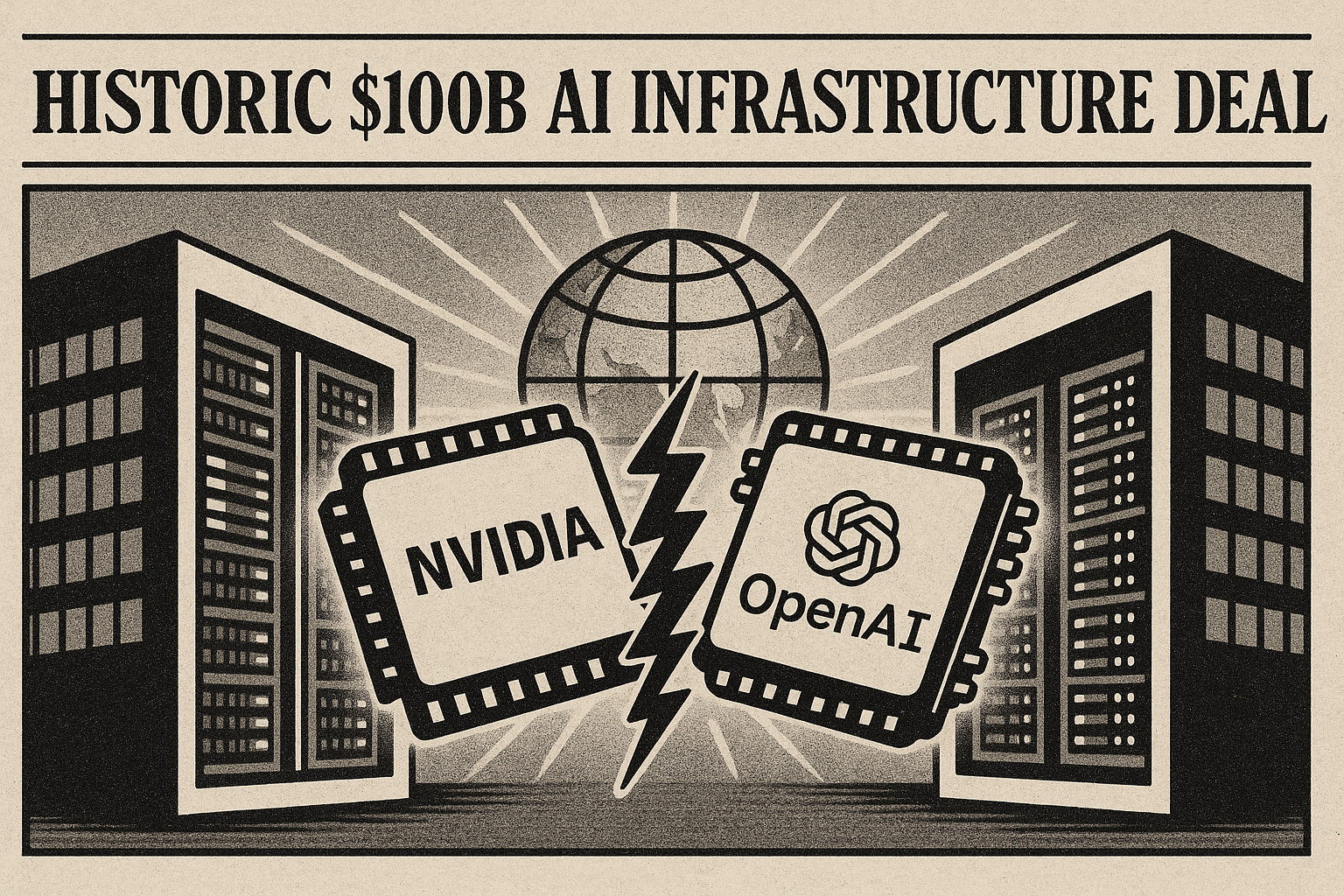
Nvidia and OpenAI Announce Historic $100 Billion AI Infrastructure Deal
Category: Infrastructure and Hardware
Source: NVIDIA Newsroom
Nvidia and OpenAI have joined forces in a monumental $100 billion partnership to build at least 10 gigawatts of next-generation AI data centers using Nvidia’s Vera Rubin platform, with the first phase rolling out in late 2026. This marks the largest AI infrastructure project to date, overshadowing previous cloud deals in both scale and ambition. The phased investment will see millions of Nvidia GPUs powering OpenAI’s future models, addressing the surging demand from over 700 million ChatGPT users and the global industry.
Both companies are aligning development roadmaps and targeting the rapid transition from lab-based AI to real-world, “superintelligent” systems. The agreement will allow for gradual build-outs—starting with 1GW—and will facilitate advanced research in large language models and agentic AI, securing OpenAI’s compute future. As more phases of NVIDIA systems are deployed, Nvidia’s commitment will scale, fueling additional innovation and attracting global interest from both the energy and semiconductor sectors.
This alliance sent shockwaves through the market, with Nvidia’s valuation hitting new highs and sparking a worldwide rally in chip stocks. However, the deal also brings a host of challenges: the need for up to 17 GW of electrical power—equivalent to the combined needs of major US cities—has raised questions about energy infrastructure, environmental impact, and global supply chain constraints for critical hardware and materials.
For more details, visit the official NVIDIA Newsroom announcement.
OpenAI, Oracle, and SoftBank Unveil Five New Stargate Data Centers Across the US
Category: Infrastructure and Hardware
Source: Bloomberg
Building on the momentum of infrastructure investment, OpenAI, Oracle, and SoftBank announced plans to build five new data centers as part of their $500 billion “Stargate” initiative. The facilities—located in Texas, New Mexico, Ohio, and a forthcoming Midwest site—will bring Stargate’s total planned capacity to nearly 7 gigawatts. This rapid expansion aims to support OpenAI’s supercomputing ambitions and scale to meet the spiraling compute demands of advanced AI models.
The flagship campus in Abilene, Texas, is already operational, and within 18 months, an initial 1.5 GW of capacity will come online in Ohio and Texas. The development is expected to create tens of thousands of jobs and underpins a larger industry trend toward multi-billion dollar, multi-gigawatt data center ecosystems tailored for transformative AI workloads.
For OpenAI, this expansion means not just keeping pace with technology demands but also helping to anchor the US as a global leader in AI compute. However, the scale brings new bottlenecks: access to power, reliance on international supply chains for key infrastructure, and the environmental and operational risks of such mammoth facilities.
See Bloomberg’s full report for more.
Global AI Regulation: Scientists and Nobel Laureates Urge UN to Establish “Red Lines”
Category: Regulation and Policy
Source: NBC News
An unprecedented coalition of more than 200 Nobel Prize winners, scientists, and world leaders joined forces this week, issuing an urgent call for binding international agreements to define “red lines” for AI development and deployment. Released during the United Nations General Assembly, the “Global Call for AI Red Lines” seeks an international ban on the most dangerous AI applications—such as lethal autonomous weapon systems, nuclear command, pervasive surveillance, and mass manipulation.
This movement reflects a mounting consensus that unregulated AI poses existential risks—ranging from engineered pandemics to potential loss of human control over critical systems. Supporters argue that, without meaningful regulatory action by the end of 2026, governments may lose any chance to shape AI responsibly.
These calls come in the context of Ukraine’s stark warnings about the role of AI in modern warfare and an evolving arms race, and follow rising debate around the pace of AI expansion versus the need for robust global oversight.
Read more at NBC News.
Citi Integrates Agentic AI Across Operations, AI Passes CFA, and FinTech Race Intensifies
Category: Finance and FinTech
Source: MarketMinute
Citigroup unveiled sweeping upgrades to its internal AI platform, Stylus Workspaces, now featuring agentic AI that dramatically streamlines multi-step tasks for employees. This enhancement puts Citigroup at the forefront of the financial industry’s agentic AI arms race, joining competitors like Goldman Sachs and JPMorgan in integrating AI assistants to optimize workflows and boost operational efficiency.
In a headline-grabbing advance, general-purpose AI models—including OpenAI’s GPT-4, Google’s Gemini 2.5, and Anthropic’s Claude Opus 4—reportedly passed the notoriously difficult CFA Level III exam in mere minutes. This milestone signals a revolution in financial credentialing, with profound implications for the industry: white-collar knowledge work, professional education, and the skills required for future financial experts are all set to transform rapidly.
Further reading: AI Masters the Market: How Advanced Models Are Reshaping Finance and Professional Credentials
Massive AI Infrastructure Investments Spark Industry-wide Ripple Effects
Category: Trends and Industry Analysis
Source: CNBC
The $100 billion Nvidia-OpenAI deal and associated Stargate data center expansion sent shockwaves through global semiconductor and cloud industries. Companies like TSMC, SK Hynix, Samsung, and Tokyo Electron saw stock surges, and European suppliers such as STMicro and Infineon gained ground, as investors recognized the scale and cross-industry impact of AI infrastructure buildouts.
However, this boom also exposed systemic challenges: shortages in data center components, heavy supply chain reliance on overseas manufacturers, and labor constraints for building and operating next-generation facilities. Energy consumption is set to skyrocket—with projections that AI data centers could draw as much power as cities like New York and San Diego combined, raising urgent questions about sustainability and environmental costs.
AI “Workslop”: Generative AI’s Hidden Cost to Productivity and Workplace Trust
Category: Enterprise and Adoption
Source: Harvard Business Review
Despite rapid adoption, generative AI has delivered disappointing ROI for many organizations. A wave of new research—featured in the Harvard Business Review and cited by outlets like CNBC, Accounting Today, and 404 Media—finds that “workslop” (AI-generated but unhelpful, redundant, or superficial content) is endemic, causing nearly 2 hours of wasted effort per instance and damaging colleagues’ trust and workplace morale.
Employees report spending significant time cleaning up AI-generated reports, emails, code, or documentation—often perceiving contributors as less competent, reliable, and creative. The studies recommend that leaders implement clearer AI standards, invest in “AI literacy,” and champion a collaborative (not shortcut-driven) mindset to recapture the promised productivity gains.
AI Regulation: Antitrust, Immigration, and National Strategies Heat Up
Category: Regulation and Policy
Source: Reuters
Nvidia’s strategic stake in OpenAI has triggered significant antitrust scrutiny, with authorities investigating potential competitive impacts on hardware, cloud, and AI service markets. At the same time, the US is seeing policy friction over high-skilled immigration as visa fees rise, while nations like Canada unveil sovereign AI platforms to localize data and model development.
Globally, Microsoft, OpenAI, and SAP announced a joint launch of sovereign AI cloud services for Germany’s public sector, ensuring high-performance AI systems remain compliant with strict regional privacy and data sovereignty laws.
AI in the Workplace: Software, Skills, and Trust
Category: Skills and Workforce
Source: CNN
A Google-backed study found that 90% of tech workers now use AI at the office, reshaping software engineering roles and increasing productivity. However, trust in AI tools remains a sticking point, with only about a quarter of developers expressing strong confidence in AI-generated code. As AI tools automate more white-collar and entry-level tasks, companies like SAP and Goodwill warn of a coming wave of workforce reductions and upheaval—making reskilling and strategic workforce planning a looming priority.
Cut Through the Hype: Debates over AI’s Social and Environmental Toll
Category: Opinion and Commentary
Source: The Guardian
Tech analysts and academic voices warn of an unsustainable gap between multi-billion dollar infrastructure outlays and actual, measurable revenues from AI products. While most corporate leaders tout AI’s promise, hard evidence of operational upsides remains elusive—raising the specter of a future investment reckoning not dissimilar to past “dotcom” bubbles, unless business models and use cases mature alongside technological capability.
Short Summaries: Additional Noteworthy News
- OpenAI, Nvidia, and Oracle’s Data Center Expansion: OpenAI, Oracle, and SoftBank launched the Stargate project, aiming to build five new US data centers, bringing planned capacity to nearly 7GW with $400B+ in investment (Investopedia).
- Sam Altman’s Infrastructure Vision: OpenAI’s CEO described “abundant intelligence” as a fundamental human right and revealed plans to build gigawatt-scale AI server factories weekly (The Neuron).
- AI and Energy: Analysts highlight the monumental energy demands of AI infrastructure, equivalent to powering millions of homes, underscoring urgent environmental and grid questions (Fortune).
- Diffusion vs Autoregressive Models: Carnegie Mellon research finds diffusion-based models outperform traditional autoregressive models in data-constrained environments, reshaping future AI scaling (CMU Blog).
- Open Source Advancements: NVIDIA Nemotron and TernFS open-source projects promise collective progress in multimodal models and exascale data management, boosting research and collaborative intelligence.
- AI Misuse in Legal Profession: Multiple legal cases in the US, including in New Jersey and California, saw attorneys fined for submitting fabricated case citations produced by AI tools, accentuating the need for AI oversight in professional domains.
- Sovereign AI Labs and Models: The UAE, with Nvidia, opened the Middle East’s first major AI & robotics research lab; Canada launched a national AI “factory” emphasizing digital sovereignty with NVIDIA and HPE support.
- Healthcare and Prior Authorization: Medicare announced a pilot program using AI for prior authorization decisions, sparking debate about transparency, fairness, and patient protections in medical AI.
- Google and Creative AI Tools: Google rolled out Mixboard—an AI-powered moodboard tool for designers and marketers—across its Labs, highlighting ongoing efforts to democratize AI for creative industries.
For direct links to all news items, visit the respective source above or our website’s table of contents.