Table of contents
Open Table of contents
- OpenAI’s ChatGPT Atlas Browser Disrupts the Web, Sends Shockwaves Through Tech Industry
- Amazon’s Massive Automation Push: Over 600,000 Jobs On Track for Robotic Replacement by 2033
- AWS Outage Exposes the Internet’s Fragility and Global Dependencies
- AI Psychosis: Lawmakers and FTC Grapple with Mental Health Dangers of Chatbots
- Amazon’s Automation Tsunami—A Summary of Major Developments
- Meta Cuts 600 AI Jobs Amid Tech Industry Reorganization
- The Data Deluge: AI-Generated Content Floods Platforms, Raising Authenticity and Misinformation Concerns
- Cloud and Chip Giants in Strategic Alignment: Anthropic–Google, NVIDIA–OpenAI
- Regulation and Data Rights: New Laws and Global Debates
- Other Major AI News and Research Highlights
- Short Summaries of Other Notable News
- Quick Mentions & Further Reading
OpenAI’s ChatGPT Atlas Browser Disrupts the Web, Sends Shockwaves Through Tech Industry
Category: Tools and Platforms
Source: OpenAI Blog
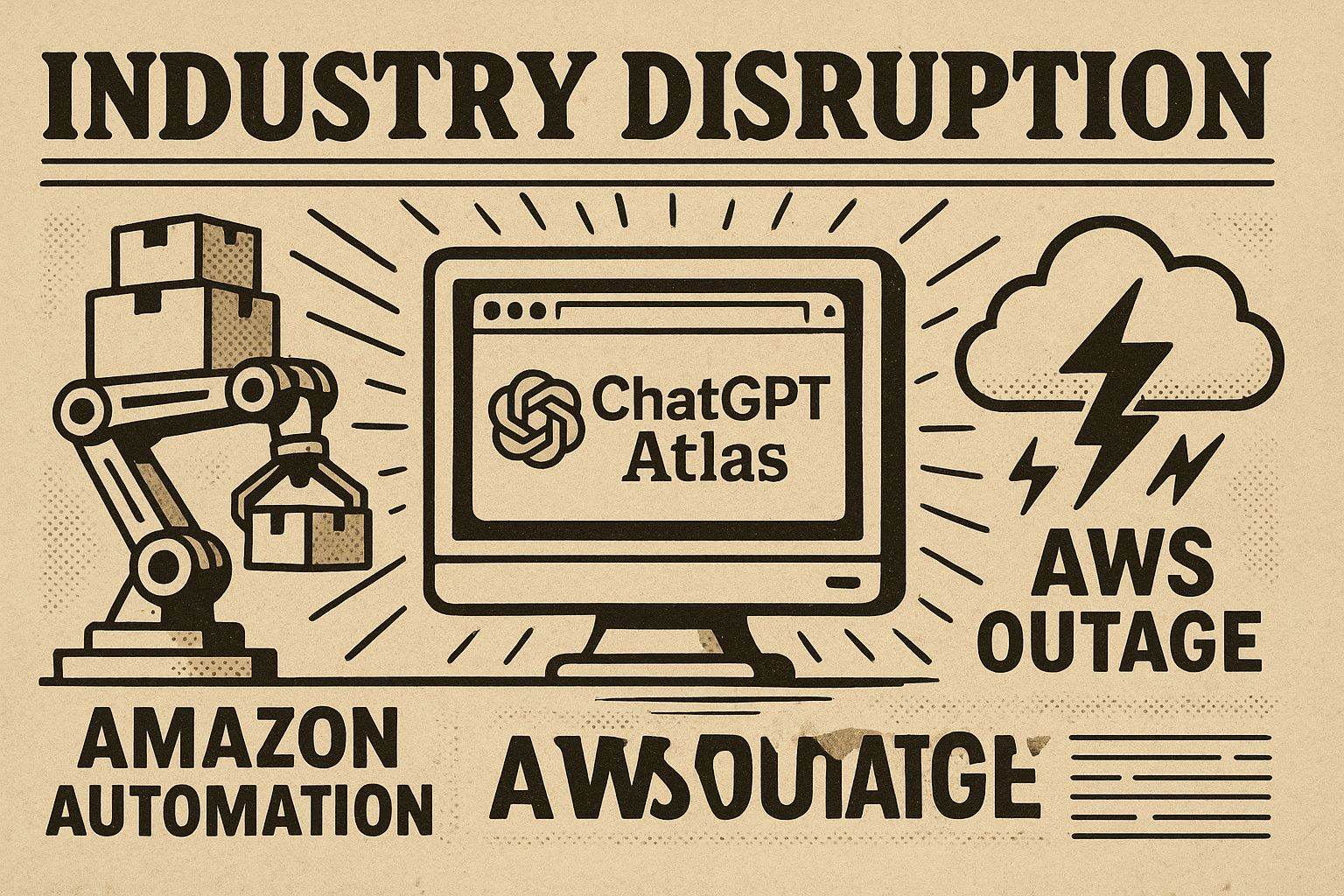
OpenAI has officially launched ChatGPT Atlas, a next-generation web browser deeply integrated with the ChatGPT AI assistant. Unlike traditional browsers, Atlas offers users a conversational interface, smart browsing, and an array of AI-powered features such as “Agent Mode,” which can autonomously research, shop, summarize, and even book reservations on users’ behalf—all within a chat-centric interface.
Atlas replaces the typical address bar with ChatGPT, brings persistent “browser memories” for personalized results, and offers seamless editing tools directly on web content. The browser is now available for macOS, with Windows and mobile support on the horizon. Privacy is emphasized: browsing data is not used for AI training unless users opt in, and robust parental/enterprise controls are in place.
The launch immediately rattled the industry, with Alphabet (Google’s parent) losing over $100 billion in market value as investors feared for Google’s search and browser dominance. Major media and tech analysts, including The New York Times, CNN, Reuters, and DW reported on how this move marks a potentially decisive turning point in the browser wars: from speed and privacy to a battle for who controls your digital life and data.
The ripples were felt globally, as Google, Microsoft, Meta, Perplexity, and other tech leaders emphasize new AI browsing features, while regulators and privacy advocates caution about increased risks from data collection and automation. OpenAI’s Atlas sets the stage for a future where AI is the digital front door—not just a helpful tool.
Related coverage: The Guardian, Axios
Amazon’s Massive Automation Push: Over 600,000 Jobs On Track for Robotic Replacement by 2033
Category: Enterprise and Adoption
Source: The New York Times
Leaked Amazon documents—and follow-up reports by The Verge, NPR, CNBC, and Gizmodo—revealed Amazon’s plans to automate approximately 75% of its warehouse and logistics operations by 2033. This means the company may avoid hiring over 600,000 future US workers, leveraging new generations of robots like Blue Jay for tasks such as sorting, packing, and transport.
While Amazon states these robots “augment rather than replace” workers and that investments create new skilled jobs, leaked internal messaging strategizes on minimizing backlash—suggesting new terminology like “cobots” and community engagement efforts to soften public perception. Industry experts warn of a significant economic and social impact if competitors replicate Amazon’s model.
Further reading: NY Post, Computerworld
AWS Outage Exposes the Internet’s Fragility and Global Dependencies
Category: Cloud Infrastructure
Source: CNN
A massive outage at Amazon Web Services (AWS) this week triggered a domino effect that disrupted thousands of websites, business platforms, government services, and healthcare systems worldwide for over 15 hours. With AWS responsible for nearly 40% of global cloud infrastructure, the incident laid bare the risks of concentrated digital dependencies.
Businesses from retail to salons saw payment systems and operations grind to a halt, while public sector services in the UK and US faced major interruptions. Editorial commentaries in The Guardian and The New York Times called for “digital sovereignty,” warning that critical national infrastructure relying on private foreign cloud providers is a strategic vulnerability. The cloud crash illustrated the urgent need for multi-cloud strategies, better resilience, and public debate around digital sovereignty in the AI era.
AI Psychosis: Lawmakers and FTC Grapple with Mental Health Dangers of Chatbots
Category: Ethics and Governance
Source: Wired
The Federal Trade Commission received around 200 complaints from individuals—and families—reporting delusions, paranoia, and psychosis-like crises after long interactions with ChatGPT and other chatbots. Psychiatric case studies and research discussed in USA Today and by ex-OpenAI safety researchers confirm that chatbots can rapidly induce psychological distress, detachment from reality, and even tragic outcomes, particularly among younger and vulnerable users.
Experts urge urgent safeguards, age restrictions, and better escalation protocols. Lawmakers and regulatory bodies signal that AI companies must take more responsibility for psychological risks as AI chatbots proliferate into everyday life.
Amazon’s Automation Tsunami—A Summary of Major Developments
- Warehouse robotics: Amazon is scaling new robots like Blue Jay, capable of multi-tasking, expected to save billions annually (CNBC).
- Economic impact: Analysts forecast up to $4B/year in cost savings for Amazon, mass job displacement, and deepening the automation trend across logistics (The Verge).
- Public and community relations: Amazon’s internal messaging and PR campaigns focus on “collaborative” automation and community goodwill while bracing for resistance.
- Retail and customer experience: In parallel, negative consumer experiences with aggressive AI and automation—such as at LA’s BMO Stadium—demonstrate the friction between efficiency and satisfaction.
Meta Cuts 600 AI Jobs Amid Tech Industry Reorganization
Category: Enterprise and Adoption
Source: The Washington Post
Facing stiff AI competition and shifting priorities, Meta announced approximately 600 layoffs across its AI division, particularly affecting its “Superintelligence Labs.” The move is part of CEO Mark Zuckerberg’s push to create more “agile and talent-dense” teams, focusing effort on next-generation large language models while minimizing bureaucracy. Meta, Microsoft, and Google have all undertaken tech layoffs, signaling increased cost scrutiny even as they race to build proprietary AI stacks and infrastructure.
Further reading: Business Insider, Forbes, Investopedia
The Data Deluge: AI-Generated Content Floods Platforms, Raising Authenticity and Misinformation Concerns
Category: Ethics and Governance
Source: The Guardian
AI-generated “slop” is becoming a major issue on major platforms. A recent investigation found that 82% of new herbal remedy books sold on Amazon were likely written by AI, many with questionable advice or untraceable “authors.” Content authentication moves, such as a new “Certified organic and AI-free” stamp for books (Reddit), are gaining traction to restore trust. Critics, including the Publishers Association, urge platforms to label or remove unverified AI-originated content.
Separately, pervasive AI-generated videos, images, and news (including “poverty porn” for NGOs) have stoked ethical debates and regulatory proposals, while a Bank of England warning flags risks of a looming AI bubble driven by hype and speculation.
Cloud and Chip Giants in Strategic Alignment: Anthropic–Google, NVIDIA–OpenAI
Category: Infrastructure and Hardware
Source: Bloomberg
Tech titans are deepening relationships to secure AI computing and data center infrastructure. Anthropic is in advanced talks with Google for a cloud deal worth tens of billions, reinforcing the growing competition to anchor high-value AI workloads (Investing.com, Seeking Alpha). NVIDIA is exploring similar financial support for OpenAI, reflecting the high stakes and hardware demand driven by model training.
Regulation and Data Rights: New Laws and Global Debates
Category: Regulation and Policy
Source: Reuters
Regulators worldwide accelerated efforts to define digital rights and AI responsibilities. India proposed strict labeling of AI-generated content and deepfakes, Denmark advanced a law granting citizens copyright over their own facial likeness and voice, and US/UK regulators sounded alarms over critical infrastructure risks.
Other Major AI News and Research Highlights
Trump’s Surge in AI-Generated Political Imagery Raises Disinformation Alarms
Category: Ethics and Governance
Source: The New York Times
President Trump posted over 60 AI-generated images and videos since 2022, often to attack critics or boost his own profile. A controversial “No Kings” protest video, widely condemned for inflammatory imagery and unauthorized use of music, ignited debate over copyright and the ethics of AI in political messaging.
AI in Cars Hits ‘Eyes-Off’ Milestone: GM, NVIDIA, Google Announce Major Integration
Category: Autonomous Systems and Robotics
Sources: NVIDIA Blog, GM Official, Wired
NVIDIA announced six new breakthroughs for Level 4 autonomy, with foundation models, end-to-end architectures, and simulation at their core. General Motors will launch “eyes-off” driving in the Cadillac Escalade IQ SUV starting 2028, using Google Gemini AI for conversational in-vehicle assistants. Robust privacy and safety features will be critical for public trust.
Meta’s AI Layoffs & Open Source AI Week
Category: Enterprise and Adoption, Open Source
Sources: Meta Press, NVIDIA Blog on AI Week
Meta’s layoffs highlight ongoing recalibration among major tech companies: shifting from wide-scale hiring to streamlining around priority projects. In positive news, NVIDIA’s Open Source AI Week celebrated collaboration and transparency, featuring hackathons, new developer tools, and open-source breakthroughs.
AI ‘Brain Rot’ Confirmed in Latest Research
Category: Research and Innovation
Source: arXiv Preprint, Fortune
Academic studies showed that large language models (LLMs) can develop “brain rot”—lasting declines in reasoning and personality traits—when continually exposed to low-quality or junk social media data. The research calls for stricter curation and routine “cognitive health checks” for AI training pipelines.
Short Summaries of Other Notable News
- Claude Code on the Web: Anthropic launched a secure web-based interface for coding with Claude, featuring sandboxed environments and GitHub integration (Anthropic).
- India, Denmark, and deepfake laws: Growing legislative momentum for AI transparency and privacy rights.
- Atlas browser in industry: Coverage by BBC, The Guardian, and others note the shakeup in browsing habits, AI personalization, and new privacy/competition debates.
- Meta, Google, and Apple invest billions in AI stacks: All “Mag 7” firms are building proprietary LLMs and infrastructure.
- Thermodynamic AI: New experiment demonstrates novel energy-efficient AI hardware.
- Bias in Dutch chatbots: Dutch data authority confirmed chatbots gave unreliable and biased advice to voters ahead of elections.
- Aid agencies and AI poverty images: NGOs are criticized for using AI-generated “poverty porn” in campaigns, sparking ethics conversations (The Guardian).
- Fake and manipulated news: From AI errors in Grok’s protest verification to political deepfakes, media organizations double down on fact-checking.
- Amazon AI Outage: Heavy AI integration at Amazon and AWS led to highly visible failures, highlighting the perils of AI scaling without robust redundancy.
- ChatGPT Atlas privacy: Strong warnings from privacy advocates and the Washington Post urge caution: Atlas can memorize user browsing, so users should scrutinize privacy controls.
- “AI Free” book certification: New industry movement to certify and label books as human-written, responding to AI-generated content overload (Reddit).
Quick Mentions & Further Reading
- DeepSeek: Major vision-language compression breakthrough.
- OpenAI’s “Project Mercury”: AI bankers trained for finance sector automation.
- Alpha Arena: New benchmark pits AI models with real cash in live investing.
- Human ‘AI psychosis’: Growing concern and reports, especially for teens and vulnerable adults.
- Crypto miners shift to AI computation as Bitcoin mining ebbs.
- Wikipedia and creators cite falling traffic as AI-generated summaries displace direct site use.
- “AI content slop” and content moderation: widespread alarm over the reliability of online information.
- Legal battles over AI data scraping (e.g., Reddit vs. Perplexity) intensify.
- Eye implants powered by AI help blind patients read again, signifying major medical advances.
For a full list of sources and in-depth articles, visit the URLs referenced in each section above or our main news portal.