Table of contents
Open Table of contents
- Nvidia Becomes First $5 Trillion Company, Redefining Tech Valuations
- OpenAI Completes For-Profit Restructuring, Cementing Microsoft Partnership and $1T IPO Ambitions
- Amazon Initiates Largest-Ever AI-Driven Corporate Layoffs
- OpenAI and AI Therapy: Over 1 Million Users Discuss Suicide Weekly
- AI Surveillance and Facial Recognition Spark Privacy Concerns Worldwide
- AI Models Demonstrate Introspective Awareness: New Breakthrough from Anthropic
- Vercel’s AI Agent Cuts Sales Team Tenfold—A Glimpse at “AI Interns” for White-Collar Jobs
- Law and Policy Updates: OpenAI, Copyright, World Governments Step In
- AI Security and Safety: New Browser, Call Center, and Exploit Developments
- Creativity and the AI Boom: Adobe, AI Artists, and Agentic Content
- PayPal and OpenAI Partner to Build the First ChatGPT Payments Wallet
- Short Summaries of Other Notable Developments
- Additional News in Brief
Nvidia Becomes First $5 Trillion Company, Redefining Tech Valuations
Category: Finance and Market Trends
Source: CNN
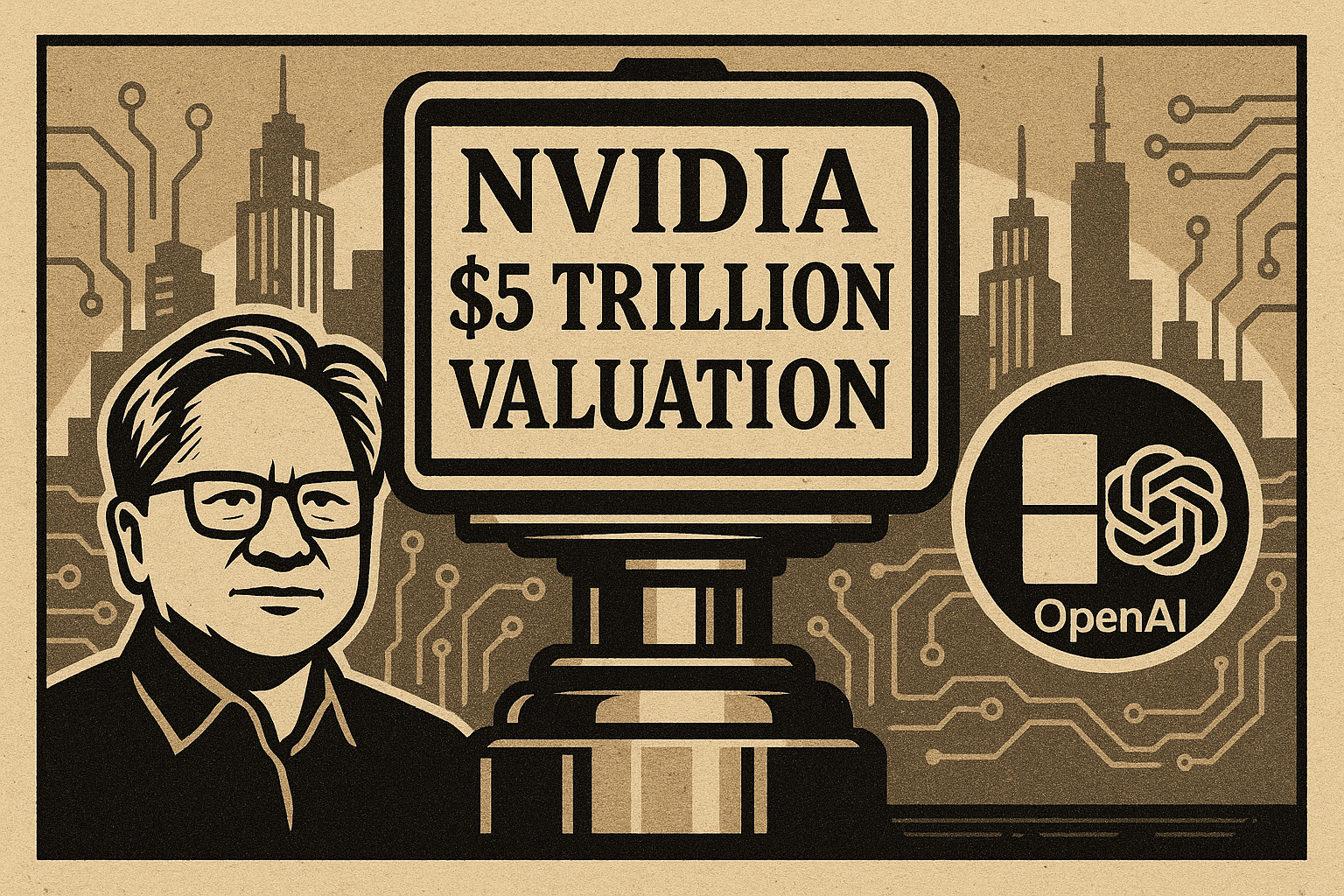
Nvidia has made history as the world’s first company to achieve a $5 trillion market valuation, propelled by an insatiable demand for AI chips and a rapid succession of strategic announcements. In just a few months, Nvidia’s valuation rocketed from $4 to $5 trillion, underscoring the company’s dominant role at the epicenter of the AI revolution. CEO Jensen Huang’s keynote at the GTC conference further captivated markets, as Nvidia announced $500 billion in AI chip orders, plans for new AI supercomputers for the US government, and a $1 billion investment in Nokia to lead 6G technology.
Nvidia’s technology now anchors not only data centers powering OpenAI’s infrastructure but also new sectors, including autonomous vehicles and advanced drug discovery. The extraordinary market rally has sparked debate over a potential AI-driven bubble, but leaders such as Federal Reserve Chair Jerome Powell and prominent analysts cite strong earnings and tangible productivity gains as evidence of genuine value creation. With partnerships extending from Uber’s self-driving vehicle fleet to major pharmaceutical and cloud players, Nvidia stands as the keystone of global AI infrastructure—though experts caution that its meteoric growth is matched by systemic significance and new risks across tech and financial sectors.
OpenAI Completes For-Profit Restructuring, Cementing Microsoft Partnership and $1T IPO Ambitions
Category: Enterprise and Adoption
Source: Fortune
OpenAI has finalized its transition from a non-profit to a for-profit entity, establishing the OpenAI Group Public Benefit Corporation and granting Microsoft a 27% stake, valued at approximately $135 billion. This pivotal move, described by industry insiders as a “seamless integration of philanthropic and commercial interests,” clears years of regulatory hurdles and uncertainty, allowing OpenAI to unlock new sources of funding while maintaining its original mission of beneficial AI for humanity.
The restructuring brings Microsoft’s total investment in OpenAI to $135 billion and comes with exclusive access to OpenAI’s models until 2032. The deal also mandates OpenAI to purchase an additional $250 billion in Azure cloud services, accelerating both companies’ AI strategies. Notably, OpenAI now prepares for an initial public offering (IPO) that could value the company as high as $1 trillion, marking what could be one of the largest IPOs in global tech history. The move positions OpenAI and Microsoft as the cornerstone partnership in the next era of generative AI innovation, even as it ignites debate over the risks of concentrated power and the commercialization of AGI (Artificial General Intelligence).
Amazon Initiates Largest-Ever AI-Driven Corporate Layoffs
Category: Skills and Workforce
Source: CNBC
Amazon has begun the largest reduction of its corporate workforce in the company’s history, laying off approximately 14,000 employees with potential total cuts exceeding 30,000. Amazon CEO Andy Jassy and HR chief Beth Galetti cite a dual focus: streamlining bureaucracy and investing aggressively in generative AI to maintain competitiveness. The move accelerates previous cost-cutting waves since 2022—already shedding over 27,000 jobs—and is concentrated on white-collar and middle management roles as AI solutions replace traditional managerial tasks.
Amazon’s restructuring underscores a wider trend among tech giants—Meta, Microsoft, and Salesforce have also announced deep cuts tied to AI-driven productivity and automation. The corporate transformation signals a growing divide in the labor market, with analysts warning of shrinking opportunities for upward mobility, especially in middle management, and a coming era in which the competitive edge may favor those who “lean in on AI.” The layoffs extend beyond the US, impacting hundreds in California and globally, and are being closely followed as a harbinger of AI’s true impact on employment across knowledge industries.
OpenAI and AI Therapy: Over 1 Million Users Discuss Suicide Weekly
Category: Ethics and Governance
Source: The Guardian
OpenAI has published its most alarming mental health statistic to date: more than 1 million people per week use ChatGPT for conversations around suicide, self-harm, or emotional crises. Collaborating with over 170 mental health experts, OpenAI has overhauled its safety protocols, leading to an 80% drop in risky model responses and a wider rollout of crisis hotline information.
The revelations have heightened public scrutiny and regulatory attention. Multiple states and the US Federal Trade Commission have launched investigations into the safety of AI therapy products. Lawsuits brought by bereaved families allege that AI chatbots played a contributory role in tragic outcomes. Meanwhile, states like Illinois and Utah have moved to ban unregulated AI mental health products. The debate around AI’s role in crisis intervention—both as a supplement and a risk to traditional therapy—has entered a new phase with OpenAI’s public data and policy overhaul.
AI Surveillance and Facial Recognition Spark Privacy Concerns Worldwide
Category: Security and Privacy
Source: Jacobin
AI-powered surveillance reached new heights this week as Immigration and Customs Enforcement (ICE) inked a $5.7 million contract for an AI-driven social media dragnet powered by Zignal Labs, whose platform is used by US and Israeli intelligence agencies. Over 8 billion social media posts are analyzed daily to “detect threats,” fueling fresh worries from civil liberties advocates about political targeting, chilling effects on free speech, and “black box” algorithmic policing. In parallel, new field reports reveal that ICE and CBP agents are actively using facial recognition technology to scan the faces of people on the street as part of citizenship enforcement—an overreach privacy advocates dub “pure dystopian creep.”
Controversies around biometric surveillance aren’t limited to the US: European privacy group Noyb has filed a criminal complaint against American facial recognition firm Clearview AI, arguing its database of billions of faces violates EU privacy law. These developments cement the urgent need for international debate around government use of AI surveillance technologies, their regulation, accountability, and the risks they pose to democratic rights.
AI Models Demonstrate Introspective Awareness: New Breakthrough from Anthropic
Category: Research and Innovation
Source: Anthropic
A team at Anthropic has found scientific evidence of “genuine introspective awareness” in large language models (LLMs) such as Claude. Through targeted experiments involving neural concept injection, models were shown to recognize and report on their own internal states—demonstrating a capacity for limited self-monitoring and reasoning about previous actions, particularly as model sophistication increases.
The implications of these early forms of AI introspection are profound: they could unlock new transparency and safety techniques but also highlight the growing complexity of LLM “minds.” While researchers urge caution, these results establish AI introspection as a critical area for future investigation, with the potential to make machine reasoning more robust and explainable.
Vercel’s AI Agent Cuts Sales Team Tenfold—A Glimpse at “AI Interns” for White-Collar Jobs
Category: Enterprise and Adoption
Source: Business Insider
Startup Vercel has demonstrated the transformative potential—and risks—of AI in sales and professional workflows, training an AI agent on its top salesperson and reducing its inbound sales team from ten human reps to just one, with the AI agent handling the bulk of customer interactions. The former reps shifted to more complex outbound roles, with company leaders stating the goal is “not downsizing but multiplying top performance with AI.” This case highlights both the upside for productivity and the disruptive potential for entry-level and repetitive white-collar jobs as advanced agents become commonplace.
Law and Policy Updates: OpenAI, Copyright, World Governments Step In
Category: Regulation and Policy
Source: Reuters
A federal judge denied OpenAI’s motion to dismiss parts of a major copyright lawsuit brought by US authors, allowing legal claims over unauthorized use of copyrighted text in AI training to proceed. The ruling marks a pivotal moment in the emerging field of “output-side” copyright law for AI-generated works and increases pressure on model developers to negotiate and comply with content licensing. At the same time, the US Senate is considering legislation to ban AI chatbot use among minors, amid growing concerns around child safety and AI content regulation. Meanwhile, Albania appointed the world’s first AI government minister—Diella—who will act as a digital “mother” of 83 AI assistants for each MP, signaling a bold step in the digitalization of state functions.
AI Security and Safety: New Browser, Call Center, and Exploit Developments
Category: Security and Privacy
Source: The Hacker News
Researchers have uncovered a severe vulnerability in OpenAI’s ChatGPT Atlas browser, with attackers able to inject persistent malicious instructions via a CSRF exploit, risking code execution and privilege escalation. The flaw exemplifies emerging risks in AI-powered interfaces as they become critical workplace infrastructure. Users are advised to regularly clear AI browser memory and demand stronger security controls for enterprise deployments.
On the open-source front, Microsoft released its call-center-ai toolkit, enabling businesses to integrate AI agents directly into phone and communication workflows, while collaborative protocols like the Model Context Protocol are rapidly being standardized, echoing the jQuery “middleware” era in web development.
Creativity and the AI Boom: Adobe, AI Artists, and Agentic Content
Category: Creative Technologies
Source: Forbes
Adobe launched 15 new generative AI features across its creative suite at MAX 2025, embedding conversational AI assistants in Photoshop, Premiere, and more. The breakthrough is emblematic of the rapid evolution of creative AI: for the first time, AI-powered “artists” debuted in the Billboard charts, and record deals are being signed for AI personas with millions of streams. Xania Monet, an AI singer-songwriter, notched a record contract—triggering alarm and debate over the changing landscape, royalties, and authenticity in music and media.
PayPal and OpenAI Partner to Build the First ChatGPT Payments Wallet
Category: Finance and FinTech
Source: CNBC
PayPal signed a deal with OpenAI to make its digital wallet the first payments platform embedded in ChatGPT, ushering in an era of AI-powered agentic commerce. Starting in 2026, users will be able to search for products and shop directly through ChatGPT with streamlined PayPal-mediated checkout, fraud protection, and order tracking. The integration solidifies ChatGPT’s role as a central e-commerce platform and signals a broader trend of major fintech firms embedding AI assistants into daily commerce.
Short Summaries of Other Notable Developments
-
Anthropic Launches Specialized Finance AI: Claude for Financial Services now boasts real-time Excel integration, live data connectors, and prebuilt agent skills, adopted by financial giants like Citi and Visa. Anthropic
-
Rise of AI in Military and Security: The US DoD, in partnership with AMD, is investing $1 billion to build supercomputers for national security and scientific breakthroughs. Meanwhile, “killer chatbots” and LLM-driven drones signal a new era of defense tech with ethical and strategic ramifications. WIRED
-
AI Bias and Content Moderation: Elon Musk’s Grokipedia, an AI-powered Wikipedia rival, launched amid immediate controversy for far-right and conspiratorial content and ideological slant. Wikipedia founder Jimmy Wales says LLMs are inadequate for reliable wiki entries, warning about the risks of algorithmic “editorialization.” WIRED
-
AI’s Expanding Economic Impact: A Wall Street Journal analysis observes a “trillion-dollar AI bet” becoming universal, with nations both rich and developing investing heavily in AI to fuel new economic paradigms.
Additional News in Brief
- Nvidia Debuts BlueField-4, IGX Thor, Omniverse DSX, and new open models, accelerating AI infrastructure for industries from robotics to healthcare and 6G wireless. NVIDIA Blog
- Salesforce Admits AI Job Destruction & Productivity Boost as management and support roles are automated. Ecency
- Senators Propose Banning Teens from AI Chatbot Use amid mounting lawsuits and safety concerns; Character.AI responds by restricting under-18 access and implementing new age verification. CNN
- Billboard Tracks AI Artists as Xania Monet and “Breaking Rust” become charting recording acts.
- Grieving Family Uses AI (Claude) to Cut Hospital Bill from $195,000 to $33,000, demonstrating AI’s emerging role in consumer advocacy. Tom’s Hardware
For deeper insights and continuous updates, visit top sources including CNN, BBC, Reuters, Nvidia, OpenAI, Anthropic, and Business Insider.