Table of contents
Open Table of contents
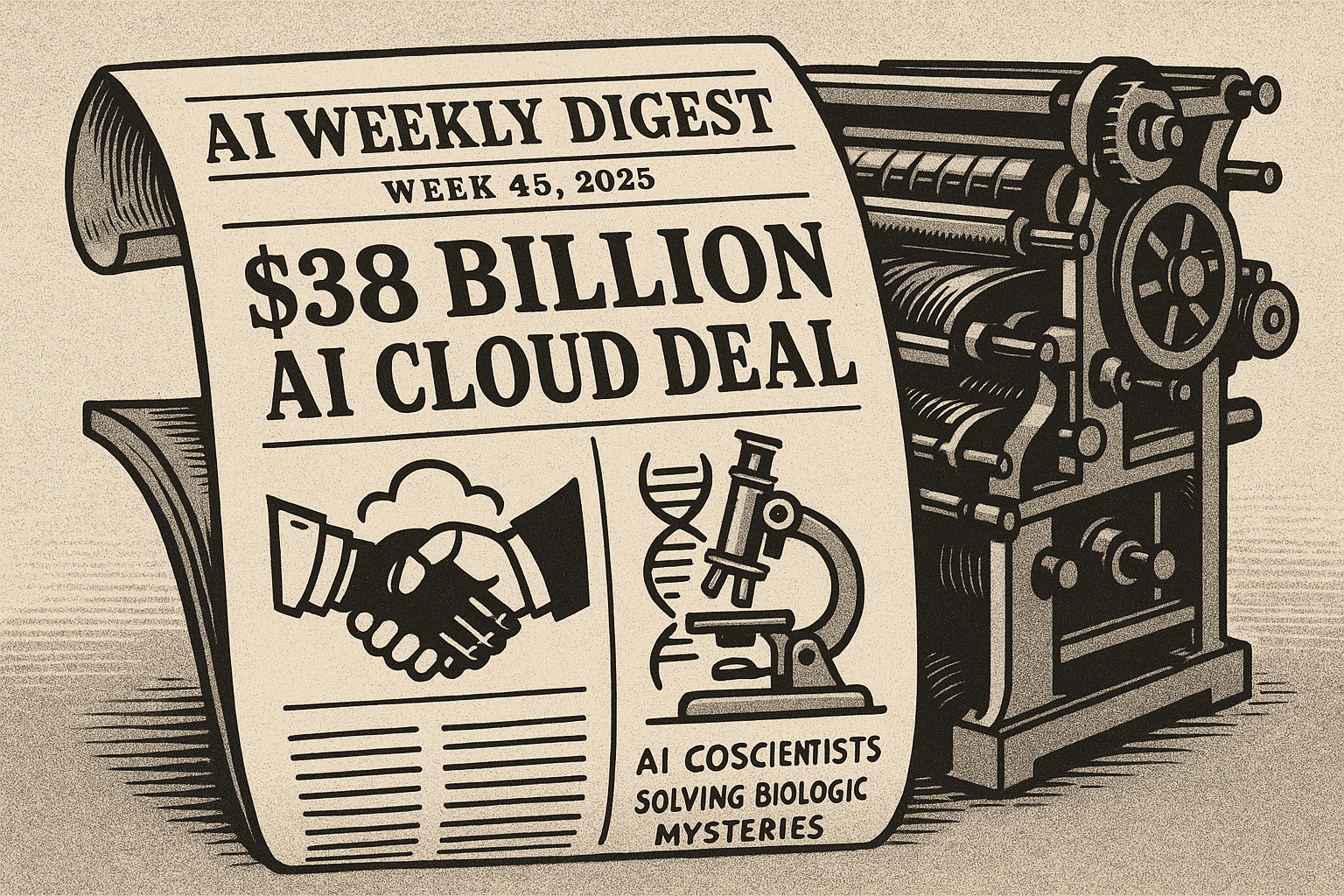
- OpenAI and Amazon Sign $38 Billion Mega Cloud Compute Deal, Transforming AI Infrastructure
- AI Co-Scientists Crack Biological Mysteries Once Thought to Take Decades
- AI Job Displacement, Profit Booms, and the Changing Labor Equation
- The AI Bubble Debate and Market Correction Fears Roil Global Tech Stocks
- AI Lawsuits and Copyright Wars Intensify: Content Creators, Publishers, and AI Giants Collide
- AI Model Safety, Benchmark Flaws, and the Google Gemma Controversy
- U.S. States Move Toward AI Transparency Laws Amid Industry Pushback
- Market and Workforce Impact: AI’s Reshaping of Jobs and Skills
- LLMs Can Now Communicate Without Words—Direct Semantic Transfer Unlocked
- Syllabi: Open-Source, Agentic AI Chatbots for Teams and Developers
- New Research: LLMs Reason by Organizing Knowledge Into Geometric Structures
- Advances in Physical AI: Smart Cities and Germany’s Industrial AI Cloud
- AI Agent Security: “Rule of Two” and the Defeat of Current Prompt Injection Defenses
- AI in Law Enforcement: Calls for Liability and System Accountability
- Noteworthy Short Summaries
OpenAI and Amazon Sign $38 Billion Mega Cloud Compute Deal, Transforming AI Infrastructure
Category: Infrastructure and Hardware
Source: OpenAI
OpenAI and Amazon Web Services (AWS) have entered a landmark seven-year, $38 billion agreement granting OpenAI access to AWS’s vast cloud infrastructure and hundreds of thousands of Nvidia GPUs. This deal not only marks a major diversification away from OpenAI’s previous Microsoft-exclusive cloud arrangement, but also positions AWS at the forefront of global AI innovation. OpenAI seeks to scale the development and deployment of new frontier models, such as a next-generation ChatGPT and other advanced generative systems, as the company commits to over $1.4 trillion in compute contracts across multiple providers.
OpenAI will leverage AWS’s EC2 UltraServers with Nvidia’s state-of-the-art GB200 and GB300 chips, with expansion planned through 2027. The agreement will support everything from training massive new models to delivering inference at consumer scale, and reinforce AWS’s status as a cloud provider for AI leaders. The market responded with Amazon shares hitting all-time highs, while discussion swirled about the sustainability of such enormous capital outlays in AI infrastructure.
“Our partnership with AWS strengthens the broad compute ecosystem that will power this next era and bring advanced AI to everyone,” said OpenAI CEO Sam Altman.
This move is indicative of the fierce arms race underway in AI infrastructure, with major tech firms now prioritizing power capacity and contracted compute as the defining resources of growth. The shift also reflects a broader industry trend towards multi-cloud flexibility and strategic independence as AI companies hedge against operational bottlenecks or lock-in.
Related sources:
- Amazon AWS Official Announcement
- The Guardian Coverage
- CNBC Analysis
- Wired Analysis
- Verdict
- Al Jazeera
AI Co-Scientists Crack Biological Mysteries Once Thought to Take Decades
Category: Healthcare and Life Sciences
Source: Nature
Recent advances in AI have produced “co-scientist” systems capable of generating experimentally sound hypotheses at a pace previously unimaginable. In one standout case, an AI system successfully solved a complex biological mystery that had eluded human researchers for a decade. These AI partners are now enabling labs to make key discoveries in fields such as genetic research and drug repurposing far faster than before, fueling optimism that AI will radically accelerate biomedical innovation and patient care.
The transition from simple AI assistants to full scientific collaborators is provoking a paradigm shift in research methodology, with implications across disciplines. As one researcher noted, “tools like the AI co-scientist have the potential to supercharge human intuition and accelerate the pace of scientific and biomedical breakthroughs.”
AI Job Displacement, Profit Booms, and the Changing Labor Equation
Category: Trends and Analysis
Source: Fortune
A mounting body of evidence points toward AI-driven automation as a primary factor behind what analysts are calling a “jobless profit boom”—record corporate earnings alongside stagnating payrolls. Major layoffs at tech giants like Amazon and Meta have been attributed to efficiency gains from AI, with private-sector payrolls remaining 5% below pre-pandemic levels and productivity surging at double the previous decade’s rate.
Economists and experts, including AI pioneer Geoffrey Hinton, warn that the structure of current profits is increasingly tied to the substitution of human labor with AI, cementing an altered, permanently smaller workforce even as overall productivity—and corporate profit—soars.
This ongoing transformation is fragmenting the labor market along lines of job complexity, empathy, and strategic skills, and is fueling calls for proactive policies to address widening employment gaps.
The AI Bubble Debate and Market Correction Fears Roil Global Tech Stocks
Category: Finance and FinTech
Source: The Guardian
Throughout the week, global equity markets—including the Nasdaq and S&P 500—faced their sharpest drop in a month, triggered by a sharp pullback in tech stocks dominated by AI hype. Investors and analysts are growing skittish over what some describe as “irrational exuberance” and a disconnect between vast capital expenditures in AI infrastructure (now topping $1.4 trillion across Big Tech) versus current realized revenues.
Rising interest rates, cautionary statements from financial leaders, and the actions of prominent short-sellers like Michael Burry (who revealed $1.1 billion in bets against AI giants Nvidia and Palantir) have amplified doubts. The week ended with headlines warning of “AI bubble” risks, a possible market correction, and debate over whether today’s spending spree will create lasting value through infrastructure and innovation—or lead to another dot-com style bust.
AI Lawsuits and Copyright Wars Intensify: Content Creators, Publishers, and AI Giants Collide
Category: Regulation and Policy
Source: The Verge
Major creative organizations—including Studio Ghibli, Bandai Namco, and Square Enix—have joined a growing movement demanding AI companies like OpenAI cease using their copyrighted content to train generative models without explicit permission. Meanwhile, court battles have heated up with potential for billions in damages at stake: OpenAI has been ordered to produce communications related to data deletion of pirated books, and faces questions regarding possible willful infringement and even sanctions for destruction of evidence.
These disputes are part of a broader reckoning over copyright, the provenance of AI training data, and fair compensation for content creators. The outcome could reshape legal and ethical standards for AI development worldwide, as governments and courts grapple with new definitions of intellectual property in the age of machine learning.
AI Model Safety, Benchmark Flaws, and the Google Gemma Controversy
Category: Ethics and Governance
Source: The Guardian
A major study from the UK’s AI Security Institute, with contributors from leading universities, found systemic flaws in more than 440 benchmarks used to evaluate new AI models. Nearly all had weaknesses undermining claims about safety, capability, or alignment—sometimes rendering results misleading or irrelevant. The issue gained urgency after Google withdrew its Gemma AI model—a move prompted by reports the system made up a defamatory allegation about a U.S. senator.
Experts warn that the absence of shared measurement standards is endangering oversight and that, without rigorous benchmarks, the industry can neither reliably claim safety nor track genuine progress.
U.S. States Move Toward AI Transparency Laws Amid Industry Pushback
Category: Regulation and Policy
Source: TechSpot
California has passed new legislation requiring businesses and government agencies to notify people when they’re interacting with AI—expanding previous disclosure rules to now cover law enforcement and public sector use. Utah has adopted similar measures. While consumer advocates praise these moves for building trust and transparency, the tech industry warns such patchwork regulations could stifle innovation or expose proprietary systems to competitor scrutiny. As more states consider transparency mandates, the battlelines are forming over how, and when, consumers must be told about the use of AI in everyday encounters.
Market and Workforce Impact: AI’s Reshaping of Jobs and Skills
Category: Skills and Workforce
Source: Bloomberry
A comprehensive analysis of 180 million job postings globally shows the evolving impact of AI on the workforce. Executional creative roles such as graphic artists, writers, and photographers have seen sharp declines, while demand for machine learning engineers has surged by 40%. Senior leadership and strategic roles have remained resilient or even grown, with customer service jobs declining less than many expected due to the continuing value of empathy and judgment.
The study emphasizes the bifurcation of the job market: roles requiring creativity or complex reasoning have a better outlook, while transferrable or repetitive positions are more vulnerable to AI-driven automation.
LLMs Can Now Communicate Without Words—Direct Semantic Transfer Unlocked
Category: Research and Innovation
Source: arXiv
Groundbreaking new research has demonstrated that large language models (LLMs) are capable of direct semantic communication—not just via text—by transferring internal network state (KV-cache) between models. This cache-to-cache paradigm enables LLMs to fuse knowledge and reason collaboratively in ways impossible with standard token-based messaging, resulting in significant accuracy improvements and latency reduction. This finding opens the door to a future featuring efficient, multi-model AI systems capable of deeper collective intelligence and collaboration.
Syllabi: Open-Source, Agentic AI Chatbots for Teams and Developers
Category: Tools and Platforms
Source: Syllabi AI
Syllabi, an open-source platform, allows anyone to create advanced, agentic chatbots powered by Retrieval-Augmented Generation (RAG), capable of integrating with tools like Slack, Discord, Google Drive, and more. The platform supports code execution, multimedia, and rich document highlighting, all under MIT license and with privacy-first principles. Designed for scalability and flexibility, Syllabi helps organizations build deeply customized team assistants, educational bots, and knowledge management solutions with full control over data and model deployment.
New Research: LLMs Reason by Organizing Knowledge Into Geometric Structures
Category: Research and Innovation
Source: Reddit
A new research paper challenges the notion that large language models simply memorize associations. Instead, findings suggest LLMs organize knowledge into geometric (vector space) structures that enable reasoning and abstraction. This geometric structure supports sophisticated inference beyond rote recall, offering deeper interpretability and guiding future developments in improving AI capabilities and robustness.
Advances in Physical AI: Smart Cities and Germany’s Industrial AI Cloud
Category: Enterprise and Adoption
Source: NVIDIA
NVIDIA, Deutsche Telekom, and partners have announced a sovereign Industrial AI Cloud for Germany—Europe’s first major large-scale, enterprise-grade AI platform for manufacturing, robotics, healthcare, and more. The system leverages thousands of NVIDIA GPUs and integrates digital twin, vision-language models, and city-scale simulation, promising to speed industrial transformation and meet stringent data sovereignty requirements.
Meanwhile, NVIDIA’s ecosystem partners demonstrated new physical AI and smart city solutions across Europe and Asia, emphasizing AI’s growing role in the management and optimization of urban environments.
AI Agent Security: “Rule of Two” and the Defeat of Current Prompt Injection Defenses
Category: Security and Privacy
Source: Simon Willison’s Blog
Two major papers this week explored vulnerabilities in LLM agent security, with Meta AI proposing the “Agents Rule of Two”—which suggests that until more robust defenses exist, AI agents should never be granted, in the same session, the ability to: (A) process untrustworthy inputs, (B) access sensitive data, and (C) change state or communicate externally. Meanwhile, researchers from OpenAI, Anthropic, and Google demonstrated that 12 recent prompt injection and jailbreak defenses can be bypassed via adaptive attacks, with over 90% success rate.
This sobering finding underscores the urgency for designing AI systems with layered, session-based constraints rather than relying solely on static defenses.
AI in Law Enforcement: Calls for Liability and System Accountability
Category: Ethics and Governance
Source: International Business Times
A landmark lawsuit in Los Angeles spotlighted the issue of liability for AI-powered home security systems. After a burglary allegedly evaded an AI-based “intelligent” system, the victim is suing for failure to intervene, raising vital questions about the ethical and legal accountability of AI systems marketed for safety-critical uses. The outcome may set precedent for future regulation and consumer protections around home AI deployments.
Noteworthy Short Summaries
Market & Finance, Regulation, and Trends
- AI Bubble, Investment Risks, and Short Bets: Michael Burry (“The Big Short”) disclosed $1.1 billion in put options against Nvidia and Palantir, spurring debate over inflated AI stock valuations and fears of a market correction (Fortune, Inc, NBC News).
- IBM, Amazon, UPS, Target Announce Thousands of Layoffs: Layoffs are attributed to old-school cost-cutting, tariffs, restructuring, and yes, AI-driven automation, but experts stress the drivers are complex and not solely AI-related. (CNBC)
- “Layoff Boomerangs,” Not-So-Durable AI Replacements: Data shows laid-off white-collar employees are being rehired at higher rates, challenging the narrative that AI-driven layoffs are always permanent (Axios).
- Big Tech Leaders, Investors Caution on AI Valuations: HSBC, General Atlantic, SoftBank, and others voice concern over the mismatch between sky-high AI capex and slower-to-materialize revenues, suggesting possible “irrational exuberance” (CNBC).
Copyright, Content, and Legal Disputes
- OpenAI and Copyright Risks: The US courts have ordered OpenAI to produce attorney communications related to deleting AI training data containing pirated books, raising the stakes for potential billions in damages (Bloomberg Law).
- Content Creators Demand Protection: Studio Ghibli, Square Enix, and others formally demanded OpenAI cease using their intellectual property without permission (The Verge).
AI Regulation, Ethics, and Societal Impact
- Transparency Laws in Utah and California: Governments will require businesses to disclose AI use to consumers, with Big Tech lobbying against broader mandates (TechSpot).
- OpenAI Ends Legal and Medical Advice via ChatGPT: OpenAI updated its policies, restricting ChatGPT from dispensing legal or medical advice to improve user safety (CTV News).
- AI Chatbots Increasingly Reflect Creator Biases: New York Times explores how chatbots are now aligning with their developers’ ideological leanings, raising questions about neutrality and trust (NYT).
Security and Platform Developments
- Amazon Sues Perplexity over Agentic Shopping Browser: Amazon launched legal action against AI startup Perplexity for allowing its shopping agent to make purchases without identifying as an agent, highlighting tensions over AI’s role in ecommerce operations (The Guardian).
- Enterprises Unprepared for Malicious AI Agents: Senior executives warn that current identity management and security systems are inadequate to handle the proliferation of AI-driven processes, with new efforts underway to unify control infrastructure (ZDNet).
- Prompt Injection and Jailbreaks Remain Major Threats: The latest adaptive attack studies show prompt injection defenses are still systematically defeated by well-designed adversarial attacks (Simon Willison).
Research, Product, and Platform News
- Google’s Project Suncatcher Eyes Space-Based AI Data Centers: Google proposes launching constellations of solar-powered AI compute satellites, promising major energy, cooling, and land-use savings (Google Research Blog).
- Anthropic and Iceland Launch National AI Education Pilot: Iceland partners with Anthropic to bring Claude AI assistants to all teachers nationwide, aiming to modernize and personalize educational experiences (Anthropic).
Additional Notable News
-
Apple Taps Google Gemini to Power New Siri: Apple will pay Google $1B/year to provide LLM capabilities for Siri, aiming to close the gap with rivals like ChatGPT and Claude (MacRumors).
-
Foxconn to Deploy Humanoid Robots in U.S. Manufacturing: Automation surges as Foxconn gears up to launch humanoid robots to assemble AI servers, symbolizing new integration of robotics and AI in industrial supply chains (NYT).
For more daily insights and breaking news, visit our website and subscribe to our newsletter.