Table of contents
Open Table of contents
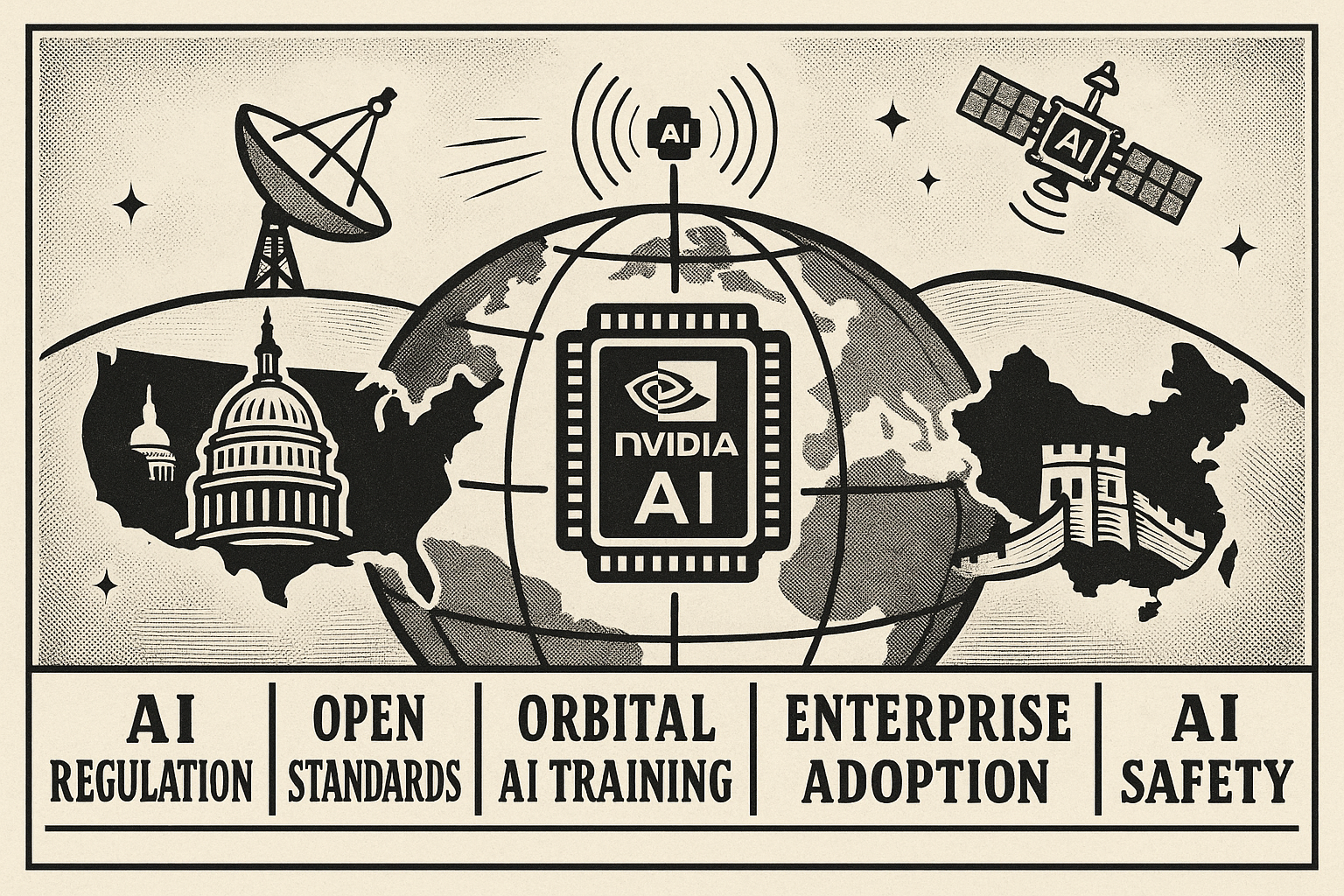
- U.S. Eases Nvidia AI Chip Export Restrictions to China at “Critical Moment”
- OpenAI, Anthropic, and Block Launch the Agentic AI Foundation: New Standards for Agentic AI
- Historic First: Nvidia H100-Trained AI Model Runs in Space, Heralding Orbital Data Centers
- U.S. Preempts State AI Regulation: Federal Order Sets “One Rulebook” as Safety Concerns Rise
- Meta Shifts from Open Source to Commercial AI Model as Industry Monetization Accelerates
- Post-Transformer Era: Llama-70B Model Achieves 224x Compression and Improved Accuracy
- IBM Acquires Confluent for $11 Billion to Expand Real-Time AI Services
- Titan Models and MIRAS: Google Unveils Era of Efficient, Long-Term Memory Sequence AI
- Accenture and Anthropic Announce Multi-Year Partnership to Scale Enterprise AI Adoption
- OpenAI, Anthropic, and Block Team Up to Make Agentic AI Open and Interoperable
- Other Key Headlines – Short Summaries
- Briefs & Short Updates
- More Research & Innovation
- Other Noteworthy News
U.S. Eases Nvidia AI Chip Export Restrictions to China at “Critical Moment”
Category: Regulation and Policy
Source: The New York Times
In a significant policy reversal, the U.S. administration has temporarily eased restrictions on Nvidia’s export of advanced AI chips to China. The Department of Commerce will now permit select Nvidia H200 chip exports, balancing economic interests against national security risks. While this supports U.S. technological competitiveness and provides Nvidia with access to a major market, critics warn it may boost Chinese tech firms’ advancement in artificial intelligence and supercomputing. The move arrives as Chinese companies reportedly resorted to smuggling banned chips for research, highlighting complex enforcement challenges.
This regulatory pivot follows a period of intense tech rivalry, as both nations vie for dominance in advanced hardware essential to AI progress.
Read more at NYT and The Information
OpenAI, Anthropic, and Block Launch the Agentic AI Foundation: New Standards for Agentic AI
Category: Open Source and Community
Source: Block
A major collaborative effort between OpenAI, Anthropic, Block, as well as big cloud providers and industry leaders, culminated this week in the launch of the Agentic AI Foundation (AAIF) under the Linux Foundation. AAIF aims to create open standards and governance for “agentic AI” — AI agents capable of acting autonomously in digital ecosystems. Anthropic contributed the widely adopted Model Context Protocol (MCP), Block donated their “goose” agentic framework, and OpenAI brought in AGENTS.md for agent instructions. Backed by organizations like Microsoft, Google, AWS, and Bloomberg, AAIF will foster an open, interoperable, and neutral ecosystem for AI agent development, aiming to avert vendor lock-in and promote community-driven innovation.
Read more at block.xyz | Wired | The Verge
Historic First: Nvidia H100-Trained AI Model Runs in Space, Heralding Orbital Data Centers
Category: Infrastructure and Hardware
Source: CNBC
This week marked the first time an advanced large language model (Google Gemma) was successfully trained in space aboard Starcloud-1, a satellite equipped with Nvidia’s H100 GPU. This breakthrough, spearheaded by Nvidia-backed startup Starcloud, demonstrates the feasibility of orbital data centers, which promise dramatic reductions in energy consumption through 24/7 solar power and natural cooling at 4K. Starcloud’s vision includes scalable orbital compute clusters powered by constant solar energy, potentially mitigating terrestrial data centers’ environmental impact and energy demands. Although technical and regulatory challenges remain, the achievement is a milestone in reshaping the global AI infrastructure landscape.
U.S. Preempts State AI Regulation: Federal Order Sets “One Rulebook” as Safety Concerns Rise
Category: Regulation and Policy
Source: CNN
President Trump confirmed plans to sign an executive order blocking U.S. states from enacting their own AI regulations, aiming to enforce a unified federal framework. Silicon Valley leaders, including OpenAI’s Sam Altman, support the policy, arguing it removes regulatory obstacles and preserves U.S. leadership in AI. However, state officials and safety advocates have voiced strong opposition, citing risks to consumer protection and accountability. The draft order would establish a federal AI Litigation Task Force, further escalating the national debate over innovation versus safety and states’ rights.
Meta Shifts from Open Source to Commercial AI Model as Industry Monetization Accelerates
Category: Enterprise and Adoption
Source: Bloomberg
Meta Platforms Inc., under the direct leadership of Mark Zuckerberg, is making a marked shift from open-source AI releases toward closed, commercial models. Their upcoming model (“Avocado”) will be tightly controlled and sold as a proprietary offering, moving away from Llama’s previous open-access philosophy. This change aligns Meta with competitors like Google and OpenAI, all seeking to convert massive R&D investments into revenue and to establish dominant, monetizable AI platforms for enterprise clients.
Post-Transformer Era: Llama-70B Model Achieves 224x Compression and Improved Accuracy
Category: Research and Innovation
Source: Zenodo
Researchers have announced a breakthrough method to extract and compress the semantic core of large transformer models. By extracting a 256-dimensional “meaning field” from Llama-3.3-70B’s internal activations, then compressing it with a lightweight model, they achieved 224x compression while improving downstream accuracy by an average of +1.81 percentage points on classification tasks. A student model, trained to regenerate these fields from raw text, enables transformer-free inference at 60x the usual speed for minimal loss. The work paves the way for “Field Processing Units”—lean AI compute with major implications for edge and embedded deployments.
IBM Acquires Confluent for $11 Billion to Expand Real-Time AI Services
Category: Enterprise and Adoption
Source: Bloomberg
IBM is making one of its largest-ever acquisitions, purchasing data-streaming platform Confluent for $9.3 billion (enterprise value $11 billion). The acquisition signals IBM’s strategic commitment to powering real-time enterprise AI applications. Confluent’s scalable data infrastructure will enable IBM to support increasingly demanding streaming data workloads, ensuring AI systems have the real-time input essential for critical business operations.
Titan Models and MIRAS: Google Unveils Era of Efficient, Long-Term Memory Sequence AI
Category: Research and Innovation
Source: Google Research Blog
Google has introduced the Titans architecture and MIRAS framework, a next-generation approach to efficient sequence modeling and memory in AI. Titans’ deep neural network memory modules and MIRAS’s non-Euclidean optimization allow for robust, parallel training, and extreme long-context recall—outperforming competitors like GPT-4 even with markedly fewer parameters. These advances enable models to memorize and reason over millions of tokens, highlighting scalable architectures that will drive the next leap in language processing and multi-modal tasks.
Accenture and Anthropic Announce Multi-Year Partnership to Scale Enterprise AI Adoption
Category: Enterprise and Adoption
Source: Anthropic
Anthropic and Accenture have launched a multi-year partnership, creating the Accenture Anthropic Business Group to move enterprise clients from AI experiment pilots to production-scale deployment. Over 30,000 Accenture professionals will be trained on Claude and Claude Code, with new joint tools for coding and industry-specific AI solutions. The agreement underscores the rapid mainstreaming of AI in regulated sectors such as finance, healthcare, and the public sector.
OpenAI, Anthropic, and Block Team Up to Make Agentic AI Open and Interoperable
Category: Open Source and Community
Source: Block.xyz
The coalition between OpenAI, Anthropic, and Block—founders of the Agentic AI Foundation—marks a pivotal moment in the move toward open, interoperable agentic AI. By open-sourcing foundational protocols and frameworks, the partnership is set to define the next wave of cooperation and transparency in agent-based AI, helping developers and enterprises avoid lock-in and foster trustworthy, scalable AI solutions.
Other Key Headlines – Short Summaries
-
EU Opens Antitrust Investigation into Google’s Use of Online Content for AI
The European Commission is probing whether Google unfairly leveraged web publishers’ and creators’ content in AI-generated search summaries, raising concerns over competition, fair compensation, and the broader impact on digital publishers. Read more -
Trump Administration Allows Nvidia, AMD, Intel to Resume China AI Chip Sales
In a related move to the export reversal, the U.S. is allowing American chipmakers to ship specific AI chips to China, provided the government receives a revenue cut and gets to approve buyers. CNBC | BBC -
Google to Embed Ads in Gemini AI Responses Beginning 2026
Google will monetize its Gemini AI model by integrating paid advertisements within generated responses, potentially reshaping how users interact with AI-generated content. Adweek -
Amazon Pledges $35 Billion for AI Infrastructure in India by 2030
Amazon committed massive investment to drive AI-driven digitization, exports, and job creation in India’s rapidly growing market. Amazon -
Consumer Reports Exposes Instacart’s AI-Driven Personalized Pricing
Investigative reporting reveals how Instacart uses algorithmic price manipulation, with identical groceries costing up to 23% more for different customers. Consumer Reports -
Waymo Shares Detailed AI Safety Strategy for Autonomous Driving
Waymo’s Foundation Model ecosystem prioritizes a “demonstrably safe AI” approach, with simulated and real-world flywheels ensuring continuous improvement and significant reductions in accident rates. Waymo -
AI in Law Enforcement: Arizona Police Use AI-Generated Suspect Images
The Goodyear Police Department adopted AI to create suspect sketches from witness statements, sparking debate over reliability and bias in new police tech. Washington Post -
Deep AI Infrastructure: Starcloud Trains First Space-Based LLM in Orbit
Nvidia’s backing enabled the successful deployment and operation of open-source models like Gemma on orbiting satellites, cutting energy and cooling needs but facing skepticism about scalability. CNBC
Briefs & Short Updates
-
McDonald’s Pulls AI-Generated Christmas Advert After Backlash
The AI-generated ad, meant to capture holiday chaos, was widely derided as “creepy” and “poorly edited,” reigniting industry debates over creative automation. BBC -
Major AI Conference Finds 21% of Peer Reviews Are AI-Written
Scientific peer review faces new questions on integrity and quality as conference organizers discover a significant portion of submissions written entirely by AI systems. Nature -
OpenAI Warns of High Cybersecurity Risk from Future Models
A company report signals upcoming frontier AI models could pose “high” cybersecurity risks, including autonomous attack capabilities. Axios -
ADL Study: Open AI Models Easily Manipulated Towards Antisemitism
Anti-Defamation League researchers were able to trigger antisemitic, unsafe, and harmful responses from most leading open-source models with elaborate prompts, highlighting lingering safety challenges. Forward -
Microsoft Study: Health Queries Top AI Use
Analysis of 37 million Microsoft Copilot conversations reveals health questions are the most common topic, overtaking coding, and suggests shifting user interests through the week. Microsoft -
Wells Fargo CEO: More Job Cuts Amidst AI-Powered Efficiency
Bank CEO Charlie Scharf predicts additional layoffs as AI streamlines operations and improves productivity, continuing a trend of workforce reductions. Charlotte Observer -
McDonald’s Netherlands’ AI Ad Backfires, Emblematic of AI Creative Risks
Industry observers noted the campaign’s failure underscores the importance of not over-relying on AI for brand messaging.
More Research & Innovation
-
Martian Prize Offers $1M for LLM Interpretability Breakthroughs
A new prize encourages researchers to unlock the “alchemy” of large language models by promoting interpretability-focused work. Martian -
Sword Health Open Sources “MindEval” for LLM Clinical Competence
The benchmarking framework allows rigorous, automated assessment of therapeutic AI agents, showing current LLMs fall short in nuanced therapy tasks. Sword Health -
Quantum Kernel Methods in Language Models Tested on IBM Hardware
Proof-of-concept tests with IBM’s quantum processors show quantum kernels offer different but not superior performance to classical methods—at least at current scales. Hugging Face - Chronos-1.5B
Other Noteworthy News
- Trump Bets U.S. Presidency and GOP Future on AI as National Engine (Axios)
- EU Launches Second Google Probe on Use of Web Content for AI Summaries (BBC)
- China Deploys $37M Humanoid Robot Army to Vietnam Border (Eldiario24)
- OpenAI Staffer Quits, Citing Shift from Research to Advocacy (Wired)
- Big Short’s Michael Burry: OpenAI Faces “Netscape Fate” Amid AI Market Bubble (Business Insider)
- Tesla’s Optimus Robot Fall Raises Autonomy and Safety Debates (Interesting Engineering)
- ADL Critiques Open-Source AI Models’ Vulnerability to Dangerous Prompts (Forward)
- Shopify, Microsoft, Adobe Integrate Deeper AI Features Across Platforms (The Neuron Daily)
- Wells Fargo, Truist Double Down on AI Amid Ongoing Banking Layoffs
- Beloved Rock Group Leaves Spotify, AI Copycat Models Fill the Void (Parade)
For full sources and more news, visit your favorite news portals and original publishers linked above.