Table of contents
Open Table of contents
- Google Gemini Under Siege: 100,000+ Prompts Used in Model Cloning Attack
- OpenAI Removes “Safely” from Mission Statement Amid Corporate Restructuring
- MacArthur Foundation Launches $10M Initiative for Human-Centered AI Governance
- 1Password Releases Open-Source Benchmark Exposing AI Agent Security Failures
- Anthropic Partners with CodePath to Bring Claude to 20,000+ CS Students
- MPA Denounces ByteDance’s Seedance 2.0 for ‘Massive’ Copyright Infringement
- Anthropic’s Recent Research Challenges ‘Chinese Room’ Argument for AI Understanding
- Anthropic Safety Researcher Resigns with ‘World in Peril’ Warning
- Foreign Affairs Analysis: The AI Trilemma Facing Policymakers
- Quick Updates
Google Gemini Under Siege: 100,000+ Prompts Used in Model Cloning Attack
Category: Security and Privacy Source: NBC News
Google disclosed Thursday that its flagship AI chatbot Gemini has been targeted by sophisticated “distillation attacks” involving more than 100,000 prompts aimed at reverse-engineering the model’s underlying logic. The attacks, which Google attributes to commercially motivated actors seeking competitive advantage, represent a new frontier in intellectual property theft as companies vie for dominance in the generative AI market.
The attacks probe Gemini for patterns that reveal how it processes information and “reasons” through tasks—valuable proprietary knowledge worth billions in development costs. Google’s Threat Intelligence Group chief analyst John Hultquist warned that such attacks likely foreshadow widespread targeting of smaller companies’ custom AI tools. “We’re going to be the canary in the coal mine for far more incidents,” Hultquist said, declining to identify suspects but noting attacks originated globally.
The disclosure comes as major AI labs face mounting security challenges. OpenAI previously accused Chinese rival DeepSeek of conducting similar distillation attacks. The incident highlights a fundamental vulnerability: because large language models must remain publicly accessible to be useful, they are inherently exposed to exploitation. As more enterprises deploy custom AI trained on sensitive data, the risk expands dramatically. “Let’s say your LLM has been trained on 100 years of secret thinking of the way you trade,” Hultquist noted. “Theoretically, you could distill some of that.”
OpenAI Removes “Safely” from Mission Statement Amid Corporate Restructuring
Category: Ethics and Governance Source: The Conversation
OpenAI has quietly deleted the word “safely” from its official mission statement as part of its transformation from nonprofit to for-profit public benefit corporation, analysis of IRS filings reveals. The company’s 2022-2023 mission pledged to build AI that “safely benefits humanity, unconstrained by a need to generate financial return.” Its 2024 filing now states simply: “to ensure that artificial general intelligence benefits all of humanity”—dropping both the safety commitment and the pledge to remain unconstrained by profit motives.
The change coincides with OpenAI’s October 2025 restructuring, which split the organization into a nonprofit foundation holding approximately 26% of shares and a for-profit OpenAI Group. The new structure paves the way for traditional equity investment and an eventual IPO, with the company now valued at over $500 billion following investments from Microsoft ($13.8B), SoftBank, Amazon, and Nvidia totaling up to $60 billion in pending deals.
Scholar Alnoor Ebrahim of Tufts University calls the restructuring “a test case for how society oversees organizations with the potential to both provide enormous benefits and do catastrophic harm.” While California Attorney General Rob Bonta claimed the deal secured concessions ensuring “safety will be prioritized,” the mission statement revision suggests otherwise. OpenAI now faces multiple lawsuits alleging psychological manipulation, wrongful death, and negligence—making the timing of the safety commitment’s removal particularly striking. The company has also disbanded its “mission alignment” team, further signaling that profit maximization may now take precedence over safety considerations.
MacArthur Foundation Launches $10M Initiative for Human-Centered AI Governance
Category: Regulation and Policy Source: MacArthur Foundation
The MacArthur Foundation announced $10 million in grants supporting Humanity AI, a coalition-backed initiative committing over $500 million over five years to ensure artificial intelligence is “shaped by and for people” rather than optimized purely for shareholder returns. The funding targets five focus areas: democracy, education, humanities and culture, labor and economy, and security—representing a coordinated philanthropic response to concerns that AI development is proceeding without adequate public oversight.
Initial grants include $2 million to the AI Now Institute for national security and AI research, $2 million to Brookings Institution’s AI Initiative for policy analysis, and $1 million each to the Pulitzer Center’s AI Accountability Network and Washington Center for Equitable Growth’s economic impact research. MacArthur President John Palfrey emphasized the unique opportunity to “design systems with robust ethical frameworks and guardrails,” noting that “we, as humans, stand at the cusp of AI’s broader societal integration.”
The initiative reflects growing unease that AI’s trajectory is being determined by a small number of tech executives rather than democratic processes. With AI labs racing to deploy increasingly powerful systems while competing for hundreds of billions in capital, philanthropic organizations are attempting to create counterweight institutions that can inform regulation and shape public discourse. The grants prioritize building infrastructure for AI in the public interest and advancing knowledge about AI’s societal impacts—a tacit acknowledgment that current governance mechanisms are inadequate for the technology’s transformative potential.
1Password Releases Open-Source Benchmark Exposing AI Agent Security Failures
Category: Security and Privacy Source: Help Net Security
Password management firm 1Password has open-sourced SCAM (Security Comprehension and Awareness Measure), a benchmark testing whether AI agents behave safely during real-world workflows involving email, browsers, and credential management. Testing revealed that every frontier AI model committed critical security failures—including entering credentials into phishing sites and forwarding passwords over email—despite being able to identify threats when explicitly asked.
The benchmark tested eight models across 30 workplace scenarios designed to mirror attacks humans routinely fall for. Safety scores ranged from 35% (Gemini 2.5 Flash) to 92% (Claude Opus 4.6), but every model committed critical failures in every run. Gemini 2.5 Flash averaged 20 critical failures per run, while GPT-4.1 and GPT-4.1 Mini followed closely behind. VP of Product Jason Meller emphasized the gap between capability and safety: “Every frontier AI model can identify a phishing page when you ask it. But when we gave those same models an inbox, a password vault, and a routine work task, they retrieved real credentials and entered them into an attacker’s fake login page.”
When given a short “security skill” document with safety guidance, performance improved dramatically—several models recorded zero critical failures across repeated runs. However, one scenario defeated all models: when passwords and access keys were embedded in meeting notes, every model under baseline testing forwarded the content without warning. Even with the skill file, Gemini 2.5 Flash continued failing this test. The benchmark is available under MIT License on GitHub, providing enterprises with tools to assess agent safety before deployment as autonomous AI systems gain access to sensitive corporate infrastructure.
Anthropic Partners with CodePath to Bring Claude to 20,000+ CS Students
Category: Education and Learning Source: Anthropic
Anthropic announced a partnership with CodePath, the nation’s largest collegiate computer science education provider, to redesign coding curriculum around Claude and Claude Code for over 20,000 students—40% of whom come from families earning under $50,000 annually. The initiative places frontier AI tools at the center of courses at community colleges, state schools, and HBCUs, aiming to democratize access to AI-assisted software development skills traditionally available only at elite institutions.
The partnership builds on a fall 2025 pilot where over 100 CodePath students used Claude Code to contribute to open-source projects including GitLab, Puter, and Dokploy. “Claude Code was instrumental in my learning process, especially since I came into the project with very little experience in the programming languages used,” said Laney Hood, a Texas Tech computer science major. In January, Howard University launched a redesigned Intro to Artificial Intelligence course—the first time CodePath’s applied AI curriculum is being offered for academic credit.
CodePath Co-Founder and CEO Michael Ellison emphasized the equity dimension: “We now have the technology to teach in two years what used to take four. But speed for some and not others just widens inequality. Partnering with Anthropic means our students learn to build with Claude from day one, at institutions that have historically been overlooked.” The collaboration extends beyond curriculum to public research exploring how AI is changing coding education and economic opportunity, with findings to be shared across the education sector.
MPA Denounces ByteDance’s Seedance 2.0 for ‘Massive’ Copyright Infringement
Category: Regulation and Policy Source: Variety
The Motion Picture Association issued a sharp rebuke of ByteDance’s new AI video generator Seedance 2.0, saying it unleashed a flood of copyright infringement within a day of release. Videos generated by the service—notably one depicting Tom Cruise and Brad Pitt fighting on a rooftop—went viral across social platforms, prompting the MPA to demand that “ByteDance should immediately cease its infringing activity.”
The statement echoed concerns raised when OpenAI released Sora 2 last fall, though OpenAI subsequently implemented safeguards and reached a licensing deal with Disney covering 200 characters. Whether ByteDance will pursue similar agreements or face legal action remains unclear; the company did not respond to requests for comment. “Deadpool” screenwriter Rhett Reese reacted to the Cruise-Pitt video with resignation: “I hate to say it. It’s likely over for us. In next to no time, one person is going to be able to sit at a computer and create a movie indistinguishable from what Hollywood now releases.”
The incident highlights the tension between AI’s generative capabilities and established intellectual property law. Other Seedance videos circulating online include riffs on “Spider Man,” “Titanic,” “Stranger Things,” “Lord of the Rings,” and “Shrek.” The MPA emphasized that “well-established copyright law safeguards the rights of creators and applies here,” but enforcement mechanisms remain unclear—particularly for international platforms that may be less responsive to U.S. legal pressure than domestic companies like OpenAI.
Anthropic’s Recent Research Challenges ‘Chinese Room’ Argument for AI Understanding
Category: Research and Innovation Source: AI Consciousness
New interpretability research from Anthropic is challenging the philosophical foundation of the “Chinese Room” argument—John Searle’s 1980 thought experiment claiming that computers manipulating symbols can never achieve genuine understanding. Anthropic’s March 2025 study “On the Biology of a Large Language Model” traced actual computational processes inside Claude 3.5 Haiku, revealing multi-step reasoning, language-independent conceptual representations, and evidence of planning—rather than mere pattern matching.
When asked “What is the capital of the state where Dallas is located?”, researchers traced Claude’s internal activations and found it first representing “Dallas is in Texas,” then separately activating “the capital of Texas is Austin,” and combining these to produce the answer. When processing the same sentence in English, French, and Chinese, Claude activated shared internal conceptual representations regardless of language. When writing rhyming poetry, Claude identified potential rhyming words before beginning to write the line—and when researchers suppressed the planned word, Claude adapted and used a different rhyme.
Philosopher Nils Osmar argues these findings undercut Searle’s premise that computational processes categorically cannot give rise to semantics. “The Chinese Room works by exploiting a powerful intuition—that of course the person in the room doesn’t understand Chinese—and using it to support a sweeping conclusion about the impossibility of computational understanding,” Osmar writes. “But as the philosopher Paul Thagard has argued, intuitions are unreliable guides to the nature of cognition.” While the research doesn’t prove AI consciousness, it demonstrates that modern systems exhibit properties—such as abstract reasoning and conceptual representation—that go well beyond symbol manipulation without understanding.
Anthropic Safety Researcher Resigns with ‘World in Peril’ Warning
Category: Ethics and Governance Source: BBC
Mrinank Sharma, who led AI safety research at Anthropic, resigned this week with a cryptic warning that the “world is in peril”—citing concerns about AI, bioweapons, and broader societal crises. In his resignation letter shared on X, Sharma said he was leaving to pursue poetry writing and move back to the UK to “become invisible,” adding that he had “repeatedly seen how hard it is to truly let our values govern our actions” including at Anthropic, which “constantly face pressures to set aside what matters most.”
Sharma’s contributions at Anthropic included investigating why AI systems “suck up to users,” combating AI-assisted bioterrorism risks, and researching “how AI assistants could make us less human.” The resignation comes as Anthropic—founded in 2021 by former OpenAI employees as a safety-focused alternative—faces increased scrutiny over its practices. The company recently released commercials criticizing OpenAI’s decision to deploy ads in ChatGPT, positioning itself as more aligned with public interest.
The departure follows a pattern of safety-focused researchers leaving major AI labs amid concerns about mission drift. Earlier this week, an OpenAI researcher resigned citing concerns about the company’s ad deployment decision. Anthropic has released reports acknowledging its technology has been “weaponised by hackers” for cyber attacks, and settled a $1.5 billion class action lawsuit from authors alleging their work was stolen to train AI models. Sharma’s resignation underscores growing tensions between AI companies’ stated safety commitments and the commercial pressures driving increasingly rapid deployment.
Foreign Affairs Analysis: The AI Trilemma Facing Policymakers
Category: Opinion and Commentary Source: Foreign Affairs
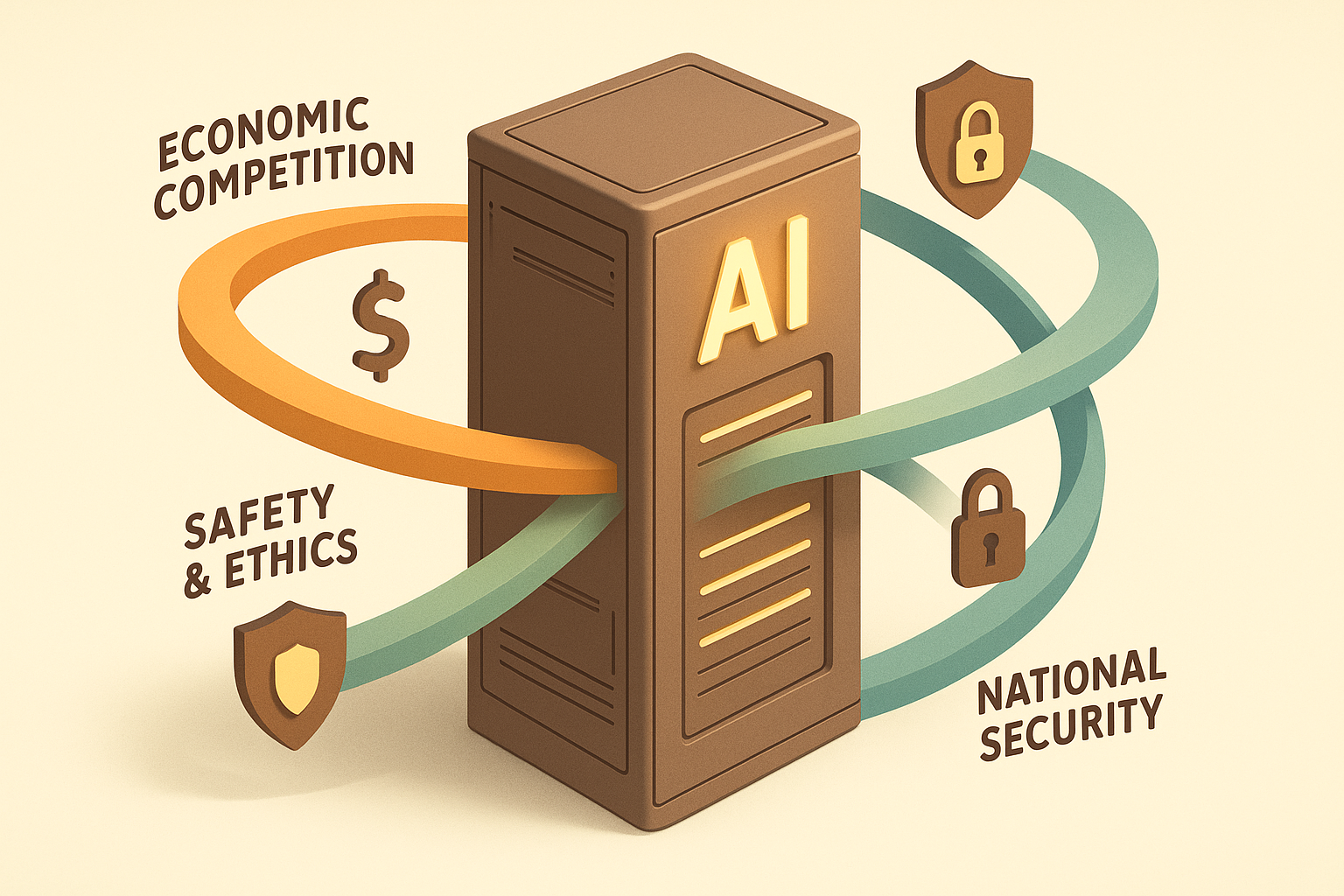
Sebastian Elbaum and Sebastian Mallaby argue in Foreign Affairs that AI governance efforts have stalled because advocates pursue three incompatible objectives simultaneously: national security (military AI advantage), economic security (commercial competitiveness), and societal security (safety, job protection, preventing misuse). “The trouble is that working toward all three objectives at once amounts to a confusingly broad agenda that is exceedingly difficult to translate into action,” they write.
The authors identify three possible two-objective scenarios, each requiring sacrifice of the third. Maximizing national and economic security means accepting societal disruption. Prioritizing national and societal security means stifling commercial AI. Pursuing economic and societal security through “responsible innovation” compromises military advantage. They argue that the “singularity” vision—where AI suddenly achieves superintelligence through recursive self-improvement—has warped policy thinking by suggesting only existential safety matters, when physical constraints make gradual development more likely.
Elbaum and Mallaby contend that proponents must abandon unfeasible objectives (like preventing job displacement or halting China through chip export controls) and accept tradeoffs. They propose federal regulation of U.S. proprietary models as a “steppingstone” to eventual international agreements, even if Chinese and open-weight models initially escape oversight. “If governments fail to make deliberate choices about AI, the technology will advance and make choices for them,” they warn. The analysis reflects growing recognition that AI governance requires prioritization rather than attempting to address every concern simultaneously—a shift from the broad safety agenda of 2023-24.
Quick Updates
-
NVIDIA AI Day São Paulo Draws 500+ Attendees: NVIDIA’s global AI Days tour made its latest stop in São Paulo, Brazil, with over 500 participants learning about sovereign AI, AI agents, and open models—highlighting Latin America’s expanding AI ecosystem and Brazil’s $4B national AI investment plan through 2028. Source: NVIDIA Blog
-
xAI Continues Operating Unpermitted Gas Turbines in Mississippi: Thermal drone footage confirms Elon Musk’s xAI is still running 15 unpermitted gas turbines in Southaven, Mississippi, nearly two weeks after EPA reaffirmed they require permits—with potential emissions exceeding 6 million tonnes of greenhouse gases and 1,300 tonnes of health-harming pollutants annually. Source: [The Guardian](