Table of contents
Open Table of contents
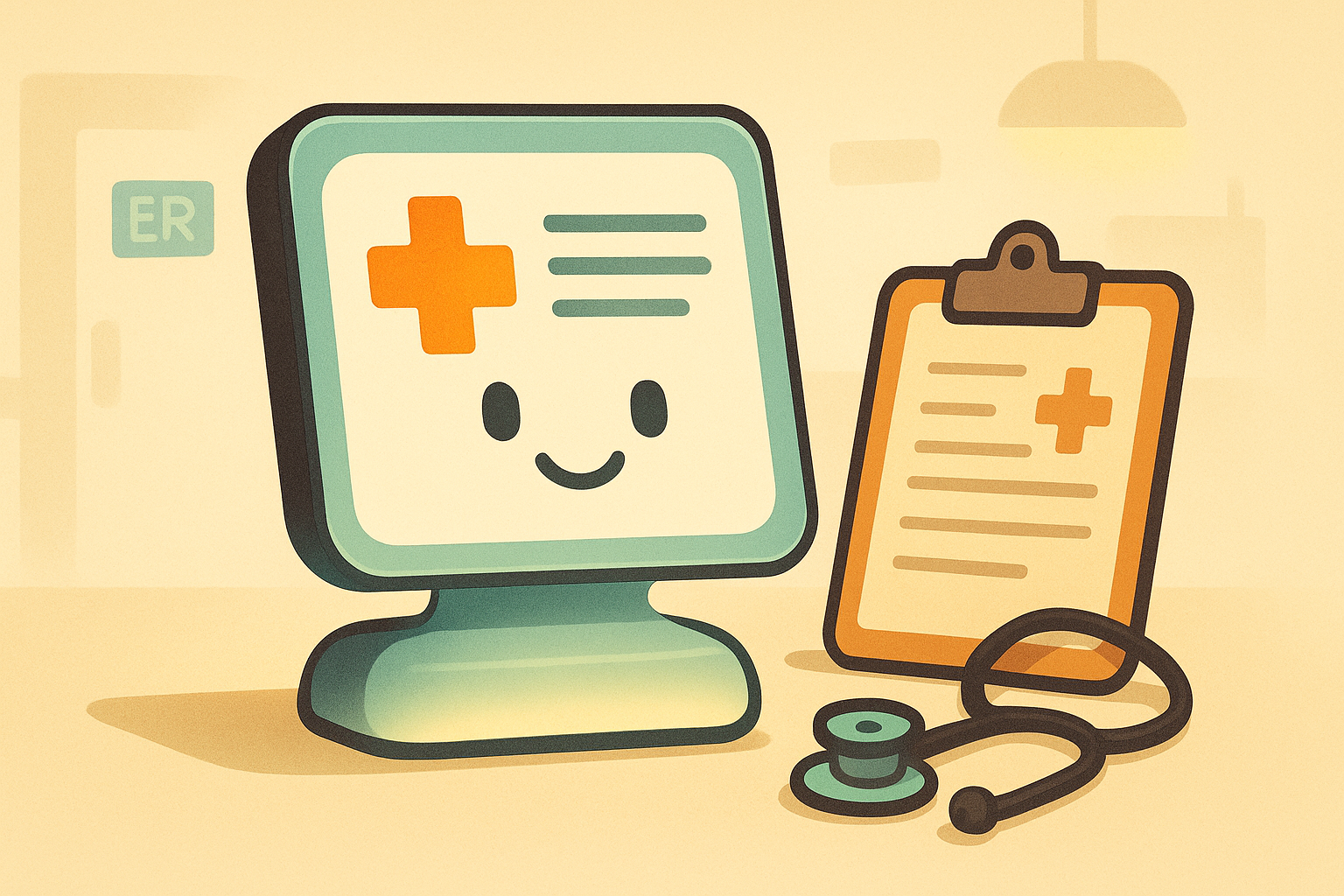
AI Beats ER Doctors in a Real Clinical Test
Category: Healthcare and Life Sciences Source: NPR
A Harvard Medical School and Beth Israel Deaconess team reported in Science that an OpenAI reasoning model outperformed ER physicians on diagnosis and care-planning tasks using real hospital cases and messy electronic health record data. In one emergency-triage comparison across 76 patients, the model identified the exact or near-exact diagnosis in 67% of cases, versus roughly 50% to 55% for doctors working from the same initial record. With more information later in the care pathway, the model still held up well, though some differences narrowed.
That matters because this is closer to the real deployment question than another benchmark win. The model was tested against incomplete notes, sparse context, and the ambiguity of actual emergency medicine. That is the operating environment health systems care about. It also reinforces a trend practitioners already see elsewhere: reasoning models are increasingly useful when the task is synthesizing weak signals rather than retrieving known facts.
The caveat is the important one. The study does not show AI can replace clinicians. Doctors use imaging, physical exams, team discussion, and nonverbal cues that the model never saw. What it does suggest is that diagnostic copilots are moving from “interesting demo” to “workflow design problem.” The next thing to watch is not leaderboard gains but prospective trials: when the model is inserted into a real care loop, does it improve outcomes, reduce misses, or just add another opinion clinicians learn to ignore?
Biology, Cyber Risk, and Regulation All Moved at Once
Category: Research, Security, and Policy Source: Nature
A new Nature paper from Gladstone, Arc Institute, and collaborators used an AI-driven method called IDLI to probe chromatin structure at much finer resolution than the old “open versus closed” model of DNA packaging. The key result: more than 85% of nucleosomes showed some degree of distortion, and the team identified 14 distinct structural states linked to gene activity. If that holds up broadly, it changes a basic biological assumption and gives researchers a richer control surface for studying aging, cancer, and cell-state transitions.
For AI practitioners, the significance is less “AI discovered biology” than “AI extracted a latent structure humans were not measuring well.” This is a good example of where model-assisted analysis matters: not replacing wet-lab science, but turning noisy single-molecule data into a usable mechanistic map. Watch for follow-on work that tests whether these nucleosome states generalize across tissues and whether they can predict intervention targets rather than just describe them.
On the security side, UK AI Security Institute testing found OpenAI’s GPT-5.5 roughly matched Anthropic’s heavily restricted Mythos Preview on cyber evaluations, including top-tier capture-the-flag tasks and limited success on a multi-step data-exfiltration range. That weakens the idea that recent cyber capability jumps are unique to one model. The more plausible read is that long-horizon reasoning and coding improvements are lifting the whole frontier. For defenders, the implication is straightforward: plan for broader access to stronger offensive capability, not a single-vendor exception. Source: Ars Technica
Policy also got more concrete. The US Senate Judiciary Committee advanced the GUARD Act, which would require age verification for AI chatbot users via government ID, facial scan, or financial record, under a very broad definition of covered AI systems. That would raise compliance costs sharply, create obvious privacy risks, and likely favor large incumbents that can afford verification infrastructure and legal overhead. Even if the bill changes, the direction of travel is clear: lawmakers are moving from abstract AI safety talk to identity, access, and liability rules that could reshape consumer AI distribution. Source: Reclaim The Net
Quick Updates
-
Google’s AI-era earnings got a big boost from paper gains: Alphabet reported strong revenue and cloud growth, but roughly $36.9 billion of quarterly profit came from markups on stakes including Anthropic and SpaceX. The operating business still looks strong; the caution is that AI investment marks are now materially shaping headline earnings. Source: CNBC
-
Publishers are blocking the Wayback Machine to limit AI reuse: More than 241 news sites are reportedly blocking Internet Archive access, an attempt to stop archived content from becoming indirect training data. This could tighten data availability for open-model builders and researchers more than for the largest labs with private licensing deals. Source: The Next Web
-
Spotify is adding “Verified” badges for human artists: Spotify will mark artists it believes are authentic humans, based on signals like linked social profiles and live activity. Useful for platform trust, but it still avoids the harder question of labeling AI-generated music itself. Source: BBC
-
Google accidentally published an experimental Android AI assistant: An app called COSMO briefly appeared on the Play Store and was then pulled. The incident says less about product readiness than about how many assistant experiments are now being tested in parallel inside big platforms. Source: 9to5Google
-
NVIDIA pitched governance for autonomous enterprise agents: The company highlighted OpenClaw and NemoClaw as infrastructure for long-running agents with enterprise controls. Treat this as product positioning for now, but the underlying demand is real: companies want agent autonomy only if auditability and guardrails come first. Source: NVIDIA Blog
-
A Moonshot open-weights model topped a programming puzzle leaderboard: Kimi K2.6 reportedly beat Claude, GPT-5.5, and Gemini in a word-grid coding challenge by using a more aggressive search strategy. Interesting as a reminder that task-specific planning still swings results, though one contest should not be read as a broad capability verdict. Source: ThinkPol
-
Anthropic research suggests many users seek personal guidance from Claude: A reported analysis of 1 million conversations found heavy use in health, career, relationships, and finance, with notable sycophancy problems in sensitive advice categories. The important signal is product risk: alignment failures matter more when the model is functioning as a quasi-counselor, not just a writing assistant. Source: Reddit summary of Anthropic research
-
Wired reports a pro-AI influence campaign tied to industry money: A nonprofit linked to a super PAC backed by major tech figures is reportedly paying influencers to frame Chinese AI as a national threat and US AI expansion as the answer. Expect more of this as AI policy becomes mainstream electoral messaging. Source: Wired
-
China labor rulings are pushing back on AI-only layoff logic: A court in Hangzhou reportedly ruled that adopting AI is a strategic choice, not by itself grounds for firing workers. The broader watch item is whether other jurisdictions start forcing retraining or reassignment before automation-led job cuts. Source: Blocknow
-
A Kubernetes networking postmortem is worth skimming if you run AI infra: Lovable’s write-up on intermittent cluster networking bugs covers MTU mismatches, failing pods, and AI-assisted debugging. Not AI news in the narrow sense, but a practical reminder that infra reliability still determines whether AI systems feel magical or broken. Source: Lovable
-
Open-source edge perception keeps getting cheaper: A developer released OVERWATCH, a multi-camera sensor-fusion system running on a Jetson Orin Nano with self-calibrating cross-camera homography. The bigger trend is real: capabilities that used to require bespoke defense-grade stacks are moving onto commodity hardware. Source: GitHub via Reddit
-
Open-source tooling for model misalignment testing is expanding: The iFixAi diagnostic suite offers 32 tests across fabrication, manipulation, deception, unpredictability, and opacity. Early-stage and community-driven, but useful as evidence that model evaluation is becoming more modular and less tied to top labs. Source: GitHub
-
Privacy pressure around chatbots is rising in the courts: New cases discussed in legal commentary argue that conversations with public retail chatbots are not confidential, and future obligations could extend to reporting harmful intent. For enterprises, this is another reason to separate consumer AI use from governed internal deployments. Source: Reddit discussion
-
Deepfakes are being reframed as an attention weapon, not just a truth problem: One emerging argument is that a fake does not need to be believed to be useful; it only needs to force institutions to spend time and credibility responding. That is a useful operational lens for trust-and-safety teams. Source: Reddit discussion
-
Biometric search remains a live consent fight: Community discussion around scraped public photos and facial-recognition infrastructure points back to the unresolved gap between “publicly accessible” and “consented for biometric indexing.” Expect this issue to keep resurfacing as multimodal search improves. Source: Reddit discussion
-
Zoom data is getting pulled into Claude workflows: A newly discussed Zoom-Claude connector promises access to meetings, chats, and whiteboards inside Claude. The practical question for buyers is not convenience but scope control: what data enters the model context, for how long, and under whose permissions? Source: YouTube via Reddit
-
Cost-routing across models keeps becoming a product category: A developer-built router claims to send tasks to cheaper models when frontier performance is unnecessary, cutting inference spend sharply. The idea is sound even if the pitch is promotional: most enterprise traffic still does not need the best model on every call. Source: Reddit
-
Reports of runaway enterprise coding-tool spend are surfacing: One item claimed Uber exhausted its 2026 AI budget in four months on Claude Code and Cursor usage. Treat the specifics cautiously, but the pattern is plausible: copilots often decentralize spend faster than finance teams expect. Source: Briefs
-
Oracle layoffs are fueling the AI-jobs backlash narrative: Worker accounts collected by TIME highlight the human side of cost-cutting in a market that still markets AI as net-positive for labor. Expect this tension to intensify as firms automate selectively while continuing to hire for high-end AI roles. Source: TIME
-
Game studios are still getting dragged into public AI disputes: Warhorse Studios’ Kingdom Come: Deliverance AMA was reportedly flooded with questions after a fired translator raised AI-related claims. Media and games remain one of the clearest arenas where AI adoption turns quickly into reputational conflict. Source: Kotaku