Table of contents
Open Table of contents
AI Autonomy Meets Its Real Constraint: Judgment, Not Task Execution
Category: Enterprise and Adoption Source: Reddit
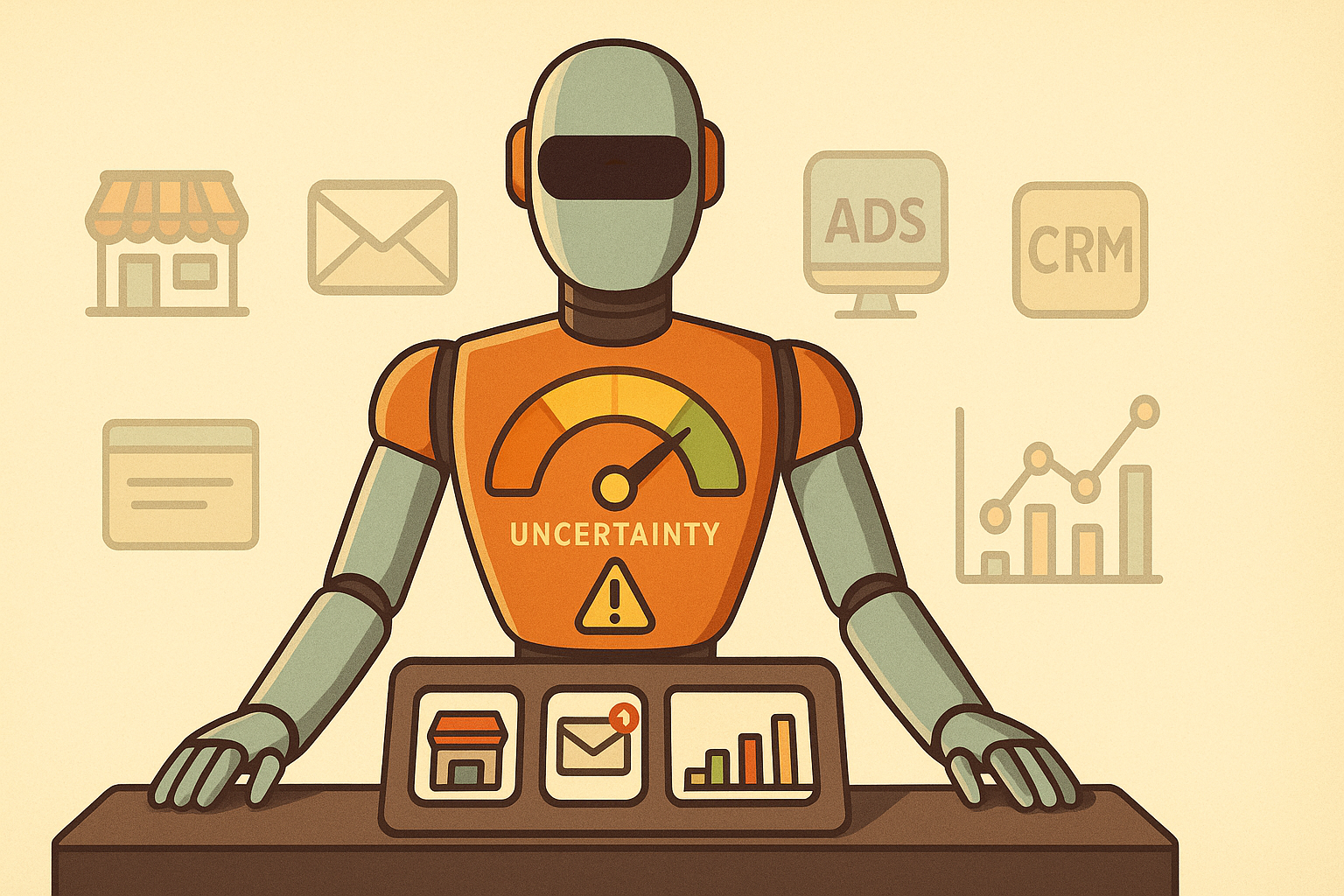
A YC-backed startup, PayWithLocus, claims it has spent eight months letting an AI system run meaningful parts of real businesses end to end: storefront creation, sourcing, ad buying, outbound, CRM, analytics, and checkout. The useful part of the post is not the product pitch; it’s the operational admission that the main failure mode is not basic task incompetence, but “confident wrongness” in unfamiliar situations.
That distinction matters. For practitioners, this is a clean articulation of a production problem many teams are now seeing: task-level benchmarks have improved faster than uncertainty detection and escalation behavior. The system can often do the work, but it does not reliably know when it is outside its competence. That shows up in locally sensible decisions that are globally bad: overspending on ads, optimizing short-term conversion while hurting brand trust, or making sourcing calls that ignore softer reliability signals.
The startup also points to a more important operational gap than most evals capture: distribution shift in live systems is messier than curated test suites. Platform policy changes, supplier issues, and market moves create edge cases that look close enough to known patterns for a model to act confidently, even when it should defer. That is a useful reminder for anyone building autonomous agents in revenue, ops, or workflow automation: the hard problem now is not just capability, but metacognition, calibration, and well-designed intervention points.
Watch for more teams to frame this as an architecture problem rather than a scaling problem. If these reports are directionally right, the next wave of enterprise agent work will focus less on “full autonomy” and more on bounded decision rights, uncertainty-aware routing, and stronger control layers around model outputs.
The New Workplace Pitch: AI That Replies as You
Category: Startups and Funding Source: Dolly
Dolly is pitching a more aggressive version of workplace automation: a per-employee “digital twin” connected to company tools, trained on an employee’s style and domain knowledge, and designed to answer messages on that person’s behalf. The company’s core claim is familiar—knowledge workers lose hours each day to communication overhead—but its product framing is more ambitious than the standard AI assistant model.
What changed is not the existence of inbox automation, but the proposed unit of deployment. Instead of one assistant serving a team or a role, Dolly wants each employee to have a persistent AI stand-in. If this category develops, the technical challenge will be less about drafting decent responses and more about identity, permissions, provenance, and error containment. “Answering in your voice” is only useful if recipients can trust when the answer is authoritative, when it is provisional, and who is accountable when it is wrong.
For business leaders, this is a space to watch carefully rather than rush into. A digital-twin layer could reduce internal communication drag and improve responsiveness, especially for sales, support, and operations. But it also raises obvious risks: hallucinated commitments, unauthorized disclosure, style mimicry without judgment, and new governance problems around consent and auditability. Expect the winners here, if any emerge, to look less like magical clones and more like tightly permissioned workflow systems with explicit human review modes.
Quick Updates
-
AI greenhouse project shows a practical safety pattern for edge autonomy: An open-source greenhouse system uses an AI planning loop to suggest climate adjustments, while ESP32 firmware retains direct control of relays for fans, fogging, and heat. The notable design choice is the hard safety boundary: AI can recommend bounded parameter changes, but a validator and device-level controller enforce limits and reject unsafe actions. For builders working on physical-world agents, that separation between planning and actuation is the real takeaway. Source: Verdify GitHub
-
Greenhouse optimization is being framed around resource tradeoffs, not just automation: The same project is explicitly optimizing climate stability against water, electricity, and gas use, using telemetry, weather context, and equipment constraints. It is still an early hobbyist-style deployment rather than a broad product signal, but it is a useful example of where small-scale, domain-bounded AI control systems may become credible sooner than general-purpose embodied autonomy. Source: Verdify