Table of contents
Open Table of contents
OpenAI Pushes Custom Networking Further Into the AI Stack
Category: Infrastructure and Hardware Source: OpenAI
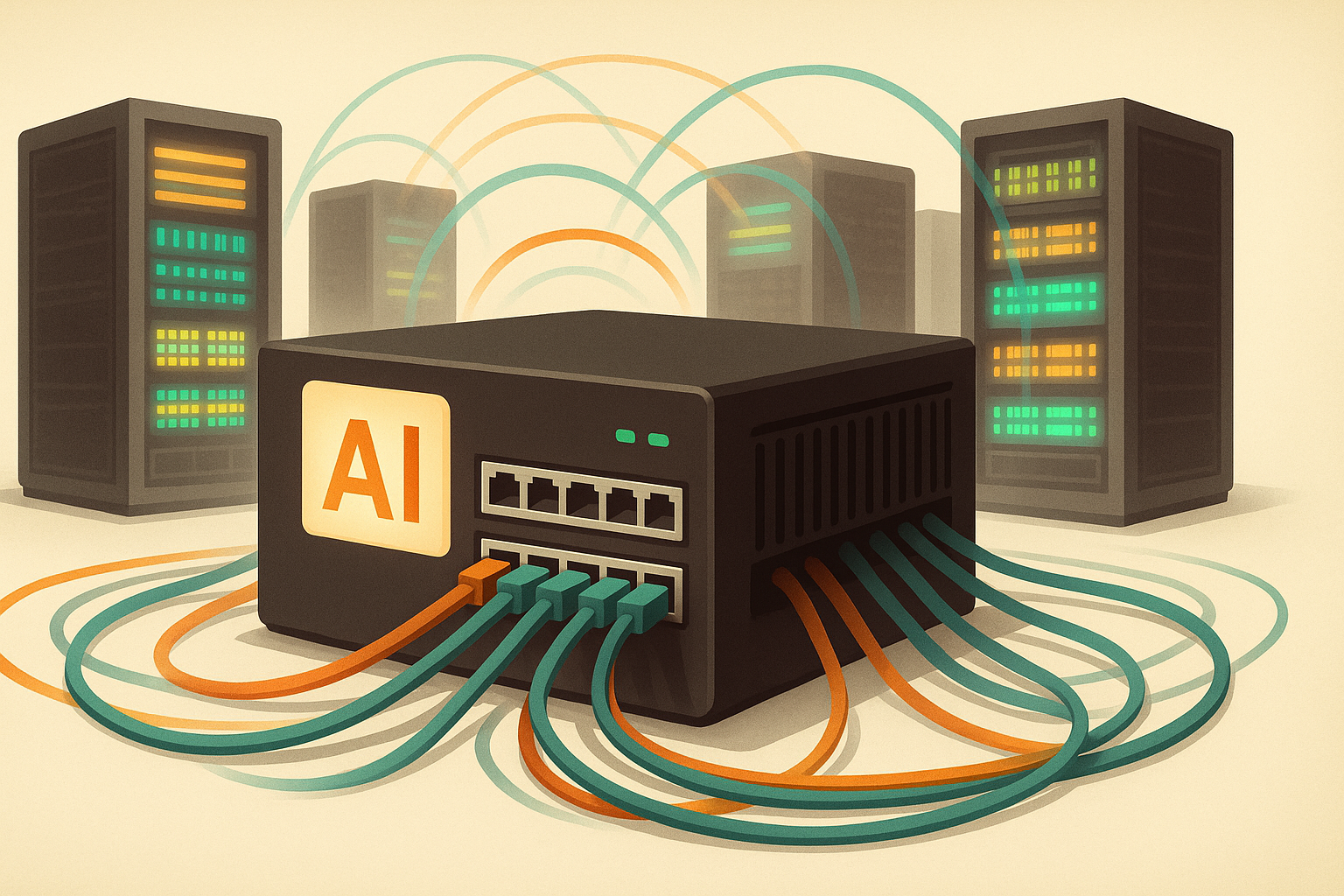
OpenAI introduced MRC, short for Multipath Reliable Connection, a networking protocol designed for large AI training clusters and contributed through the Open Compute Project. The core pitch is practical: keep GPU-to-GPU communication fast and stable even when links are congested or failing. MRC combines multi-plane 800 Gb/s connectivity, adaptive packet spraying across many paths, and source routing on top of RoCE and SRv6.
What matters here is less the acronym than the direction of travel. Frontier labs are no longer treating networking as commodity plumbing. At very large cluster sizes, training performance is increasingly constrained by communication patterns, hotspots, and recovery from failures—not just raw GPU count. If OpenAI is already deploying this on GB200 systems, it suggests the next phase of model scaling depends as much on custom interconnect behavior as on model architecture.
There is also a broader ecosystem signal. By pushing the spec through OCP rather than keeping it entirely internal, OpenAI is nudging hyperscalers, system builders, and networking vendors toward a more AI-specific stack. Watch whether others adopt similar transport-layer designs, especially as clusters move toward 100,000+ GPU scale. That will tell you how much of future AI advantage comes from software and data—and how much comes from owning the fabric underneath.
AI Hiring Gets Real While AI Layoff Logic Looks Thin
Category: Trends and Analysis Source: Fortune
A new Gartner study, reported by Fortune, found that AI-related workforce cuts are common but not strongly tied to better returns. Among large enterprises surveyed, 80% of those piloting AI or autonomous tech reported workforce reductions, yet Gartner found no correlation between those cuts and higher ROI. The message is straightforward: trimming headcount may satisfy a near-term narrative, but it is not the same thing as building a productive AI operating model.
That finding lands alongside a more concrete workforce shift at General Motors. GM cut more than 600 IT workers and said it is refocusing on AI-native development, data engineering, analytics, cloud engineering, model and agent development, and new AI workflows. In other words, some companies are not simply “automating jobs away”; they are swapping one talent mix for another.
The implication for practitioners and leaders is important. The market is moving from generic AI adoption talk to organizational redesign: fewer broad IT roles in some functions, more demand for people who can build data pipelines, integrate models into systems, evaluate agents, and operate cloud-heavy AI stacks. But Gartner’s data is a warning against assuming those shifts automatically pay off. The companies to watch are not the loudest on layoffs—they are the ones showing measurable gains in cycle time, revenue, or operating leverage from AI-specific teams and workflows.
Quick Updates
-
Weekend-scale personal tools keep getting more plausible: A developer used AI tooling to build a sleep-tracking investigation system in roughly eight hours, combining microphones, Raspberry Pi capture, Garmin sleep data, Home Assistant automation, and a local web app. The notable signal is not “AI solved sleep,” but how much custom, niche software is now feasible for a single person without a traditional build cycle. Source: martin.sh
-
GM is explicitly rebalancing toward AI skills: Beyond the broader ROI debate, GM’s move is a concrete example of enterprise demand shifting toward AI-native development, data engineering, cloud platforms, prompt engineering, and agent/model work. Expect more large firms to describe restructuring as a skills transition rather than a pure efficiency play. Source: TechCrunch
-
OpenAI’s secondary sales underscore how mature the private AI capital market has become: Reporting around a 2025 tender offer says more than 600 current and former employees sold shares in a multibillion-dollar transaction before any IPO. The useful takeaway is market structure: major AI companies now have enough private liquidity to reward employees and reset ownership without public listing pressure. Source: The Wall Street Journal
-
Another lawsuit ties chatbot interactions to a mass shooting case: A newly filed federal case in Florida reportedly argues that an AI provider had a duty to detect warning signs and potentially warn about violent intent. This is part of a widening line of litigation shifting from “AI caused harm” claims toward negligence and duty-to-warn theories. Source: Reddit discussion citing court filing
-
Google DeepMind is pitching an AI-native pointer interface: Details are light, but the framing is clear—move from explicit prompting toward a more context-aware, cursor-level interaction model in Chrome and related environments. Watch for actual product behavior, not concept language: the real question is whether this reduces friction better than today’s sidecar copilots. Source: Google DeepMind
-
Prompt-to-app demos keep expanding, but verification still matters: A Reddit post showing a browser-based macOS clone allegedly built from a single prompt is another example of how fast front-end prototyping has become. Impressive for interface generation; less useful as evidence of maintainable software without code quality, architecture, or deployment details. Source: Reddit
-
Consumer video novelty remains a weak signal for business impact: A viral clip of someone using AI to insert himself into Game of Thrones shows how routine synthetic media compositing has become. Technically interesting, but strategically this is table stakes now unless tied to a workflow, toolchain, or monetization model. Source: Reddit
-
Hobbyist robotics continues to test the boundary between prototyping and safety: A Reddit post highlights a drone that tracks targets with a laser using Claude-generated guidance. The project says more about how accessible AI-assisted robotics development has become than about any breakthrough—but it is also a reminder that capability diffusion is outpacing norms and safeguards. Source: Reddit