Table of contents
Open Table of contents
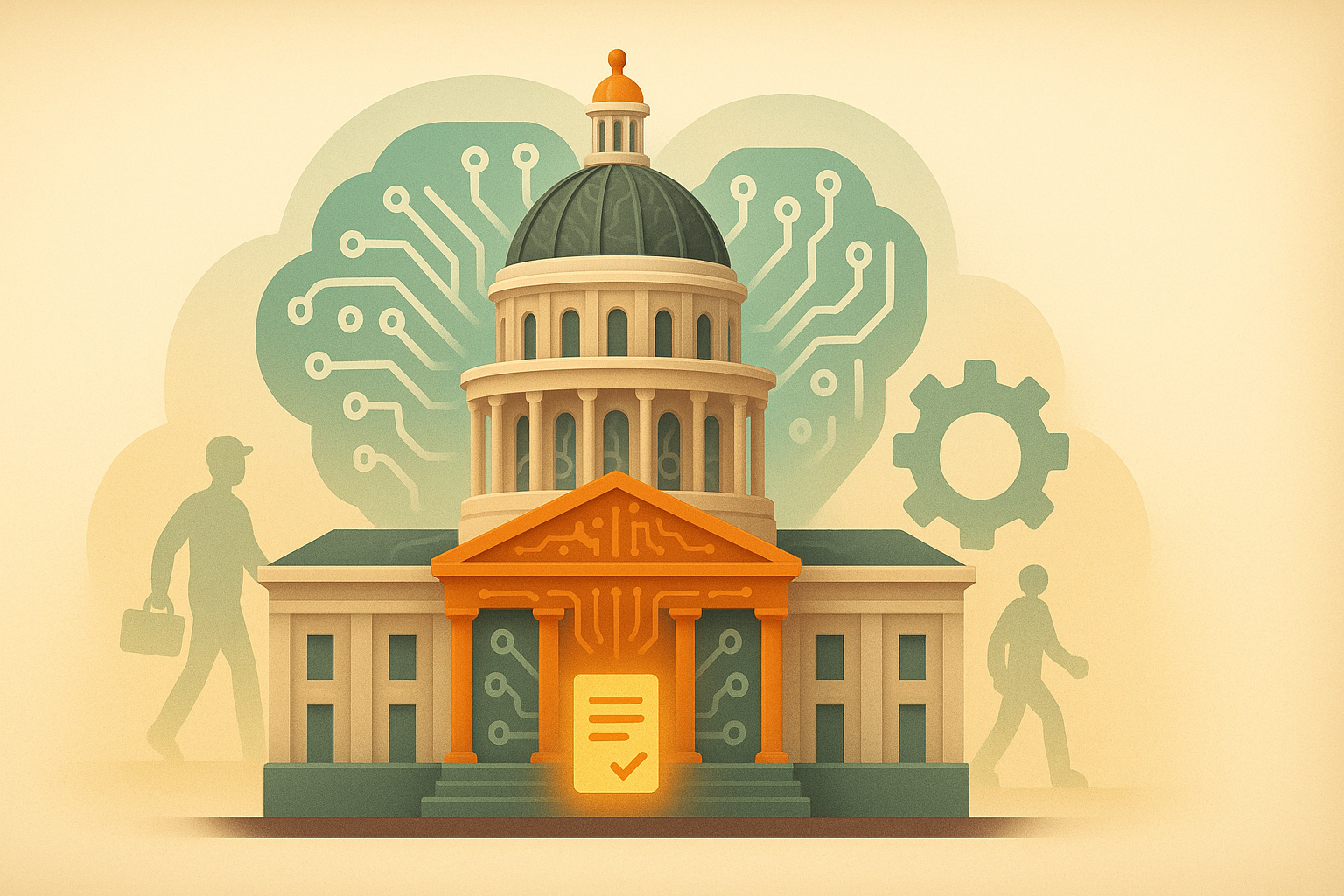
California starts treating AI job disruption as a policy problem
Category: Regulation and Policy Source: Office of Governor Gavin Newsom
California has signed what appears to be the first U.S. state executive order explicitly aimed at preparing for AI-driven job displacement. The order directs state agencies to develop long-term labor market responses with input from academia, unions, and industry, and to explore interventions beyond standard unemployment insurance. That matters because it moves the conversation from abstract warnings about automation to early institutional planning.
The policy is notable less for immediate mandates than for what it legitimizes: retraining at scale, incentives for firms that retain workers while adopting AI, and even discussion of new capital-distribution models such as “universal basic capital.” For business leaders, the message is clear: workforce transition is becoming a public-policy agenda, not just a private restructuring choice. For AI companies, California may become an early test bed for disclosure expectations, labor incentives, and future compliance obligations tied to deployment impacts.
What to watch next is whether other states follow with harder measures. Executive orders are easy to announce and harder to operationalize, but this one creates a precedent. If labor-market protections begin attaching to AI adoption, that will shape enterprise rollout economics just as much as model performance does.
Google pushes AI deeper into the scientific workflow
Category: Research and Innovation Source: MIT Technology Review
Google DeepMind has introduced “Gemini for Science,” a set of experimental tools aimed at accelerating research work rather than general-purpose productivity. The package combines literature synthesis via NotebookLM-style tooling, hypothesis generation using multi-agent methods derived from Co-Scientist, and computational discovery workflows built on systems such as AlphaEvolve and ERA. The significance is not just another model launch; it is a clearer productization of AI for specific scientific tasks.
This is where the market is heading: from broad chatbot utility to domain-specialized systems that sit inside real workflows. In science, the bottlenecks are often paper digestion, idea triage, replication checks, and simulation iteration. If these tools are reliable enough, they could compress weeks of preparatory work into hours. That would be meaningful for pharma, materials, climate, and academic labs with constrained staff.
The catch remains the same as elsewhere in AI: verification. Tools that synthesize literature and generate hypotheses are only useful if researchers can audit outputs quickly and trust failure modes. The practical question is whether these systems become genuine research multipliers or just another layer of plausible but noisy assistance. Watch for external validation, not demos: published lab outcomes, reproducibility gains, and evidence that scientists keep using the tools after the novelty wears off.
Quick Updates
-
Berkeley Law draws a hard line on AI use in coursework: UC Berkeley Law will ban AI across most graded assignments starting summer 2026, allowing exceptions mainly for legal research and specific classes that teach AI use directly. The move reflects a growing split in higher education between AI adoption and skill-preservation concerns. Source: The Decoder
-
AI backlash is reaching campuses: The tension around AI and jobs is now visible in graduation ceremonies, where students have reportedly booed speakers promoting AI optimism. It’s a signal that labor anxiety and trust deficits are no longer confined to policy circles. Source: The Independent
-
“AI washing” is becoming a real credibility problem: UK PR professionals say companies are stretching to label ordinary automation as AI in order to win coverage and investor attention. For practitioners, this matters because overclaiming is starting to erode signal across the whole category. Source: The Guardian
-
Public AI skepticism is getting harder to dismiss: A widely discussed appearance by investor Marc Andreessen underscored a broader issue: even prominent AI backers still struggle to explain concrete benefits in plain language. That gap between capital deployment and clear value articulation is becoming more visible. Source: Futurism
-
Wix’s reported cuts highlight AI-era software economics: Reddit reports say Wix may cut 800-1,000 employees, even as revenue grows, amid pressure from AI infrastructure costs and the shift from template-based site building to AI-generated creation. If accurate, it’s another reminder that AI can expand product capability while compressing margins and weakening old moats. Source: Reddit
-
AI governance is expanding beyond governments and tech firms: Pope Leo XIV issued an encyclical warning that opaque algorithms controlled by a few companies risk new forms of dehumanization, while Anthropic co-founder Chris Olah used the moment to argue for broader moral and interdisciplinary oversight. The practical takeaway: AI governance debates are widening into culture, religion, and global equity. Sources: Variety, Anthropic
-
Chert is pitching AI delivery through iMessage: Chert launched infrastructure for building AI-driven experiences on Apple’s iMessage, positioning the channel as a higher-trust alternative to SMS for support, outbound, and consumer agents. It’s early and promotional, but it fits a broader trend: distribution and channel access may matter as much as model quality. Source: Chert