Table of contents
Open Table of contents
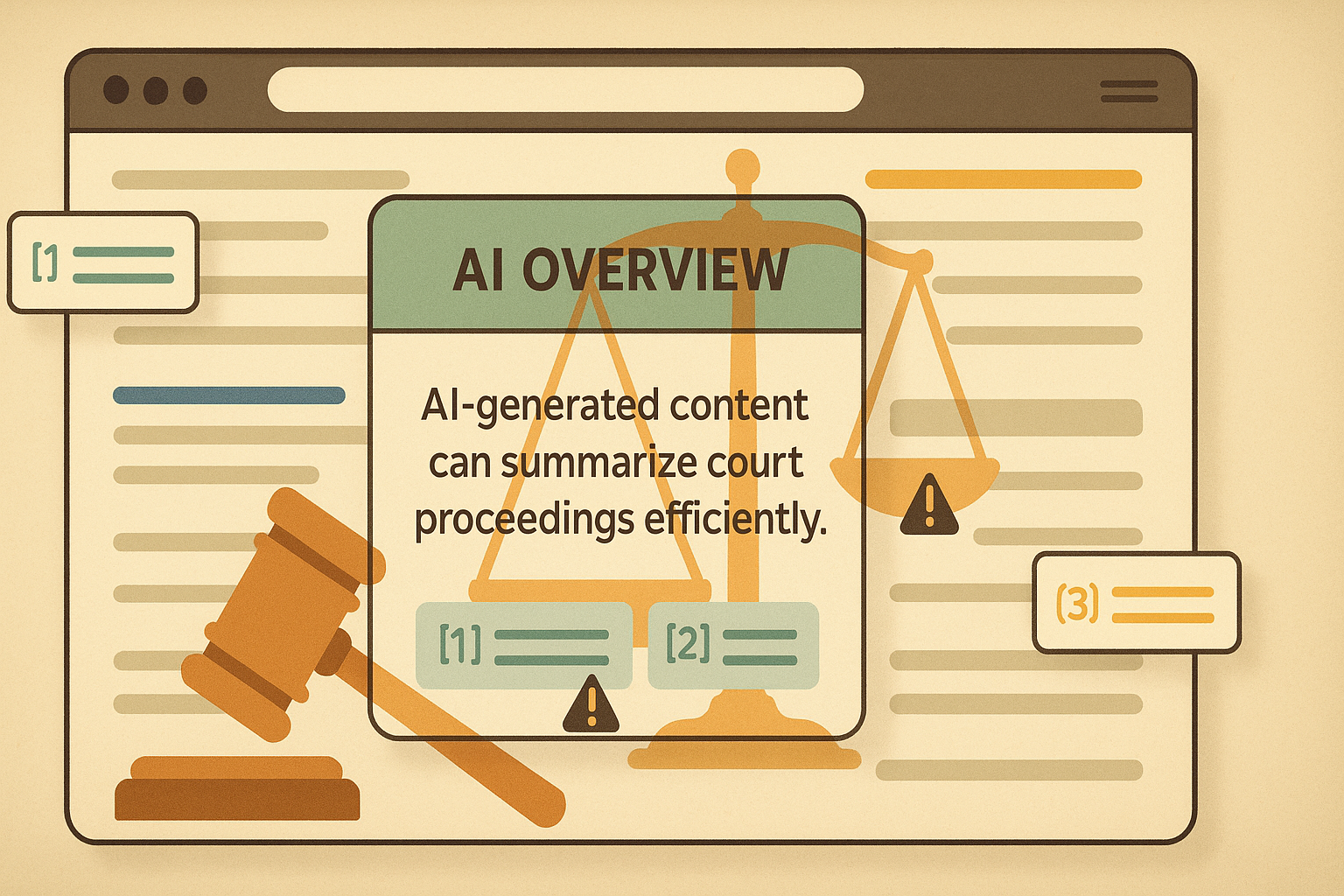
German court says Google owns its AI Overviews
Category: Regulation and Policy
Source: The Decoder
A German regional court has ruled that Google is directly liable for false claims made in AI Overviews, rejecting the idea that these summaries should get the lighter-touch liability treatment historically applied to search results. The case centered on AI-generated claims that linked publishers to fraud and misconduct, including statements not found in the cited sources.
The important shift is conceptual: the court treated the overview as Google’s own substantive output, not a neutral pointer to third-party content. That matters far beyond search. If other courts follow this logic, product teams shipping AI summaries, copilots, and answer engines may face a much higher bar for verification, especially when outputs make factual allegations about people or businesses.
For operators, the practical implication is simple: retrieval alone is not a legal shield if the model synthesizes, compresses, or embellishes. Expect more pressure for source-grounded generation, narrower output scopes in sensitive domains, and stronger audit trails showing what evidence supported a given answer.
This story also lands as policymakers are trying to catch up with frontier systems more broadly. In a new essay, Anthropic CEO Dario Amodei argues that AI capability growth is outrunning policy, and calls for transparency rules, frontier-model testing frameworks, export controls, and labor-impact tracking. Whatever one thinks of his prescriptions, the German ruling shows courts may move faster than legislatures in defining AI accountability. Source: Dario Amodei
Autonomous drones cross a wartime threshold
Category: Autonomous Systems and Robotics
Source: New Scientist
According to a senior figure in Ukraine’s defense industry, a test conducted two years ago used fully autonomous drones with no human oversight to identify and kill soldiers in a designated area. If accurate, this is one of the clearest public signs yet that lethal autonomy has moved from theoretical red line to real battlefield use.
The operational detail matters. These were not merely drones with assisted targeting or navigation; they were launched toward a front-line area and then switched into a mode where an onboard model searched for and intercepted targets on its own. Even if the test was limited and not deployed widely, the precedent is significant: once militaries prove a capability under wartime pressure, the barrier to repetition usually falls.
A related report adds another uncomfortable layer to the autonomy stack. Dutch reporting, cited by TVP World, says visual mapping data collected from Pokémon Go players helped train Niantic Spatial systems that can support GPS-independent navigation, including defense applications via a partnership with Vantor. Niantic reportedly said player scans were used in an early version of the model. That is less about one company than about a broader pattern: consumer-generated spatial data can become dual-use infrastructure very quickly. Source: TVP World
Watch three things next: whether governments harden rules around meaningful human control, whether commercial mapping and perception datasets face tighter disclosure requirements, and whether anti-jamming, vision-based navigation becomes a standard feature in next-generation drone platforms.
Quick Updates
-
Grit rewrites Git in Rust with help from agents: GitButler’s Scott Chacon says the team used AI agents to build a library-first, memory-safe Rust implementation of Git that passes roughly 99% of the C Git test suite. The technical signal is real, but the project is not yet fully battle-tested; the more durable takeaway is that agent-assisted porting of mature systems code is becoming practical when paired with strong test suites. Source: GitButler Blog
-
Google DeepMind pushes diffusion-based text generation: Google introduced DiffusionGemma, an open model aimed at much faster text generation by producing text in parallel blocks rather than token by token. NVIDIA separately says it has optimized the model for RTX-class local inference, which makes this one to watch for latency-sensitive on-device apps if quality holds up in real workloads. Sources: Google Blog, NVIDIA Blog
-
Argentina floats legal framework for AI-run companies: President Javier Milei has reportedly proposed allowing “non-human corporations” managed by AI systems, alongside broader deregulation and lower corporate taxes. The headline is provocative, but the substance to watch is liability: if an AI-managed entity causes harm, courts and counterparties will still need a human or legal pocket to pursue. Source: Financial Times
-
Enterprise AI-first without mass layoffs: Infobip CTO Izabel Jelenić argues that AI-first should be treated as an operating model, not a layoff program, with gradual rollout across coding, review, and testing. The useful point for leaders is that AI seems to reward disciplined teams more than it replaces them. Source: ShiftMag
-
Deepfake fraud pressure rises in the creator economy: Sumsub published a practical overview of how voice cloning, impersonation, and synthetic media scams are hitting creators and platforms. Vendor content, so keep some distance, but the operating advice is sound: stronger identity verification, fast takedown paths, and audience education are becoming baseline controls. Source: Sumsub
-
Open-source “LLM council” tooling keeps expanding: A new project called The AI Counsel packages multi-model deliberation workflows, local/cloud model support, MCP integration, search, and Docker deployment into one open-source stack. Interesting for teams experimenting with ensemble-style reasoning, though the real question remains whether structured debate beats a single strong model on cost and reliability in production. Source: GitHub
-
Personal memory-layer assistants keep showing up: One Reddit builder shared a “constant memory” personal intelligence system after roughly 1,000 hours of work, aimed at carrying context across chats and tools. Not a market-moving release, but it reflects persistent demand for user-controlled memory and context portability across assistants. Source: Reddit
-
Practitioners report diminishing returns in coding models: A distinguished engineer posting on Reddit argued that recent frontier model upgrades are no longer changing software engineering workflows much, especially for careful, chunked development where humans still validate architecture and platform details. Anecdotal, but it tracks a wider shift from raw model gains to workflow design, tool integration, and evaluation discipline. Source: Reddit
-
The deployment bottleneck is increasingly iteration, not first launch: Another practitioner post argues that the hard part in production AI is turning logs, failures, and user behavior into a repeatable loop of dataset curation, fine-tuning, evaluation, and redeployment. That is consistent with what strong teams are finding: feedback infrastructure is becoming more important than one-off model selection. Source: Substack
-
Wall Street’s new AI acronym arrives: “MANGOS” — Meta, Anthropic, Nvidia, Google, OpenAI, SpaceX — is making the rounds as a replacement for FAANG in some corners of tech finance. More meme than metric for now, but it does capture where investor attention has moved: model labs, compute suppliers, and distribution platforms. Source: TechCrunch