Table of contents
Open Table of contents
Anthropic pushes Claude deeper into team workflows with Claude Tag
Category: Enterprise and Adoption
Source: Anthropic
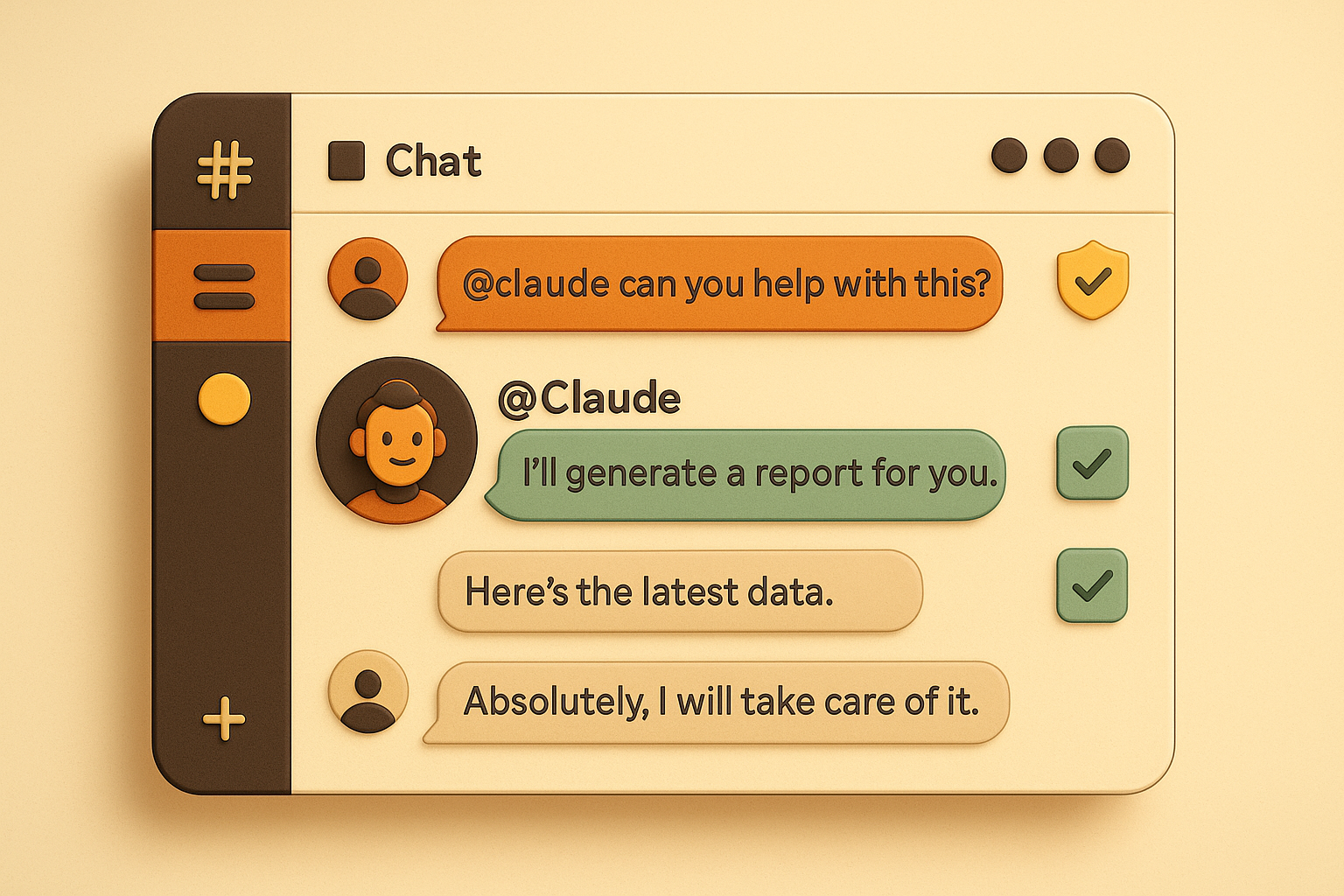
Anthropic launched Claude Tag, a Slack-native way to use Claude as a shared teammate rather than a one-user chatbot. Teams can call @Claude in channels, let it retain channel context, assign longer-running tasks, and optionally allow proactive follow-ups. Admins get per-channel identities, tool permissions, spending controls, and activity logs.
What changed here is not raw model capability but interface and operating model. Slack remains the control plane for a large share of enterprise knowledge work, and Anthropic is clearly trying to make Claude persist inside that flow instead of living in a separate chat tab. The important feature is shared context: one Claude instance can accumulate team-specific memory and act asynchronously across threads, which is much closer to how agent products are actually being deployed.
What to watch is governance friction. Persistent context, cross-channel knowledge access, and proactive behavior are exactly the features enterprises want for productivity—and exactly the features that raise questions around data boundaries, auditability, and accidental overreach. If Claude Tag works, it will strengthen the case that the winning enterprise AI products are not general copilots but tightly permissioned agents embedded in existing collaboration systems.
A model wrote a bootable Windows-style kernel. The real story is verification.
Category: Research and Innovation
Source: Tolmo
Tolmo published a striking demo: Claude Fable 5 reportedly generated a bootable, Rust-based, NT-shaped kernel from an empty repo in 38 minutes of active model time. The project, ntoskrnl-rs, spans about 5,100 lines across 27 files and includes core kernel subsystems such as scheduling, memory management, interrupts, object management, and I/O. It compiled, booted in QEMU, and passed 42 built-in self-tests.
The headline is impressive, but the more useful signal is narrower. This was not a production kernel, not a full Windows replacement, and not proof that low-level infrastructure can now be safely outsourced to models. It is, however, evidence that state-of-the-art systems can synthesize coherent low-level architectures, iterate through compile/runtime failures, and produce something structurally credible in a domain that used to be treated as too specialized for LLMs.
Why it matters now: the frontier is shifting from “can the model write it?” to “how do we trust what it wrote?” In safety-critical code, passing self-tests is a starting point, not a deployment bar. For practitioners, this points to a growing need for verification-heavy workflows—property testing, formal methods, provenance controls, and stronger review pipelines—especially as AI starts touching kernels, drivers, cryptography, and infrastructure code that sits deep in the software supply chain.
NVIDIA targets scientific data bottlenecks, not just model training
Category: Tools and Platforms
Source: NVIDIA
At ISC, NVIDIA introduced and expanded a set of CUDA-X tools aimed at AI-for-science workloads: the DAQIRI networking library for real-time instrument data capture, ALCHEMI microservices for chemistry and materials discovery, and cuPhoton reference code for high-throughput scientific imaging pipelines. The company’s most eye-catching claim is on astronomy workflows, where cuPhoton reportedly accelerated FITS image loading and reading by 14,900× and signal processing/analysis by up to 8,400× on Grace Blackwell systems.
The important shift is strategic. NVIDIA is pushing beyond “train bigger models faster” into owning the data path around scientific instruments and simulation environments. DAQIRI is meant to catch data as it streams off detectors; cuPhoton is built for petabyte-scale scientific imagery; ALCHEMI wraps domain-specific materials and chemistry functions as microservices. That is a play for scientific workflow infrastructure, not just chips.
The caveat is obvious: these numbers come from NVIDIA, on NVIDIA hardware, under favorable conditions. Still, the direction matters. Research organizations increasingly need real-time or near-real-time processing, especially where raw data rates exceed what can be stored. If these tools gain adoption outside flagship partnerships, they could make GPU-native scientific pipelines more standard—and deepen dependence on NVIDIA’s software stack at the same time.
Mistral ships OCR 4 for enterprise document pipelines
Category: Tools and Platforms
Source: Mistral AI
Mistral released OCR 4, a document AI model focused on enterprise ingestion workloads. It adds bounding boxes, block classification, inline confidence scores, and support for 170 languages, and Mistral says it can be deployed self-hosted in a single container. Pricing starts at $4 per 1,000 pages via API, with lower batch pricing.
This matters because document ingestion remains one of the least glamorous but most persistent bottlenecks in enterprise AI. RAG, search, workflow automation, and agent systems all depend on reliable extraction from PDFs, scans, forms, and mixed-layout documents. Bounding boxes and block typing are especially useful because they turn OCR output into something downstream systems can chunk, rank, and reason over with fewer brittle heuristics.
The main thing to watch is whether Mistral can convert feature completeness into production share. The self-hosted option is likely the real differentiator for regulated buyers that want modern document AI without shipping sensitive files to a third-party API. As always with OCR benchmarks, independent evaluation matters more than vendor preference studies—but the product is aimed at a real budget line, not a demo category.
Quick Updates
- Oracle says AI adoption contributed to 21,000 job cuts over the past year: Oracle’s annual report shows headcount fell about 13% as the company restructures around cloud and AI investment. The notable point is not just layoffs, but that AI is now being cited explicitly in public filings as an operational driver of workforce reduction. Source: BBC
- Agentic platform design meets org design: Olivier Wulveryck argues that Team Topologies maps cleanly onto “agentic platform” deployments, with the platform absorbing more operational and cognitive load so business-facing teams can use agents without owning all the underlying complexity. Useful reading for leaders turning agent pilots into platform strategy. Source: Olivier Wulveryck