Table of contents
Open Table of contents
Oracle’s AI Buildout Gets a Hard Market Reality Check
Category: Finance and FinTech Source: heise
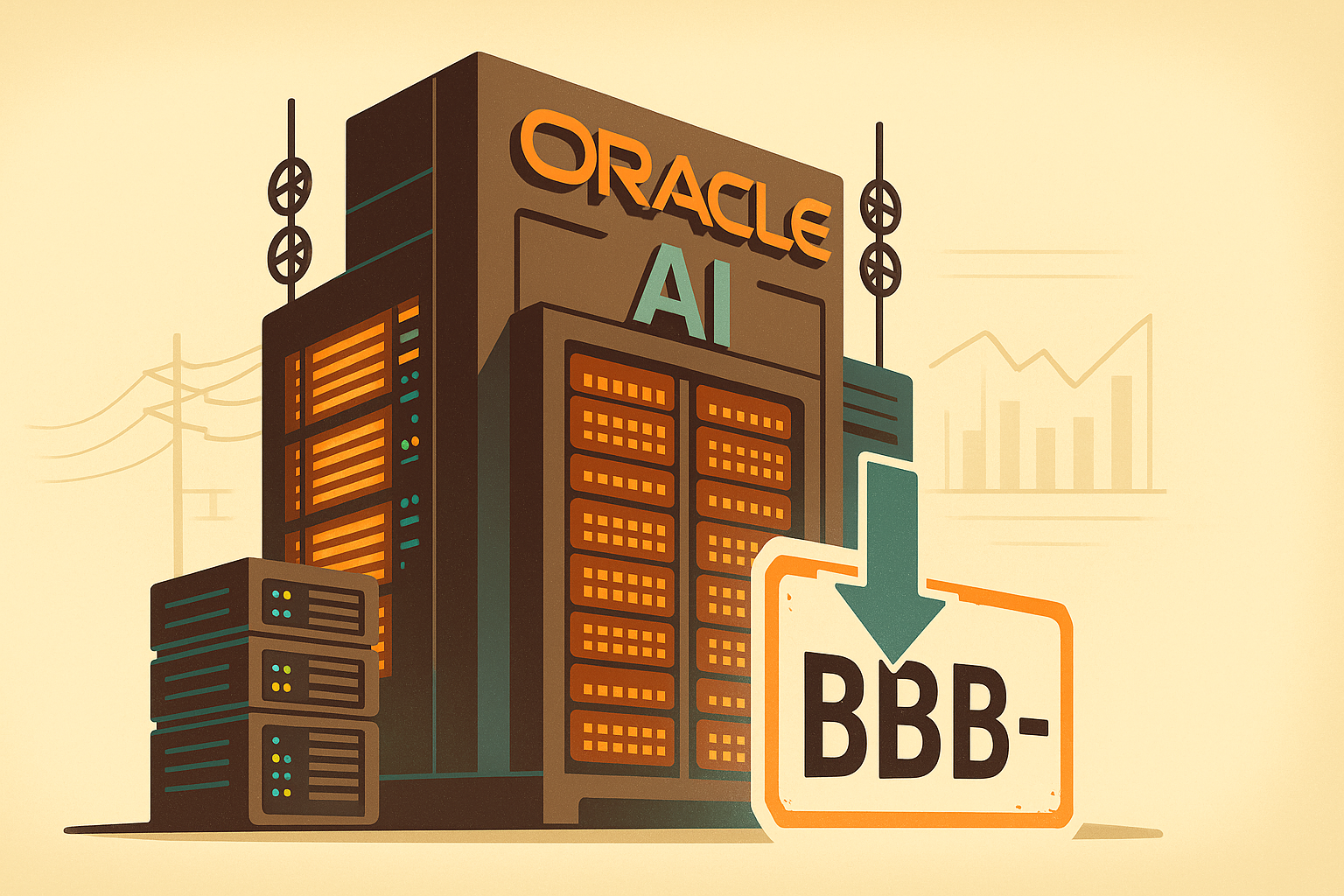
S&P cut Oracle’s credit rating to BBB-, the last rung above junk. The reason was not weak demand, but the opposite: Oracle’s aggressive expansion as an AI infrastructure provider is driving debt and capital needs faster than the agency is comfortable with. S&P now expects roughly $42 billion in negative free operating cash flow for fiscal 2027 and says Oracle may spend $90 billion to $95 billion on AI datacenter expansion, well above earlier expectations.
The more important detail is concentration risk. S&P reportedly views OpenAI as Oracle’s central credit risk, with a large share of contracted-but-undelivered service volume tied to a single customer. That is the kind of dependency investors tolerated when AI infrastructure looked like a pure growth story. It looks different once you attach long-dated leases, rising component costs, and uncertain downstream monetization.
Why it matters: this is one of the clearest signs yet that the AI stack’s financial stress is moving from startup burn and GPU shortages into hyperscale balance sheets. Oracle is trying to transition from software margins to infrastructure economics, and that means taking on the capital intensity that Microsoft, Google, and Amazon can absorb more easily. If AI demand keeps compounding, Oracle may be rewarded. If demand normalizes or key customers slow, the downside is much sharper.
What to watch now is whether this remains Oracle-specific or becomes a broader repricing of AI infrastructure risk. In particular: customer concentration, financing terms for new datacenter builds, and whether cloud providers can sustain current capex without pressuring the rest of the business. The market is starting to ask harder questions about who actually earns durable returns from the buildout.
DoorDash Shows What Enterprise AI Looks Like After the Demo
Category: Enterprise and Adoption Source: DoorDash Engineering
DoorDash published a practical case study on generating food metadata at scale with multimodal AI. The stack combines text, images, and web search; uses “LLM juries” to score outputs; and runs an automated context-optimization loop to improve prompts and retrieval. The company says the system improved annotation accuracy by about 20%, cut backfill time from a month to days, and removed the need for human labeling in this workflow.
The useful signal here is not the headline metrics, which should be read as company-reported, but the system design. DoorDash is treating model quality as an operational pipeline problem: better context assembly, automated evaluation, distributed inference, and synthetic data generation. That is much closer to how durable enterprise AI systems are being built than the simpler “pick a stronger model” narrative.
For practitioners, the standout idea is the jury pattern. Single-model outputs remain noisy for structured metadata tasks, but multi-model or multi-pass adjudication can improve reliability enough to automate expensive annotation layers. The tradeoff is added latency and cost, which DoorDash appears to offset through distributed inference and targeted context optimization rather than brute-force scaling.
The broader implication: enterprise value is increasingly coming from orchestration around models, not just the models themselves. Teams building extraction, classification, and enrichment systems should pay attention to evaluation loops, multimodal grounding, and where synthetic data can safely replace manual labeling. That is where a lot of the practical leverage is showing up.
Quick Updates
-
IBM warns on AI-era spending shifts: IBM said customers redirected budgets toward servers, storage, and memory for AI datacenters, hurting demand for its z17 mainframe and sending shares sharply lower. The useful read-through is that AI capex is now crowding out adjacent enterprise spend, not just adding to it. Source: CNN
-
Anthropic commits C$10 million to Canadian AI research: The funding will support Amii, Mila, Vector, and affiliated healthcare researchers and startups, largely via Claude API credits and related resources. This is ecosystem influence as much as philanthropy: model providers are deepening ties with academic hubs that shape talent and applied research agendas. Source: Anthropic
-
Anthropic launches Claude for Teachers: Verified US K-12 educators get free premium Claude access plus integrations with curriculum and classroom tools. The notable point is distribution: education remains a strategic wedge for model providers, with privacy guarantees and workflow integrations doing the real adoption work. Source: Anthropic
-
Bonsai 27B claims phone-class deployment: Prism ML says its 27B model runs on an iPhone 17 Pro using 1-bit and ternary weights, with a 4-bit vision tower and 262K context. Interesting if replicated, but for now this is a vendor claim to watch for independent latency, quality, and thermal-performance validation. Source: Prism ML
-
x86 vendors push ACE for AI math on CPUs: The proposed AI Compute Extension builds on Intel AMX, adds FP8 support, and shifts toward outer-product acceleration. For infra teams, this is worth tracking as CPU vendors try to stay relevant for more AI workloads beyond orchestration and preprocessing. Source: Chips and Cheese
-
ContextVault enters the crowded memory layer race: The startup is pitching shared, persistent memory for AI tools and agents, with MCP compatibility, scoped access controls, and organizational retrieval. The category is getting clearer: companies want durable context across tools, but differentiation will come down to interoperability, security, and whether memory actually improves output enough to justify another layer. Source: ContextVault
-
sx 2.0 turns shared folders into AI skill distribution: The new desktop app syncs markdown-based “skills” from Dropbox, Drive, OneDrive, and similar services into clients like Claude Code, Cursor, Copilot, and Gemini. It is a pragmatic approach for non-technical teams that want reusable AI workflows without standing up a server or using git. Source: sx
-
A self-referential RL project gets early traction on GitHub: “ai-trains-ai” describes an outer RL loop that learns to write inner-loop RL jobs, with reported reward gains and transfer to held-out tasks. It is an early experiment, not a validated result, but it reflects growing interest in automating training pipeline design rather than only tuning model weights. Source: GitHub
-
One Shot Challenge leans into promptcraft as sport: The contest format is simple—one prompt, one model, one run—and winners will be showcased at the SIGGRAPH Hack Awards. Mostly an event note, but it’s another sign that prompt design is being packaged as a competitive creative format rather than just a developer skill. Source: One Shot Challenge