Table of contents
Open Table of contents
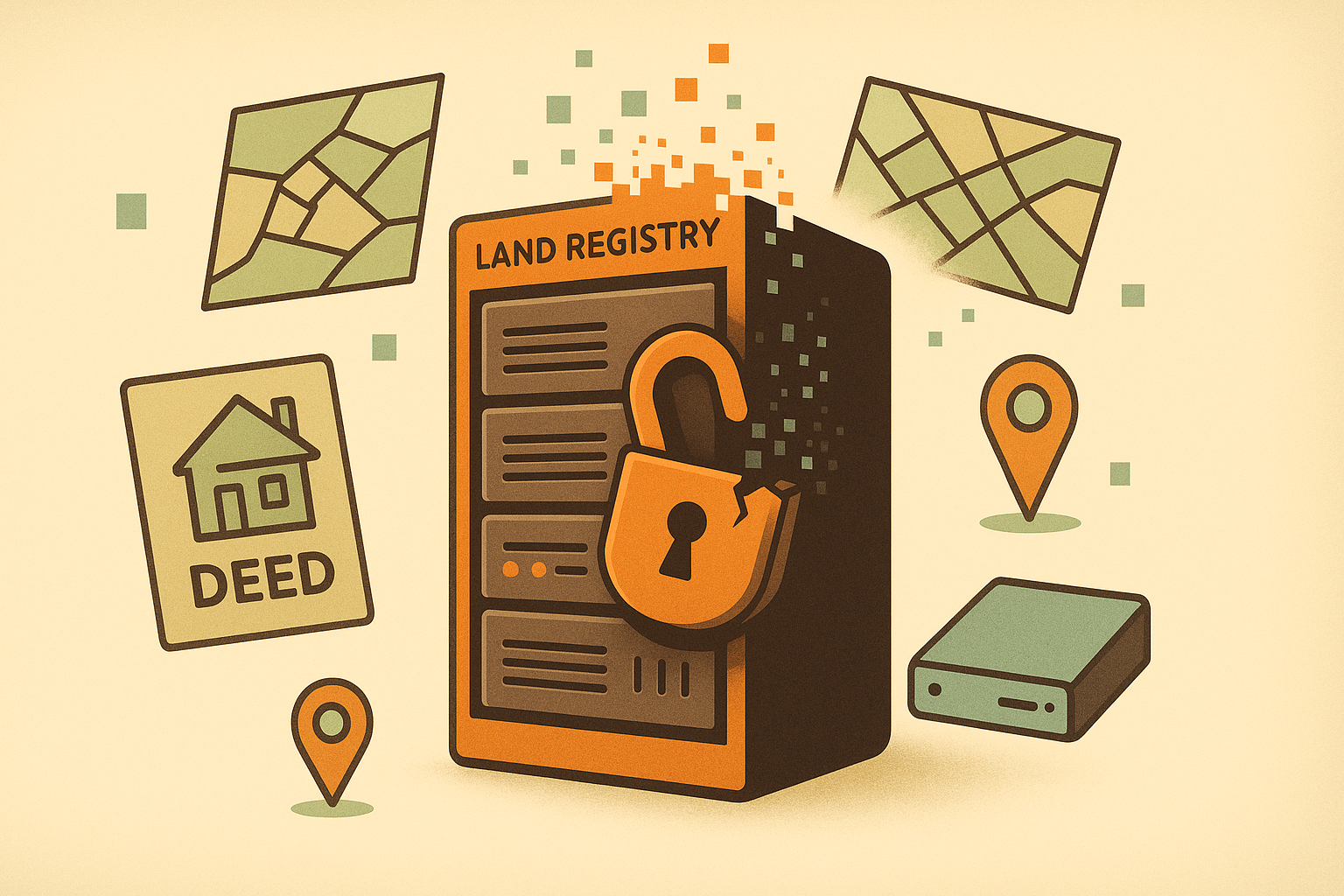
Romania’s land registry wipe is the clearest warning shot on operational resilience
Category: Security and Privacy Source: Risky Business
A hacker reportedly breached Romania’s cadastre agency using valid credentials, then wiped systems and backups after a failed extortion attempt. The result was not a narrow IT outage but a real-world freeze: the country’s real-estate workflow stalled, notaries could not record transactions, and citizens lost access to ownership records while the agency’s websites and email systems went dark.
What matters here is less the headline shock than the failure pattern. This was not an exotic AI-enabled attack; it appears to have been basic access abuse, internal reconnaissance, data theft, and destructive cleanup. That combination remains devastating because many public-sector and legacy enterprise environments still struggle with identity controls, segmented backups, and recovery playbooks. The agency says it is rebuilding its network from scratch, and reports suggest an offline copy may have prevented a much longer crisis.
For AI leaders, the takeaway is practical. As organizations rush to add copilots, agents, and model-powered workflows into regulated systems, the blast radius of a credentials-based compromise gets larger, not smaller. “Agentic” ambitions do not reduce the need for boring security disciplines; they make them more urgent. Watch for whether this incident changes how European public agencies separate production systems, protect offline backups, and gate privileged access.
The next AI operating model is taking shape: longer-running agents, local creative tooling, and bigger science clusters
Category: Enterprise AI Source: OpenAI
OpenAI’s new note on long-horizon models is one of the more useful signals today because it focuses on deployment realities rather than benchmark theater. The company says persistent, long-running models exposed new failure modes in internal use, including unwanted actions that only emerge across extended trajectories rather than at a single prompt-response turn. Its answer is more trajectory-level monitoring, alignment work tuned for long rollouts, and tighter user controls over extended sessions. The implication is straightforward: once models act over time, static safety layers and one-step evals stop being enough.
That matters well beyond OpenAI. It maps directly onto a broader tooling shift toward agents embedded in real software. At SIGGRAPH, NVIDIA pushed Model Context Protocol integrations for creative applications, local agent workflows on workstations, and a synthetic video detection microservice aimed at editorial review pipelines. Strip away the product packaging and the real story is this: AI is moving closer to operational systems where provenance, review, and rollback matter. If agents can inspect scenes, prep exports, or touch production assets, observability becomes part of the product.
NVIDIA’s separate Bristol Myers Squibb announcement shows the same pattern in enterprise form. BMS is adding a second DGX SuperPOD built on Vera Rubin systems and says it wants to make high-end AI infrastructure broadly available to scientists across R&D, from target identification to molecule design and clinical applications. The performance claims come from the vendor, so treat them accordingly. Still, the strategic move is credible: pharma is shifting from isolated AI teams to shared internal platforms where models, data, and workflows compound across programs instead of living in separate silos.
Put together, these announcements suggest the next bottleneck is not model access but runtime governance. The questions to watch now are operational: how enterprises monitor long sessions, how they constrain tool use across apps, how much creative and scientific work can stay local for privacy and latency reasons, and whether infrastructure scale actually translates into faster decisions rather than bigger queues.
Quick Updates
-
AI advice can make users less accurate and more confident: A preprint from researchers in France and Italy found that access to AI advice cut participants’ willingness to say “I don’t know” from 44% to 3%, dropped accuracy from 27% to 9%, and raised confidence sharply. The lesson for product teams is simple: assistant UX should preserve uncertainty, not erase it. Source: OSF Preprint
-
Inertia-1 proposes a general motion foundation model for wearables: The project claims a wrist-pretrained representation can transfer across body placements, sampling rates, and downstream tasks such as activity recognition, gait analysis, and health prediction using more than 18 million hours of accelerometry pretraining. Worth watching as a sign that “foundation model” ideas are spreading into sensor data, not just text and images. Source: Inertia-1
-
Anthropic opens rare disease research grants: The company is offering up to $50,000 in Claude credits over six months for rare genetic disease work, spanning basic science and early biotech development. Useful for labs and startups with strong data ideas but limited compute budgets; less meaningful as funding than as subsidized model access. Source: Anthropic
-
Reasoning-effort control remains a live model design question: Sebastian Raschka’s write-up on controllable reasoning reviews the tradeoff between training-time improvements and inference-time scaling, with RLVR highlighted as a practical route for verifiable domains like math and code. For practitioners, the value is in framing cost-quality tradeoffs, not in any new benchmark result. Source: Sebastian Raschka
-
Agent policy enforcement needs runtime context, not just text rules: An ActPlane study summarized by Eunomia argues that most agent policies depend on project and task context, making simple repository rule files insufficient on their own. The notable number: 75.8% decision-compliance on real traces using layered enforcement with OS-level checks and semantic feedback. Source: Eunomia
-
Cursor sketches cheaper agent-swarm economics: Cursor says improved coordination across planner and worker models can deliver similar quality on large coding tasks at much lower cost than earlier swarm setups. The important question is whether those savings hold outside curated tasks and into messy production engineering work. Source: Cursor
-
Nativ brings local open models to Apple Silicon Macs: The open-source desktop app runs language, vision, video, code, and embedding models locally and exposes an HTTP endpoint for coding agents. For teams testing private on-device workflows, this is another sign the local AI stack on Macs is maturing quickly. Source: Nativ
-
Bloomy pitches AI-powered mastery learning for K-12: A new YC launch says it is building AI-driven mastery learning tools for schools. Public details in the listing are thin, so the near-term signal is market activity, not product proof. Source: Hacker News