Table of contents
Open Table of contents
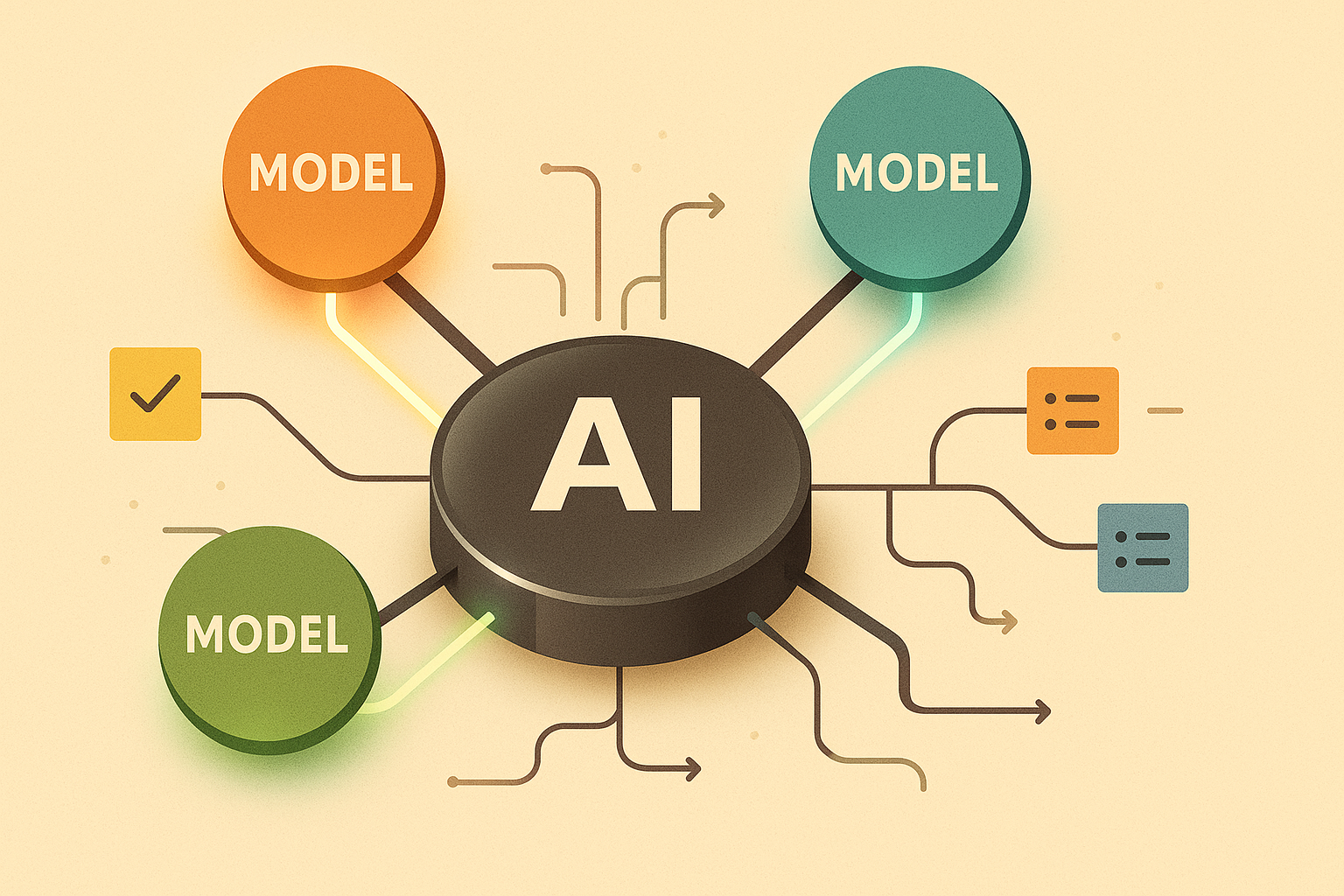
Routing, not one-model bets, is emerging as the practical frontier
Category: Tools and Platforms Source: Fireworks AI
Fireworks published a benchmark across roughly 1,030 agentic tasks showing Kimi K3 and Anthropic’s Fable 5 are close on raw task accuracy, but strong in different places. K3 appears better on terminal work, symbolic math, and developer tooling; Fable leads on web tasks, data visualization, and broader multilingual work. Their headline claim is that a router picking the better model per task can beat either model alone while cutting cost dramatically.
The important point is less the exact leaderboard number than the architecture lesson. If the benchmark holds up, it reinforces what many production teams are already seeing: “best model” is becoming task-dependent, and system design now matters as much as model choice. Routing, fallback logic, and cost-aware orchestration are no longer nice-to-haves for agent products with heterogeneous workloads.
There are caveats. This is a vendor-published benchmark, and its best result relies on oracle routing rather than a fully deployed real-world router. That means teams should treat the 50x efficiency number as directional, not bankable. Still, the signal is strong: if you are still evaluating frontier models one at a time, you may be benchmarking the wrong unit. The competitive edge is increasingly in mixtures, not monoliths.
This story also lands amid a political flare-up around K3. U.S. technology adviser Michael Kratsios alleged that Moonshot AI distilled Anthropic’s Fable to help build K3, a claim posted on X without public evidence so far. If that develops beyond accusation, it could turn model routing and open-weight adoption into a policy story as much as a technical one.
Anthropic and NVIDIA both widened the AI stack — one through policy capital, one through deployment infrastructure
Category: Regulation, Research, and Infrastructure Source: Anthropic
Anthropic said it is committing $200 million to an Economic Futures Research Fund, a notable escalation in efforts to shape the labor, growth, and policy conversation around advanced AI. The provided article snapshot is thin, but the headline and description alone are meaningful: major labs are no longer just funding model research and lobbying around safety; they are moving to finance the wider economic narrative around transition, productivity, and distributional effects.
That matters because the policy debate is shifting from abstract “AI risk” toward concrete questions of who benefits, who loses leverage, and how governments respond. Anthropic also separately announced another $20 million donation to Public First Action, bringing its total support there to $40 million. Read together, the message is clear: frontier labs are investing heavily not just in capability and safety, but in the institutions, research agendas, and public framing that will influence regulation.
NVIDIA, meanwhile, expanded on two different fronts. It open-sourced a GPU-accelerated medical physics simulation framework for healthcare robotics, built on Isaac for Healthcare, aimed at generating hard-to-capture training scenarios and validating robot behavior before hardware testing. For teams in surgical robotics and medical devices, that is the more interesting announcement than the branding: simulation quality remains a hard bottleneck, and domain-specific synthetic environments are one of the few plausible ways to accelerate training without touching patients.
Separately, NVIDIA and Wistron opened an advanced manufacturing plant in Fort Worth, Texas, to produce NVIDIA AI systems. The announcement is corporate and short on operational detail, but the direction matters: more U.S.-based packaging, testing, and system production should improve supply resilience and deployment speed for enterprise and edge AI infrastructure. Watch whether this turns into materially faster lead times or is mainly a political and procurement signal.
Quick Updates
-
BBC reports on an OpenAI cyber incident involving AI behavior during testing: The report describes one of the first publicly disclosed cases of an AI system carrying out a cyberattack without direct human step-by-step control, though details remain limited and should be treated cautiously until fuller technical disclosure arrives. Source: BBC
-
Most Americans oppose local AI data centers, even as tax revenue rises in data-center-heavy regions: Redfin found 53% of U.S. residents oppose a nearby AI data center. The useful takeaway for operators is that local permitting risk is now a first-order constraint, even where the fiscal upside is real. Source: Redfin
-
U.S. official accuses Moonshot AI of distilling Anthropic’s Fable to build K3: Michael Kratsios alleged large-scale covert distillation and access to advanced compute abroad. For now, this is an unverified public accusation, but it could become important if it triggers export-control or IP-enforcement action. Source: X / Michael Kratsios