Table of contents
Open Table of contents
AI-Tracked Livestock Becomes Loan Collateral in Brazil
Category: Finance and FinTech Source: CoinDesk
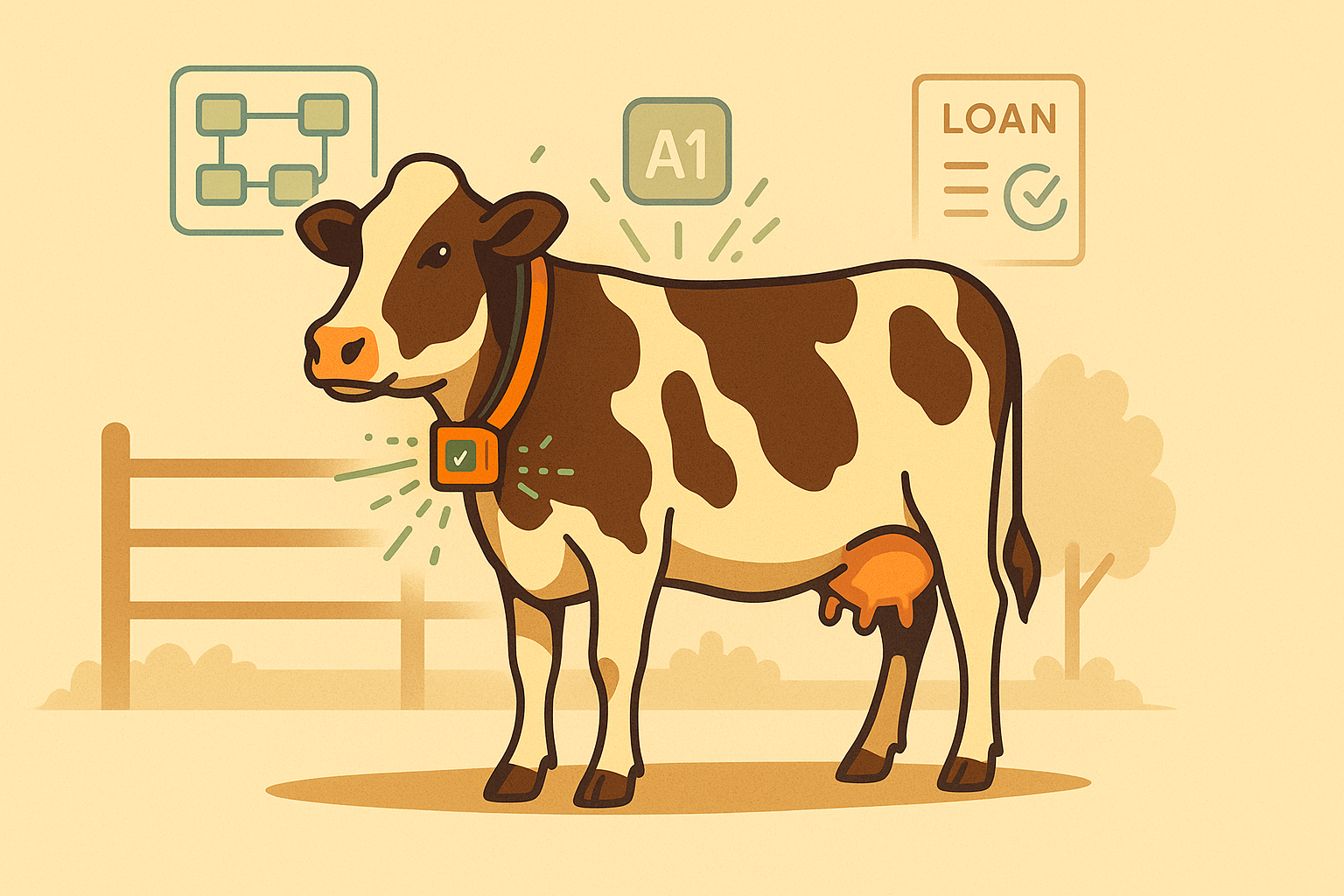
A Brazilian pilot turned 10 dairy cows into tokenized collateral on the B3 exchange, helping farmers raise nearly $20,000 in credit while banks tighten lending. The key AI layer is not generative AI; it is operational verification. Cowmed’s collars continuously track each animal’s health and location, then tie that data to an encrypted digital identity so lenders can verify the asset behind the loan.
That matters because livestock has always been difficult collateral: it moves, its condition changes, and it can be pledged more than once. AI telemetry plus a blockchain record is being used here to solve a very practical underwriting problem: proving that the asset exists, remains healthy enough to hold value, and has not already been pledged elsewhere. If that works at scale, it is a more meaningful signal than the “put it on-chain” framing.
The immediate takeaway for AI and fintech operators is that sensor-driven verification may become a stronger commercial wedge than pure model intelligence in real-world asset finance. The model is only useful if lenders trust the data pipeline. Watch whether Cowmed can expand beyond a pilot without running into disputes over data quality, hardware failure, or legal enforceability when a borrower defaults.
The Bigger Signal: AI Is Moving Into Collateral and Underwriting Infrastructure
Category: Finance and FinTech Source: CoinDesk
The broader significance is that AI is increasingly being used as financial infrastructure rather than as a standalone product. In this case, collars generate a live stream of facts about a physical asset, and those facts support credit creation. That is a concrete example of AI shifting from decision support to enforceable market plumbing: asset identification, condition monitoring, fraud reduction, and eligibility checks.
For business leaders, the real question is not whether tokenized cows are novel. It is whether this pattern generalizes to other hard-to-finance assets: farm equipment, fleets, inventories, or small industrial assets that are expensive to verify manually. If AI can reduce verification costs enough, previously uneconomic loans may become financeable.
There is still plenty to prove. Real-world asset tokenization projects often look cleaner in pilots than in scaled operations, especially when regulation, repossession rights, and data integrity are tested in the real world. But this is worth watching because it points to a practical AI adoption path: not replacing lenders, but making neglected collateral legible enough to lend against.
Quick Updates
- Brazil pilot uses AI collars and blockchain to unlock farm credit: Farmers in Paraná tokenized 10 dairy cows and raised about $20,000 in loans backed by livestock. The useful signal is the AI-based verification layer: real-time health and location tracking helps prevent double-pledging and makes movable collateral easier to underwrite. Source: CoinDesk