Table of contents
Open Table of contents
Cloudflare pushes for an agent-ready web
Category: Tools and Platforms Source: Cloudflare
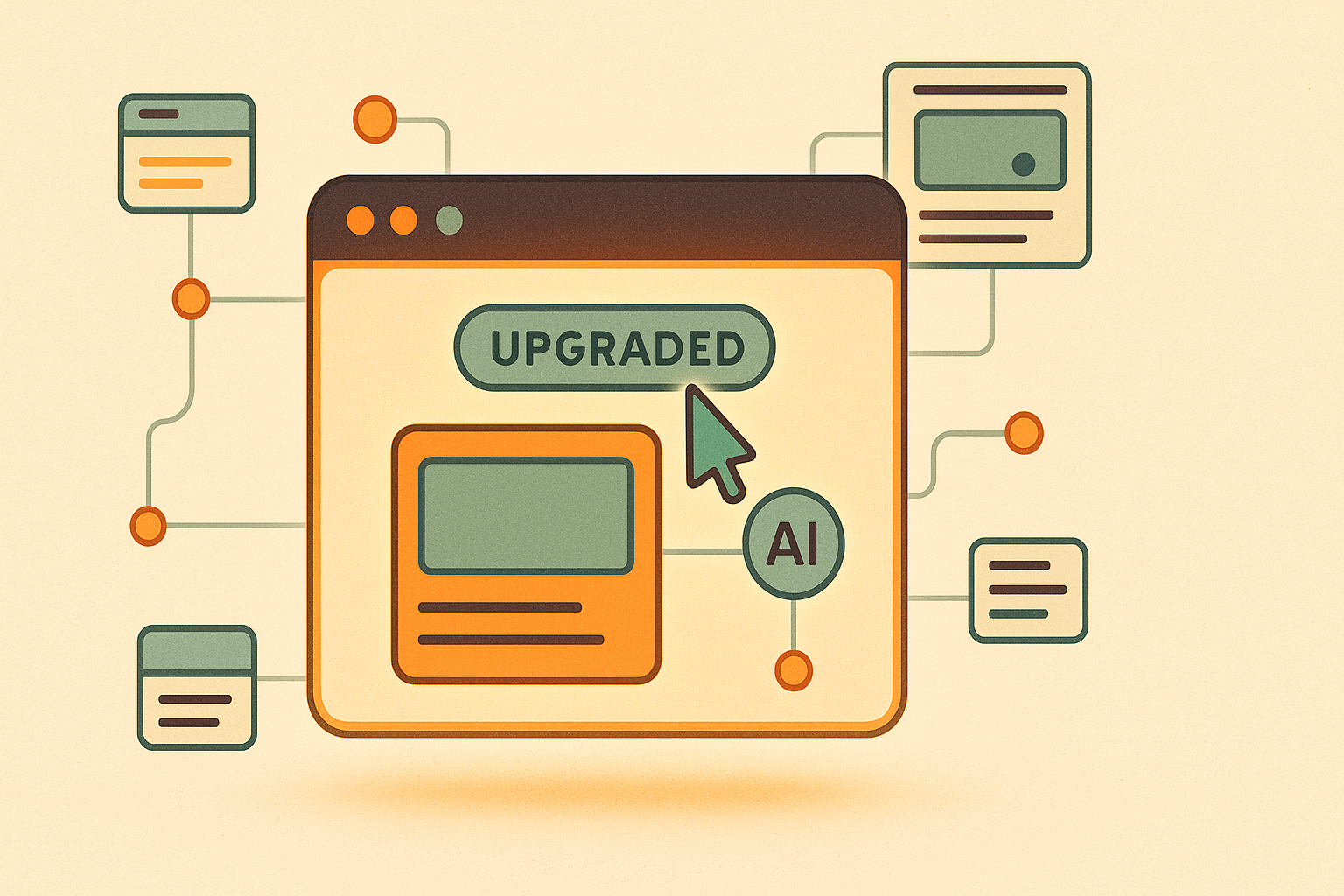
Cloudflare had the most consequential product day in AI infrastructure. It launched a developer preview of WebMCP, which lets websites expose a Model Context Protocol interface without changing origin code; released MCP v2, a stateless redesign aimed at running cleanly on serverless Workers; and added “Agent Readiness” plus “Answer Engine Optimization” dashboards for measuring whether AI systems can find, parse, and cite a site. Taken together, this is a serious attempt to make the web legible not just to search crawlers but to agents that browse, call tools, and transact.
What changed is not just another MCP implementation. WebMCP lowers adoption friction by promising that a site can become agent-usable with “one switch,” while MCP v2 removes session complexity that made many deployments awkward in serverless environments. The practical significance: agent interfaces may become cheaper to expose, easier to scale, and more standardized across ordinary websites rather than only APIs built specifically for LLM apps.
The business angle is just as important. Cloudflare is positioning “recommended by AI” as the successor to “ranked by search,” with new metrics such as citation rate, prominence, and share of voice. Some of this clearly repackages SEO logic for the answer-engine era, and the underlying measurement methods deserve scrutiny. Still, the direction is real: if customer discovery increasingly happens inside model outputs, publishers and commerce sites will want tools to see whether they are visible there at all.
What to watch next: whether WebMCP gains support beyond Cloudflare-heavy stacks, whether MCP v2’s stateless approach becomes the default implementation model, and whether site owners accept AEO-style optimization as a durable channel rather than a short-lived analytics category. If this sticks, “agent-ready” will become a standard web requirement alongside mobile-friendly and crawlable.
Meta’s ad systems failed on AI-generated child abuse content
Category: Ethics and Governance Source: WIRED
WIRED reported that more than 50 ads containing AI-generated child sexual abuse imagery appeared across Meta platforms, according to findings from the Tech Transparency Project. Some promoted nudify-style apps, and some remained visible in Meta’s ad library for months. Meta removed the ads after being contacted and said it had also disabled many earlier, but the core issue is that the company’s ad review and enforcement systems still let this material through.
This matters beyond one platform scandal. Generative tools have sharply lowered the cost of producing abusive synthetic media, while ad systems remain optimized for volume and automation. That combination creates a predictable failure mode: bad actors can cheaply generate variants, buy distribution, and exploit the lag between policy, detection, and enforcement. The fact that these were paid placements, not just user posts, makes the lapse more severe.
For AI practitioners and platform teams, the lesson is blunt. Safety systems that look adequate in model demos or policy pages can fail badly when exposed to scaled adversarial use. Watch for more pressure on ad screening, provenance checks, age-risk classifiers, and escalation pipelines tied specifically to synthetic content. Expect regulators and civil society groups to treat “we removed it after notice” as an insufficient answer.
AMD buys Taalas to sharpen its inference story
Category: Startups and Funding Source: AMD
AMD said it will acquire Taalas, a startup focused on specialized AI inference silicon. The company says Taalas optimizes inference dataflows to reduce compute and memory bottlenecks, and plans to integrate the technology into its accelerator roadmap alongside Instinct GPUs and broader rack-scale systems. This is a strategic buy aimed less at training prestige and more at the harder commercial problem emerging now: efficient, production-scale inference.
That timing matters. The industry narrative is shifting from who can train the biggest model to who can serve useful models cheaply, quickly, and at scale. Specialized inference hardware is becoming more attractive as workloads diversify and margins come under pressure. AMD’s move suggests it sees an opening not just to chase Nvidia on general-purpose accelerators, but to compete on system-level efficiency for specific model-serving patterns.
The usual caveat applies: this is an acquisition announcement, not product evidence. But it is still a meaningful signal about where semiconductor competition is heading. Watch whether AMD turns Taalas into differentiated deployed products rather than just roadmap language, and whether other chipmakers make similar bets on narrowly optimized inference architectures.
Quick Updates
-
Bond markets are flashing risk on AI-boom fiscal bets: The Economist argues governments are leaning too hard on optimistic AI-growth assumptions while long-term bond yields stay elevated, a reminder that public AI investment plans now face a tighter capital environment. Source: The Economist
-
Human reviewers missed one-third of risky agent commands: Data from more than 40,000 plays of an AI-agent permission game found users missed about 33% of dangerous commands, especially innocuous-looking
npm runcases. Useful evidence against overreliance on human approval prompts for agent safety. Source: scalex.dev -
“No-code” gets a fresh reality check: A commentary tied to Airtable’s sale argues coding agents are eroding the old no-code value proposition and shifting demand toward more flexible low-code and open stacks. Directionally plausible, though still more thesis than market proof. Source: exe.dev
-
Microsoft’s AI revenue appears heavily concentrated on OpenAI: Reporting based on filings suggests roughly 70% of Microsoft’s AI revenue is tied to OpenAI-related workloads, underlining how much one partnership still anchors a supposedly diversified AI business. Source: Bloomberg
-
Artificial Analysis updated its model and provider benchmarking view: The latest Intelligence Index refresh folds in nine evaluations and continues to compare model quality, speed, and cost across providers. Useful reference point, but practitioners should still map benchmark wins to their own workloads. Source: Artificial Analysis