Table of contents
Open Table of contents
AI Is Forcing a Rethink of the US Science System
Category: Policy Source: The Economist
Michael Kratsios argues that the US research system still largely runs on assumptions set by Vannevar Bush’s 1945 blueprint: fund basic science, let institutions do the work, and trust the downstream payoff. His case is that this model now looks mismatched to the AI era, where strategic competition, faster technology cycles, compute concentration, and tighter links between research and deployment all change what “science policy” needs to do.
Why it matters now: AI is collapsing the distance between basic research, infrastructure, and industrial policy. Frontier work increasingly depends not just on grants and labs, but on access to compute, data, talent, and supply chains. For practitioners and operators, the policy question is no longer abstract. If Washington revisits the architecture of science funding, the effects could show up in who gets resources, how public-private partnerships are structured, and whether national research capacity keeps pace with model development concentrated in a handful of firms.
The piece is opinion, not legislation, and it doesn’t by itself signal imminent reform. But it is a useful marker of where elite policy debate is heading: from “fund more research” toward “redesign the system around AI-era realities.” Watch for this framing to surface in agency mandates, NSF priorities, and any future proposals that tie scientific competitiveness more explicitly to compute and commercialization.
Prompt Injection Has Reached the Courtroom
Category: Security and Privacy Source: Ars Technica
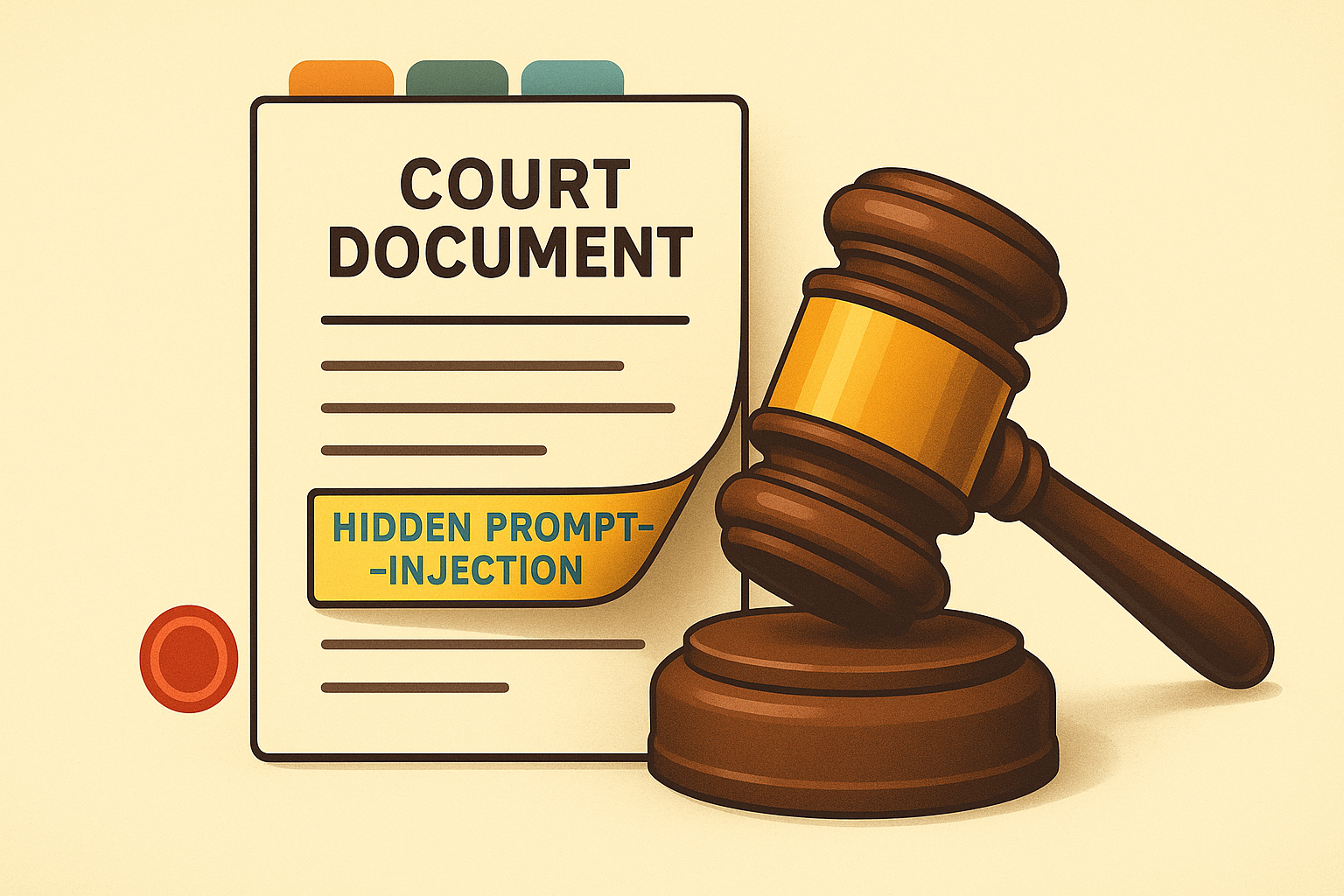
A Connecticut judge described what appears to be the first known US case of a litigant hiding prompt-injection text inside court filings in an attempt to sway any AI systems that might review them. The hidden text instructed an AI reader to favor the plaintiff’s arguments and ignore prior denials. The tactic failed, and the court said it does not use AI to review or decide filings, but the plaintiff was still sanctioned and barred from future e-filing.
The operational takeaway is bigger than this case. Prompt injection is no longer confined to demos, red-team exercises, or enterprise software risk memos; it is turning up in real procedural workflows. Courts, legal departments, and any organization that ingests third-party documents into LLM-powered pipelines should read this as a warning about input-layer attacks, not just hallucinated outputs. If a system touches adversarial text, it needs isolation, scanning, and human review paths.
There is also a governance angle. Most public discussion around AI in law has focused on fake citations and fabricated case law. This case broadens the threat model: even if model outputs are monitored, manipulated inputs can still become an attack surface. Expect more institutions to write explicit rules around hidden AI instructions, document sanitization, and what counts as abusive conduct when AI-assisted systems sit anywhere in the workflow.
Quick Updates
- Printytron launches text-to-STL tool for practical 3D parts: A new free web tool promises to turn plain-English descriptions into printable STL files for brackets, clips, holders, and replacement parts without CAD. The claim is interesting for rapid prototyping and maker workflows, but it should be treated as an early product signal until users validate geometry quality, tolerances, and repeatability. Source: Printytron