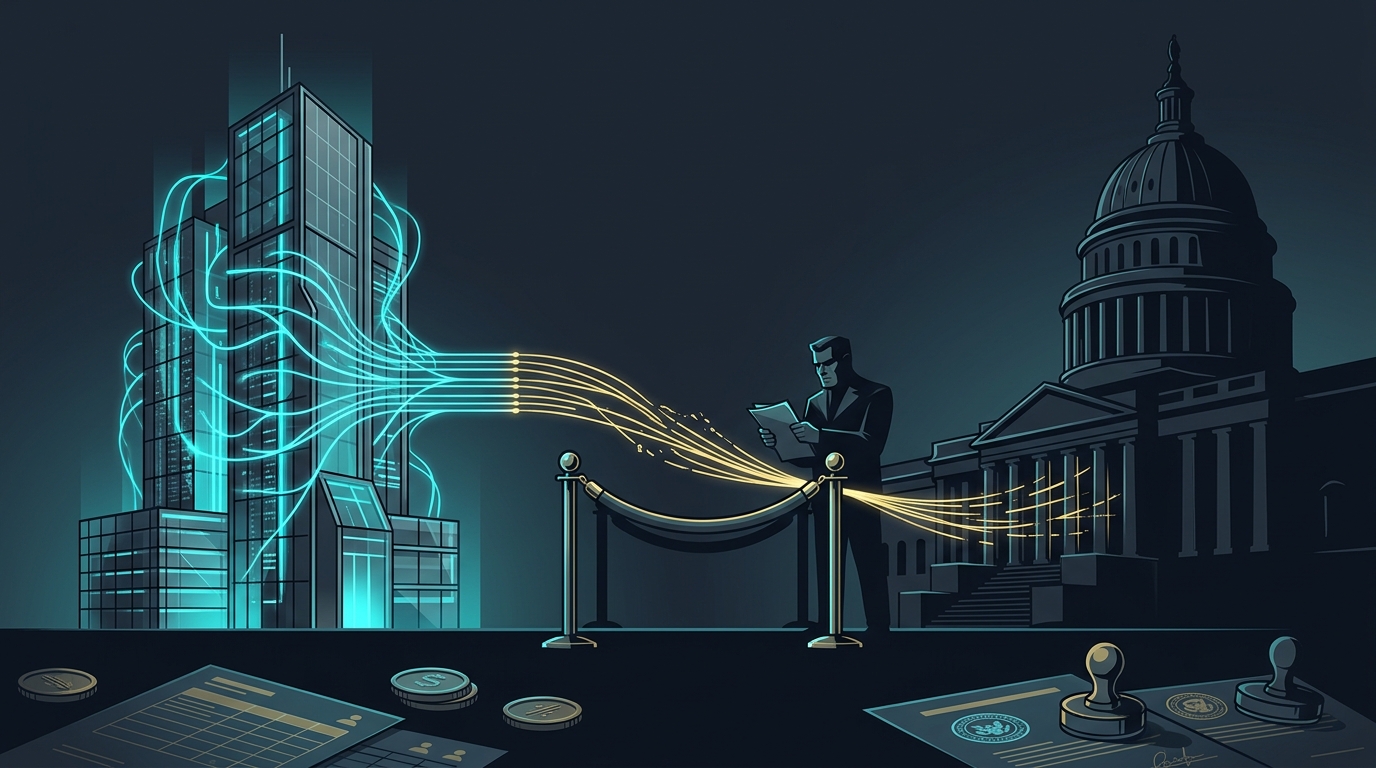
OpenAI has found a remarkably elegant way to make an old political problem sound like a product feature.
According to Financial Times reporting summarized by The Guardian and TechCrunch, Sam Altman has been discussing a plan for OpenAI to give 5% of its equity to a U.S. sovereign-wealth-style fund, with other leading AI companies potentially doing the same. The public would share in the upside. AI wealth would not remain trapped inside venture portfolios and employee stock plans. The great machine would throw coins from the parade float.
That is the friendly version. It is not trivial. If AI really does concentrate economic value on the scale its builders keep promising, the public should get more than cheaper autocomplete and a motivational speech about reskilling.
But timing has a way of ruining clean narratives. The proposal arrives just after Washington pressured frontier labs over model access, after Anthropic restored Fable 5 under tighter safeguards, and after OpenAI’s own GPT-5.6 Sol preview turned the frontier model launch into a controlled guest list. Now the industry is not merely asking the state to regulate it, bless it, buy from it, and protect it from foreign rivals. It is floating the idea that the state should own a slice of it.
Very democratic. Also very convenient.
The public stake is doing two jobs
OpenAI has been preparing this argument for months. Its April policy paper, Industrial Policy for the Intelligence Age, says advanced AI could concentrate wealth and power unless policy spreads the gains more broadly. It proposes tools including a public wealth fund whose returns could be distributed directly to citizens.
Taken alone, that is a serious idea. There are defensible versions of it. Alaska did not invent oil, but it built a public mechanism around oil wealth. Norway did not apologize for turning national resources into a sovereign fund. If AI becomes infrastructure as important as energy, compute, or finance, a public claim on some of the upside is not crazy. It may be late.
The problem is that OpenAI is not a neutral political philosopher submitting homework. It is a company seeking capital, permission, market trust, export clarity, government contracts, and protection from backlash. Its current structure already contains a strange stack of mission language, nonprofit control, a public benefit corporation, Microsoft’s roughly 27% stake, investor expectations, and a foundation equity position supposedly aligned with humanity’s benefit.
Now add Washington as a potential shareholder.
That changes the character of the proposal. A public dividend is no longer just redistribution. It is also relationship management. It says: if we become unimaginably valuable, you are in the cap table too. Please remember that when you write the rules.
This is not automatically corruption. It is more subtle, which is why it deserves attention. The regulator does not need to be bribed in a cartoon bag-of-cash sense for incentives to bend. If the government owns part of the company it regulates, then safety enforcement, competition policy, export controls, procurement, and antitrust all start to carry a second question: are we protecting the public, or protecting the public’s investment?
That is a very different control surface.
The backlash is not just partisan noise
The live reaction was ugly, but not empty.
On Hacker News, the most useful thread split between two instincts: a public stake in AI wealth could be a reasonable way to organize taxation and national benefit, but doing it under the pressure of a specific administration “reeks of cronyism.” On Reddit, the reaction was harsher and less lawyerly. Users called it a bailout setup, pay-to-play government, and a conflict where the referee gets part-ownership of one team.
Some of that is overheated. Online forums can turn a policy balloon into a constitutional fireball before the coffee cools. Still, the core skepticism is rational. People are not only asking whether the public should share in AI gains. They are asking who controls the fund, who gets the dividend, who decides which companies qualify, and whether political access becomes part of the cost of doing frontier AI.
That last question matters because it connects directly to the model-access story. The same week brought more evidence that frontier capability is being distributed through trusted-partner arrangements, government consultation, and safety-triggered redeployments. Anthropic’s Sonnet 5 launch and Fable 5 restoration showed the pattern clearly: more capability, lower price, tighter controls, and more visible state involvement.
So the public hears two messages at once. First: these systems are too important and risky to leave entirely to the market. Second: the companies building them would like a negotiated structure in which they keep operating, keep compounding, and offer the state a piece of the future.
That is not the New Deal. It is a term sheet wearing a flag pin.
Watch the conflict, not the percentage
The 5% number is probably not the important part. It may change. The talks are preliminary. Congress may need to act. Other labs may refuse. The fund may never happen.
The important part is the direction of travel. Frontier AI is moving from “companies should be regulated” to “companies and states should be financially intertwined because the technology is too strategic to treat normally.” That may be inevitable. It may even be useful in some form. But it should not be smuggled in as feel-good public benefit language while everyone politely avoids the conflict of interest sitting in the middle of the table.
If a public wealth fund is the right answer, build it like public infrastructure: statutory authority, independent governance, transparent holdings, conflict rules, clear distribution mechanics, and a firewall between ownership and supervision. Make it boring enough to survive a change of administration. Make it explicit enough that the public can tell whether it is a dividend, a tax substitute, an industrial-policy tool, or a loyalty program for companies already too important to anger.
The AI industry likes to say it is building the future. Fine. Then it should be able to handle future-grade governance, not just future-grade valuation.
The uncomfortable truth is that “shared upside” can be both a legitimate social goal and a political toll. The difference is design. Without that design, the public may get a tiny claim on the boom while the companies get something much more valuable: a regulator with skin in their game.
That is not broad prosperity yet. That is a velvet rope with dividend paperwork.