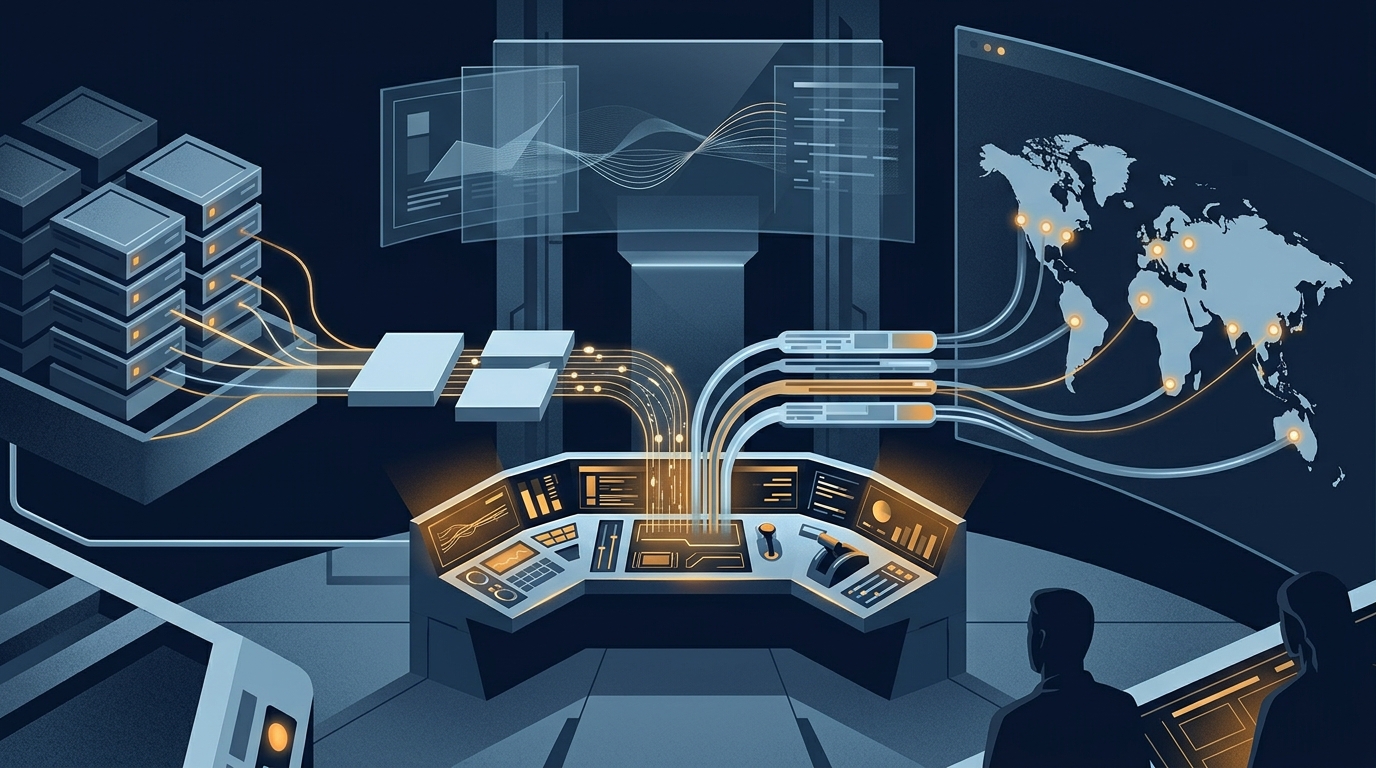
The AI race is becoming less mystical and more industrial. That is an improvement, mostly because industrial systems are easier to inspect than magic tricks wearing venture capital.
For years, the public story was simple: whoever built the smartest model would win. Better reasoning, better benchmarks, better demos, bigger context windows, cleaner vibes from the launch video. Capability still matters. It matters a great deal. But the newer signals point to a different center of gravity.
The durable advantage is shifting from genius to control.
Not control in the theatrical sense of one company owning the future. Control in the operational sense: reserved compute, default distribution, provenance standards, enterprise contracts, developer gravity, hardware access, and the bureaucratic machinery that turns impressive models into dependable infrastructure. The smartest model in the room is useful. The model that can be bought, deployed, trusted, routed, audited, and supplied at scale is the one that becomes hard to dislodge.
Capacity is becoming a product
OpenAI’s new guaranteed capacity offer is a clean signal. It turns access to compute into something large customers can reserve through one- to three-year commitments. That is not a benchmark announcement. It is infrastructure packaging.
This matters because enterprises do not standardize on uncertainty. A CIO may enjoy a model demo. A procurement office does not enjoy discovering that the critical workflow depends on capacity that may or may not exist when the quarter closes. Reserved access changes the conversation from “can your model answer this?” to “can your platform carry this workload predictably?”
That is a less glamorous question and therefore more important.
The same pattern appears in trust infrastructure. OpenAI’s layered provenance push, combining C2PA metadata, SynthID watermarking, and a public verification tool, will not solve synthetic media manipulation by itself. Metadata can be stripped. Watermarks can fail. Standards adoption is always slower than the press release suggests. But provenance is becoming a product surface rather than a policy aspiration.
That is the industrial turn: not just better generation, but more controls around the generated thing.
Distribution is the quiet weapon
Google is attacking the same problem from the other side. Its I/O push made Gemini a deeper part of Search, Android XR glasses, Workspace, and developer infrastructure. The interesting part is not whether a pair of smart glasses can translate a menu without making everyone at the table quietly reassess the wearer’s life choices. The interesting part is distribution.
Google does not need every user to visit a new AI destination. It can put AI into the places users already ask, look, navigate, write, search, and wait for the browser to stop being annoying. If Search becomes an agent surface, and Gemini becomes ambient across devices, Google is not merely competing model against model. It is competing surface area against surface area.
That is a different kind of moat. A better model can beat a worse model in a lab. It has a harder time beating a good-enough model already sitting inside the user’s default workflow with context, identity, permissions, and traffic.
The developer side reinforces the point. Google’s expanded NVIDIA alignment and cloud training paths are not just ecosystem decoration. They are an attempt to make Gemini and Google Cloud feel like the obvious production route for teams already living in accelerator tooling, RAG patterns, hybrid inference, and optimization work. Platforms win when adoption feels like the path of least resistance.
Sometimes the moat is not a wall. It is a paved road everyone is too busy to leave.
Revenue is proof of control
Anthropic’s reported revenue surge, if directionally accurate, is another sign that the market is maturing. The key point is not valuation theater. The point is that enterprise buyers may now be rewarding reliability, coding workflows, API usage, and organization-wide deployment strongly enough to change the economics of a frontier lab.
That should narrow the industry’s attention. The buyer is not only paying for intelligence. The buyer is paying for a system that can survive procurement, security review, internal rollout, developer adoption, budget scrutiny, and Monday morning production reality. Benchmarks can open the door. Control keeps the contract.
This is also where the hardware story becomes uncomfortable. The Financial Times report that China blocked Nvidia’s localized RTX 5090D V2 shows how fragile the supply side is becoming. Even chips designed to thread export-control constraints can become strategically unacceptable once regulators believe they enable meaningful AI capability.
That is not a side plot. Compute access is being partitioned by jurisdiction, policy, and industrial strategy. The AI stack is learning an old lesson from telecoms, energy, and defense: supply chains are governance structures with invoices attached.
The serious race is for the control plane
The next phase of AI competition will still include model breakthroughs. OpenAI’s claimed contribution to a long-standing discrete geometry problem is exactly the kind of result serious people should watch carefully. If general reasoning models can generate new mathematical paths, capability has not stopped mattering. Not even close.
But capability alone is becoming insufficient as a competitive story. The stronger question is what surrounds the capability. Who controls capacity? Who owns the default interface? Who can prove provenance? Who has developer mindshare? Who can pass enterprise review? Who can route workloads cheaply enough? Who can still ship hardware when policy tightens?
That is where the AI industry is becoming more legible. The winners may not be the companies with the most dazzling isolated model result. They may be the companies that make intelligence administrable.
Administrable intelligence is less romantic than artificial general intelligence. It sounds like something a committee would name after removing all the dangerous adjectives. But it is the thing customers, regulators, platforms, and operators can actually use: intelligence with capacity guarantees, audit trails, supply resilience, budget discipline, deployment support, and controls that remain visible after the demo ends.
The old question was, “How smart is the model?”
The better question now is, “Who controls the conditions under which the model matters?”
That is where the moat is moving. Not toward genius alone, but toward command of the pipes, contracts, defaults, proofs, chips, and workflows around it. The age of AI theater is not over. It rarely leaves voluntarily. But the serious contest is moving backstage, where the lights are worse and the power is real.