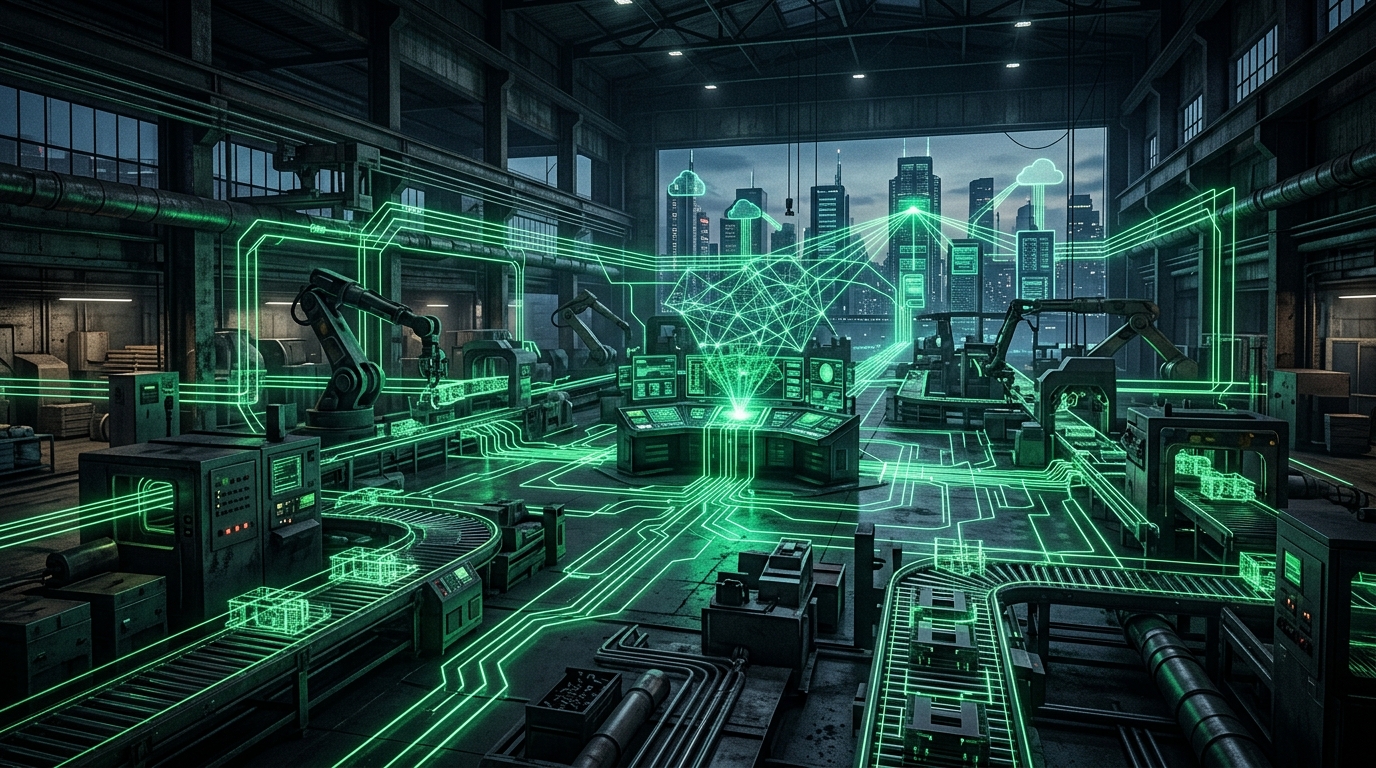
NVIDIA is no longer content to sell the shovel. It wants to define the mine, the map, the foreman, the power meter, and preferably the language everyone uses to describe the rocks.
That is the real story inside its latest physical-AI push. The easy version is that NVIDIA launched Cosmos 3, talked up AI PCs, expanded its AI cloud ecosystem, and introduced a factory-operations blueprint. Fine. Product announcements are a renewable resource, and NVIDIA now produces them with the calm confidence of a company that knows half the industry has to pretend the slide deck is a weather report.
The sharper point is this: NVIDIA is trying to make the physical world programmable through its stack.
Not metaphorically. Literally enough to matter.
This is not just a robotics model
Cosmos 3 is being sold as an open world foundation model for physical AI. NVIDIA says it combines physical reasoning, world generation, and action generation in one system, with checkpoints, datasets, training scripts, deployment tools, and NIM microservices. The company also claims leading results across physical-AI benchmarks and offers Nano and Super variants for different deployment tiers.
That sounds like model-launch theater until you look at what it is for. Cosmos is not mainly another image or video toy for the timeline. Its useful purpose is to help robots, autonomous vehicles, warehouse systems, and video agents reason about physical scenes, generate synthetic data, predict future states, and learn action policies.
In other words, it is not trying to win the internet’s weekly beauty contest for video clips. It is trying to become part of the training and operating loop for machines that move, inspect, transport, and decide in real places.
That distinction showed up quickly in developer reaction. In a Hacker News thread, several commenters pushed past the marketing copy and zeroed in on the practical question: is this a world model for physical systems, or just a glossy generator wearing a hard hat? One commenter noted that the special value is not generic video generation but action-conditioned prediction. Another was less charitable, saying some examples looked like “bad game engine and AI slop” and questioning whether they would make good training data for real-world systems.
Both reactions are useful. The hype is that synthetic worlds can compress robotics development from expensive physical iteration into software iteration. The skepticism is that reality has a nasty habit of not reading vendor benchmarks.
The factory agent is the tell
The more revealing announcement is NVIDIA’s Factory Operations Blueprint, or FOX. NVIDIA describes it as a reference design for an autonomous factory manager agent that connects machine signals, quality systems, work instructions, operational alerts, specialized agents, and robot fleets into one decision layer.
That phrase, “factory manager agent,” is where the temperature changes.
The industry spent the last year dressing chatbots as coworkers. NVIDIA is now dressing the factory control room as an AI system. FOX is meant to sit above the plant: watching quality, material transport, safety, machine data, operating procedures, and model training. It does not merely answer questions. It orchestrates.
The partner claims are, naturally, polished to a mirror finish. Foxconn projects an 80% improvement in root-cause analysis time, a 15% increase in labor productivity, and a 10% decrease in machine failure rates. Pegatron talks about reducing asset redundancy costs. Advantech talks about energy savings. Spingence claims 99.6% defect recall and fewer defect escapes.
Treat those numbers as forward-looking vendor evidence, not gospel. Partner ROI figures in launch posts should always be handled like a phaser set to “maybe.” Still, the architecture is the important signal. NVIDIA is not pitching one robot brain. It is pitching a repeatable control layer for industrial AI, built from NVIDIA models, NVIDIA blueprints, NVIDIA serving infrastructure, NVIDIA workstations, and NVIDIA cloud partners.
That is a platform move.
The cloud comes closer to the machine
The same pattern appears in NVIDIA’s AI cloud expansion. The company frames regional AI clouds as “AI factories” for training, fine-tuning, inference, agentic AI, physical AI, and sovereign AI. Partners are supposed to bring capacity closer to local industries, regulated data, national programs, developers, and physical systems.
Strip away the slogan and the operational logic is sound. Physical AI cannot live entirely in a generic cloud abstraction. Robots, cameras, vehicles, factories, hospitals, warehouses, and smart spaces have data gravity, latency constraints, compliance boundaries, and ugly integration surfaces. If AI is going to move from office text to operational control, compute has to get closer to where the world is being sensed and acted on.
This is where NVIDIA’s move becomes uncomfortable for competitors. The company is not merely defending GPU share. It is tying together local AI PCs, deskside supercomputers, regional clouds, synthetic data tools, world models, robot training workflows, and factory agent blueprints. Each piece strengthens the others. Each piece also makes it easier for customers to stay inside the NVIDIA orbit once they begin.
That is the quiet power of the strategy. CUDA was the developer moat. Physical AI may be the deployment moat.
The risk is the simulation becoming the sales pitch
There is a real breakthrough hiding in here: robotics and industrial AI desperately need better ways to generate rare cases, test policies, inspect workflows, and reduce dependence on slow physical data collection. Cosmos 3 and FOX point toward a future where factories can train, simulate, monitor, and adjust AI systems faster than today’s bespoke integration work allows.
But the trap is equally real. The better the simulation looks, the easier it becomes to confuse coverage with truth. A synthetic warehouse does not automatically capture the bent bracket, the tired operator, the miscalibrated sensor, the undocumented workaround, the pallet that arrived wet, or the machine whose behavior changed after maintenance three shifts ago.
Physical AI fails differently from text AI. A bad answer is annoying. A bad action can break equipment, waste material, injure someone, or quietly optimize the wrong process for weeks. The control layer matters more than the demo because the demo has no blast radius.
That is what readers should watch next: not whether Cosmos 3 wins another benchmark, and not whether the phrase “AI factory” survives another keynote. Watch whether independent teams can reproduce useful results outside NVIDIA’s partner orbit. Watch whether factory agents get real audit trails, rollback paths, hard permission boundaries, and failure-mode reporting. Watch whether synthetic data improves edge-case performance or merely makes the training set look busier.
NVIDIA’s bet is that the next great AI platform is not the chatbot. It is the world itself, wired through models, sensors, agents, and accelerated infrastructure.
That may be right. But if the physical world becomes the platform, the benchmark is no longer a leaderboard.
It is whether the machine stops when it should.