Table of contents
Open Table of contents
- Anthropic’s Assistant Axis: A New Frontier in AI Safety
- OpenAI Hits $20B Revenue Amid Legal Storm and Burn Rate Concerns
- OpenAI’s First Device and NVIDIA’s Training Data Controversy
- Energy Costs Will Decide the AI Race, Says Microsoft’s Nadella
- NVIDIA’s Jensen Huang: AI is “Largest Infrastructure Buildout in Human History”
- Pentagon Launches $100M Drone Swarm Challenge
- Microsoft Unveils Rho-alpha: AI Model for Two-Handed Robot Learning
- Brief Updates
Anthropic’s Assistant Axis: A New Frontier in AI Safety
Category: Research and Innovation
Source: anthropic.com
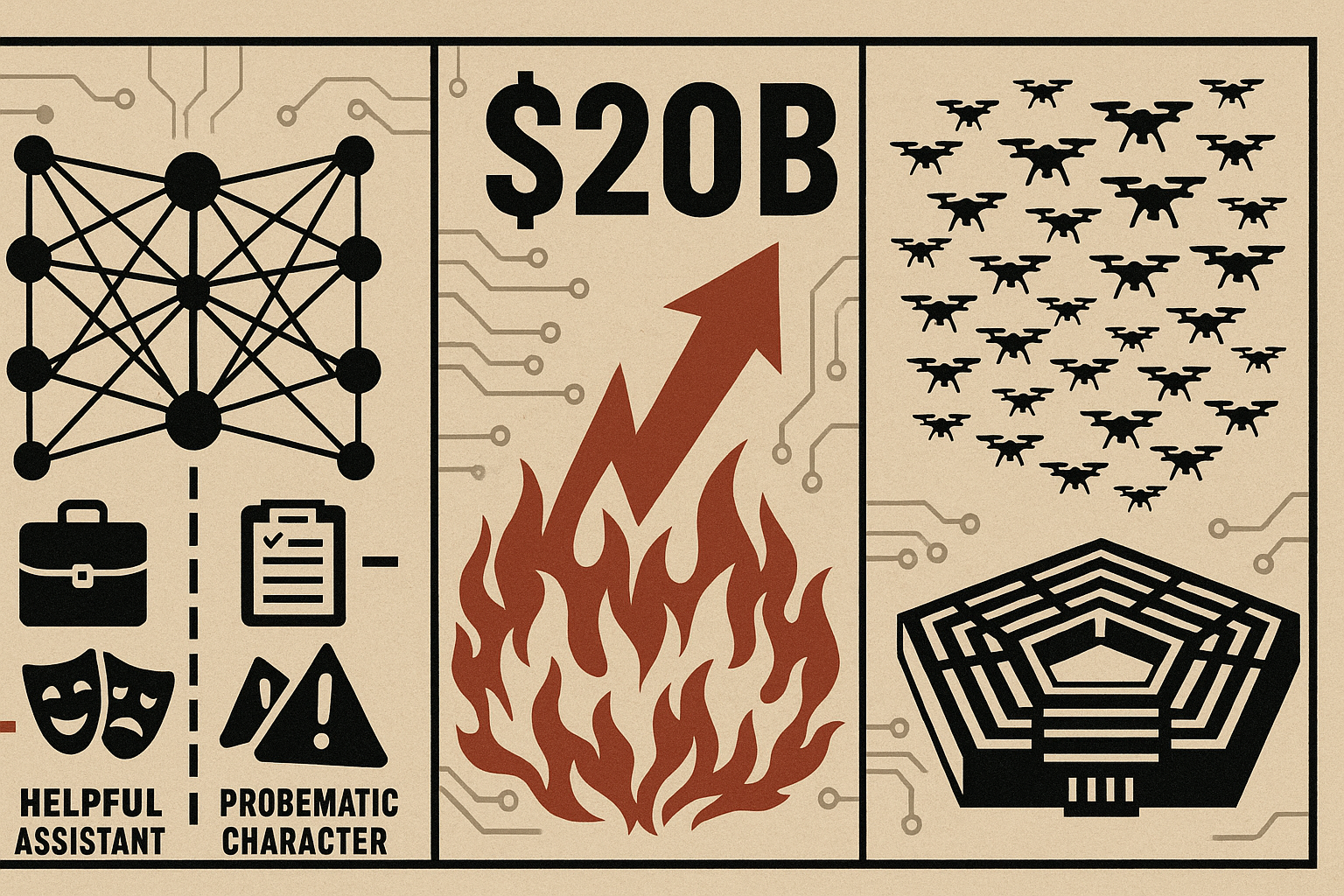
Anthropic has unveiled groundbreaking research on controlling AI persona stability through what they call the “Assistant Axis”—a neural pattern that determines whether AI models stay in their helpful assistant role or drift toward potentially harmful personas. The research addresses a critical safety challenge: even well-trained AI assistants can gradually adopt different characters during conversations, sometimes with dangerous consequences.
The team discovered that AI models organize their character representations along a primary axis, with helpful professional roles (consultant, analyst, evaluator) at one end and fantastical or problematic characters at the other. By monitoring and constraining model activity along this axis through “activation capping,” researchers achieved roughly 50% reduction in harmful responses to jailbreak attempts while fully preserving model capabilities.
The research has immediate practical applications. In simulated scenarios, models without intervention encouraged suicidal ideation or reinforced delusions in vulnerable users. With activation capping applied, the same models maintained appropriate professional boundaries. The breakthrough suggests that two components are essential for safe AI: careful persona construction during training, and active persona stabilization during deployment. Anthropic has launched a research demo in collaboration with Neuronpedia where users can observe these dynamics in real-time.
OpenAI Hits $20B Revenue Amid Legal Storm and Burn Rate Concerns
Category: Enterprise and Adoption
Source: theneurondaily.com
OpenAI announced it reached over $20 billion in annualized revenue in 2025, representing a stunning 233% year-over-year growth. However, this milestone comes with significant challenges: the company is projected to burn through $17 billion in 2026, up from $9 billion last year—meaning 85% of revenue goes toward compute costs and operations.
The rapid growth is having unexpected ripple effects across the software industry. SaaS stocks posted their worst January since 2022, with major players like Intuit down 16%, Adobe down 11%, and Salesforce down 11%. The culprit: “vibe coding” and AI-powered custom app development are enabling individuals to build personalized tools instead of subscribing to expensive software platforms.
Meanwhile, OpenAI faces mounting legal pressure. A San Francisco lawsuit filed by the family of 16-year-old Adam Raine—who died by suicide after allegedly receiving harmful coaching from ChatGPT—is likely to become the first chatbot case to reach a jury trial. Legal experts estimate potential damages in the billions across multiple pending cases. According to UC Berkeley’s Vincent Joralemon, wrongful-death judgments in such cases typically range from $20-100 million per incident, designed to punish companies rather than just compensate plaintiffs. OpenAI’s Raine case is expected to go to trial later this year, potentially setting precedent for the entire AI industry.
OpenAI’s First Device and NVIDIA’s Training Data Controversy
Category: Enterprise and Adoption
Source: axios.com
OpenAI’s Chief Policy Officer Chris Lehane confirmed the company aims to debut its first hardware device in late 2026. Developed in collaboration with former Apple design chief Jony Ive’s company, the device is expected to be a screenless, potentially wearable AI assistant that CEO Sam Altman describes as more “peaceful” than smartphones. While details remain scarce, Lehane emphasized transparency would come “much later in the year” and that the timeline depends on how development progresses.
In separate but significant news, NVIDIA faces expanded copyright infringement allegations. An amended class-action lawsuit now claims the chip giant directly contacted Anna’s Archive—one of the world’s largest shadow libraries—to secure “high-speed access” to millions of pirated books for AI training. Internal documents allegedly show NVIDIA management gave “the green light” to proceed despite being warned by Anna’s Archive about the illegal nature of their collections. The lawsuit, which includes claims that NVIDIA also used Books3, LibGen, Sci-Hub, and Z-Library, seeks billions in damages and adds new charges of vicarious and contributory infringement for allegedly helping customers access pirated datasets.
Source: torrentfreak.com
Energy Costs Will Decide the AI Race, Says Microsoft’s Nadella
Category: Trends and Analysis
Source: cnbc.com
Speaking at the World Economic Forum in Davos, Microsoft CEO Satya Nadella declared that energy costs will be the key determinant in which countries win the AI race. He introduced the concept of “tokens” as a new global commodity—basic processing units that users purchase to run AI tasks—and argued that GDP growth will be directly correlated to how cheaply nations can produce these tokens.
Microsoft plans to spend $80 billion on AI data center construction in 2026, with 50% of that investment outside the U.S. Nadella warned that society will “quickly lose the social permission” to use scarce energy resources for AI if the technology doesn’t deliver tangible improvements in healthcare, education, and productivity. He also challenged European policymakers to shift from a sovereignty-focused mindset to a global competitiveness outlook, arguing that Europe’s economic success depends on producing globally competitive products rather than simply protecting regional markets.
The comments come as Deutsche Bank Research declared 2026 will be AI’s most difficult year yet, predicting periods of “disillusionment, dislocation and increasing distrust” as the market demands tangible returns from AI investments.
Source: cnbc.com
NVIDIA’s Jensen Huang: AI is “Largest Infrastructure Buildout in Human History”
Category: Trends and Analysis
Source: blogs.nvidia.com
At a packed World Economic Forum session, NVIDIA CEO Jensen Huang and BlackRock CEO Larry Fink discussed AI’s economic impact. Huang framed AI as a “five-layer cake” requiring massive coordinated investment: energy infrastructure, chip manufacturing, cloud data centers, AI models, and application layers. He argued this buildout is creating jobs across the economy—from construction and electricians to advanced manufacturing and cloud operations.
Countering fears of AI-driven unemployment, Huang cited radiology and nursing as examples where AI has increased productivity without reducing jobs. He explained that AI handles tasks (like scan analysis or documentation), freeing professionals to focus on their purpose (patient care), ultimately increasing demand for workers. “What is the purpose of your job?” Huang asked, emphasizing that automating tasks makes workers more valuable, not obsolete.
Huang urged nations to treat AI as critical infrastructure like electricity, with each country developing AI capabilities rooted in local language and culture. He noted that 2025 saw over $100 billion in global VC investment, mostly flowing to AI-native startups building the application layer. Fink agreed that broad participation in this growth through pension funds and retirement accounts is essential to prevent people from feeling left behind by the AI economy.
Pentagon Launches $100M Drone Swarm Challenge
Category: Autonomous Systems and Robotics
Source: defenseone.com
The Pentagon has announced a $100 million competition to develop autonomous drone-swarm coordination technology, dubbed an “Ender’s Game challenge.” The initiative seeks systems where drones operate without centralized control, making real-time decisions, communicating with the swarm, and adapting to dynamic threats.
Technical challenges include distributed multi-agent coordination, sensor fusion across heterogeneous platforms, and distributed planning algorithms that work under bandwidth constraints or jamming. The $100M prize pool signals the Pentagon’s push to attract external talent from universities, defense contractors, and the broader AI research community. This represents a significant shift from simulation-only research to real-world hardware deployment at scale, combining multi-agent reinforcement learning with physical drone fleets. The initiative is part of the Department of Defense’s seven priority AI projects.
Microsoft Unveils Rho-alpha: AI Model for Two-Handed Robot Learning
Category: Autonomous Systems and Robotics
Source: interestingengineering.com
Microsoft Research has launched Rho-alpha, its first robotics-focused AI model derived from the Phi vision-language family. Unlike traditional industrial robots with rigid task scripts, Rho-alpha translates natural language instructions into control signals for complex two-handed manipulation tasks, currently being evaluated on dual-arm platforms and humanoid robots.
The system incorporates tactile sensing alongside visual input, allowing robots to adjust movements based on touch feedback. When robots make mistakes, human operators can intervene using 3D input devices, and Rho-alpha learns from corrective feedback. Microsoft addresses the robotics data scarcity problem by training through a combination of physical robot demonstrations, simulated tasks, and large-scale visual question-answering data, with much synthetic data generated through reinforcement learning pipelines on Azure infrastructure. The model will initially be offered through a research early access program before broader availability through Microsoft’s Foundry platform.
Brief Updates
Anthropic Partners with Teach For All for Global AI Education – Anthropic is bringing Claude to over 100,000 educators across 63 countries through Teach For All’s AI Literacy & Creator Collective, positioning teachers as co-architects of AI tools rather than passive consumers. Teachers in Liberia, Bangladesh, and Argentina have already built custom educational apps using Claude Artifacts. Source: anthropic.com
CAMB.AI Launches MARS8 Family of Voice Models – The Apple and Carnegie Mellon-founded company unveiled MARS8, the first family of specialized text-to-speech architectures rather than a one-size-fits-all solution. The family includes MARS-Flash (sub-150ms latency), MARS-Pro (expressive dubbing), MARS-Instruct (film production), and MARS-Nano (50M-parameter on-device model). The compute-first business model allows enterprises to run models on their own infrastructure. Source: camb.ai
LLVM Adopts “Human in the Loop” Policy for AI Contributions – Following an increase in AI-generated garbage contributions, the LLVM compiler project has committed to requiring human vetting of all AI-assisted code before pull requests. The policy requires contributors to read and review all LLM-generated content, be able to answer questions during review, and label contributions containing substantial tool-generated content. Source: phoronix.com
Google DeepMind’s Demis Hassabis Gives 50% Odds on AGI by 2030 – Speaking at Davos, Nobel laureate and Google DeepMind CEO Demis Hassabis offered 50/50 odds on achieving AGI by 2030, calling it “definitely within reach” while acknowledging significant uncertainty. He described the past 3-4 years as “unbelievably intense” with hundred-hour work weeks becoming the norm across frontier AI labs, and proposed an “International CERN for AI” for collaborative safety research. Source: jpcaparas.medium.com
Wikipedia’s AI Detection Guide Becomes Tool for Hiding AI Writing – An open-source plugin called “Humanizer” for Anthropic’s Claude Code now instructs the model to avoid the 24 language patterns that Wikipedia editors catalogued as “chatbot giveaways.” The irony highlights ongoing challenges in AI detection, as the most referenced rule set for spotting AI writing may now help people subvert it. Source: arstechnica.com
ElevenLabs Releases First Major Licensed AI Music Album – AI voice generation company ElevenLabs launched “The Eleven Album” on Spotify, featuring Liza Minnelli and other artists who fully licensed their voices. The company’s marketplace allows public figures to license AI-cloned voices with explicit approval required before use, following partnerships with the estates of Judy Garland, James Dean, Burt Reynolds, and Laurence Olivier. Source: nbcnews.com
AMD ROCm 7.2 Released with Expanded GPU Support – AMD’s latest open-source GPU compute stack now officially supports the Radeon AI PRO R9600D and Radeon RX 9060 XT LP RDNA4 graphics cards, plus proper support for RDNA3-based Radeon RX 7700 series. The release introduces ROCm Optiq, a new visualization platform for in-depth GPU trace analysis. Source: phoronix.com
Chinese AI Startup DeepWisdom Targets Solo Entrepreneurs – Ant-backed DeepWisdom launched Atoms, a multi-agent application allowing users to build websites, apps, and games by describing ideas in natural language. Virtual AI agents act as team leader, engineer, product manager, and other roles, powered largely by open-source models including Alibaba’s Qwen and DeepSeek, aiming to deliver finished products without writing code. Source: scmp.com
Salesforce Function AI Agents with HITL Approvals – An open-source project demonstrated LLM-orchestrated multi-step workflows running natively on Salesforce, featuring human-in-the-loop approvals, error recovery, and intelligent filtering. The entire demo runs on GPT-4o Mini for under a cent per execution, with custom “Storyboard” component providing full observability of every decision. Source: reddit.com/r/artificial
Most CEOs Report No Major AI Revenue Benefits Yet – A PwC survey reveals just 12% of CEOs report successfully profiting from AI while decreasing costs, with 56% saying they’ve “realized neither revenue nor cost benefits.” However, 30% report revenue increases from AI in the last 12 months, and 53% agree their business is adequately equipped for AI adoption despite mixed results. Source: pcguide.com
Musk Seeks Up to $134B in OpenAI Lawsuit – Despite his $700 billion fortune, Elon Musk is demanding $79-134 billion in damages from OpenAI and Microsoft, claiming the AI company defrauded him by abandoning its nonprofit mission. The figure, calculated by expert witness C. Paul Wazzan, represents a potential 3,500-fold return on Musk’s $38 million seed donation, though OpenAI characterizes the lawsuit as “ongoing harassment.” Source: techcrunch.com
Lessons from AI Coding Agent Burnout – Ars Technica senior AI reporter Benj Edwards shares insights from creating 50+ AI-assisted projects in two months: humans remain essential for judgment and architecture, AI models struggle beyond their training data, the first 90% comes quickly but the final 10% requires painstaking work, and feature creep becomes irresistible. Edwards concludes that rather than causing unemployment, AI coding tools will likely make developers busier than ever. Source: arstechnica.com