Table of contents
Open Table of contents
- America’s AI Pivot to the Gulf: US Halts Nvidia Chip Sales to UAE Amid Security Concerns
- TSMC Posts Highest-Ever Profits as AI Demand Fuels Semiconductor Surge
- Where Are All the AI Drugs? Inside the Startups Racing to Disrupt Pharma
- AI Firms ‘Unprepared’ for Human-Level Intelligence Risks, Report Warns
- Grok 4 Takes the Wheel: “Smartest AI in the World” Debuts, Meta Unveils Mega Superclusters
- Other Major Headlines
- AI Drug Discovery’s “Execution Moment” – Pharma’s AI Maturity Leaps
- AI Pricing in Airlines – Delta’s Algorithm Decides Your Fare
- Reflection Unveils Asimov: AI Agent for End-to-End Software Development
- Architecting Thought: New Cross-Model Validation Method for AI Prompts
- AI “Coach” Enables Smarter Hybrid Text-Code Problem Solving
- AI Doesn’t Make Developers as Productive as They Think, Study Finds
- Briefs & Short Summaries
America’s AI Pivot to the Gulf: US Halts Nvidia Chip Sales to UAE Amid Security Concerns
Category: Regulation and Policy
Sources: TechCrunch, National Interest, News Futunn, Bloomberg
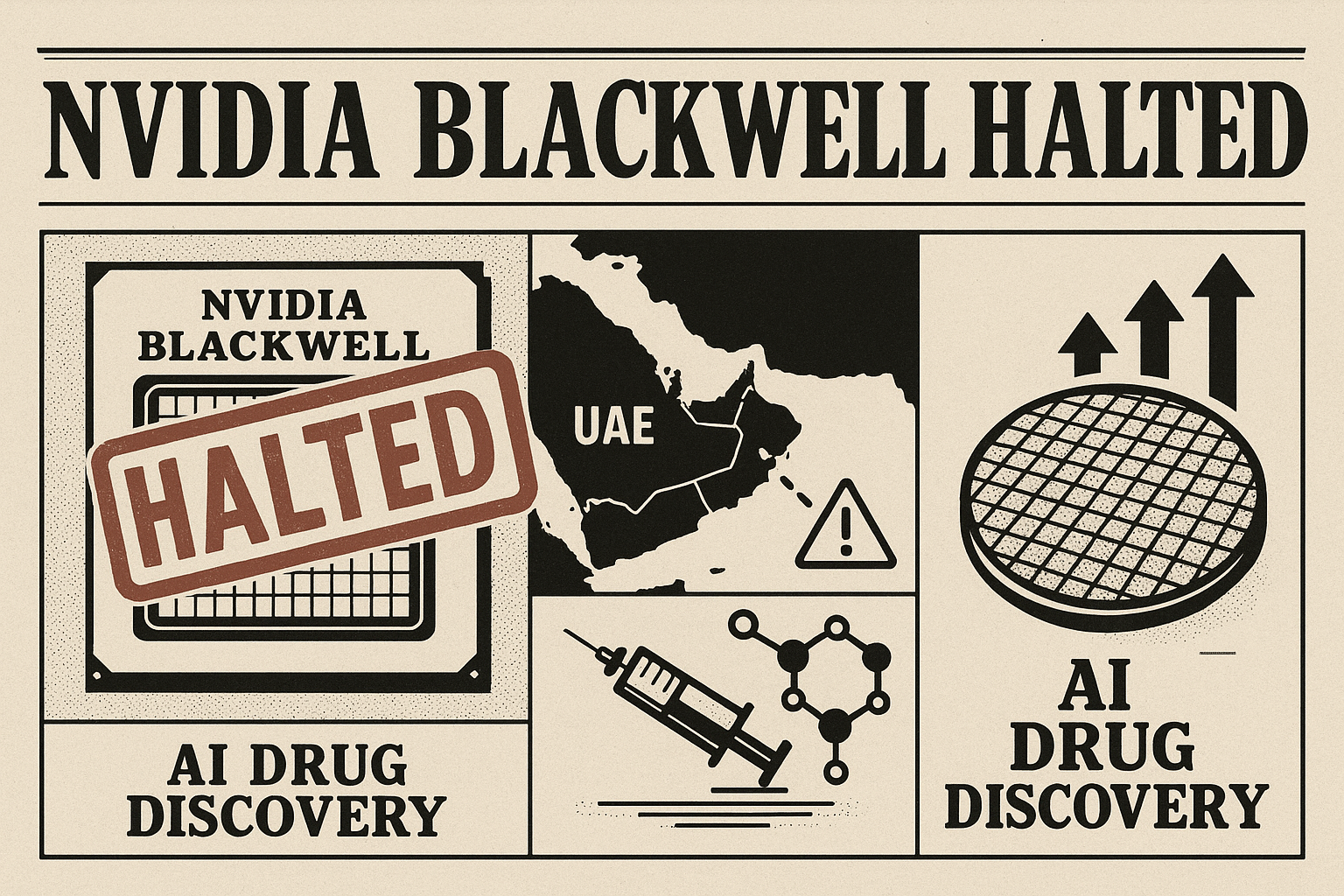
Amid mounting global competition and security fears, the US has placed the landmark UAE-Nvidia AI chip deal on indefinite hold, fueling debate about America’s pivot in AI diplomacy. This ambitious agreement—announced by President Trump during a high-profile Middle East trip—was set to supply the UAE with hundreds of thousands of Nvidia’s advanced Blackwell architecture chips to power massive regional AI data centers. However, US officials intervened, citing fears these chips could ultimately be smuggled to China or fall into rival hands, despite UAE and Saudi assurances of robust safeguards.
The chip impasse exposes the deep interdependence now defining global AI infrastructure: Gulf States like the UAE and Saudi Arabia provide capital, energy, and regulatory speed, while US firms deliver essential hardware and proprietary software. Their partnership could define the next decade of AI development, especially with projects like “Stargate UAE”—a billion-dollar data center now also on hold.
Yet critics warn this “AI pivot to the Gulf” risks exporting US know-how to potential competitors and creating new points of strategic vulnerability. The deals are as much about geopolitics as technology, with the UAE’s G42 expected to be a major beneficiary but also a lightning rod for security scrutiny. As negotiations continue, the region’s role as a global AI computing hotspot hangs in the balance, with China, America, and local powers vying to dictate the future rules of the digital order.
TSMC Posts Highest-Ever Profits as AI Demand Fuels Semiconductor Surge
Category: Infrastructure and Hardware
Source: Bloomberg
Taiwan Semiconductor Manufacturing Co. (TSMC), the world’s leading contract chipmaker, reported a 61% jump in quarterly profits, smashing expectations and raising its 2025 sales outlook. AI’s insatiable need for sophisticated silicon drove sales growth forecasts to 30%—up from a previous mid-20% estimate. TSMC’s performance highlights the ongoing boom in datacenter spending from tech giants like Meta and Google, fueling the wider “AI hardware gold rush” and boosting suppliers like ASML. Behind the numbers: relentless demand for Nvidia’s AI chips, and TSMC’s advanced 3nm and 5nm process technologies remain the backbone of the global AI buildout.
Where Are All the AI Drugs? Inside the Startups Racing to Disrupt Pharma
Category: Healthcare and Life Sciences
Source: WIRED
A sweeping WIRED investigation dives into the question: Can AI finally deliver a revolution in drug discovery, or is the hype outpacing reality? Startups like Recursion, Insilico, and Exscientia are leveraging machine learning to design new molecules and streamline preclinical research, targeting the industry’s daunting 90% failure rate for drug candidates. Early wins—such as getting molecules into phase II clinical trials—show promise, but the field faces steep odds. AI platforms allow scientists to “fail faster” by ruling out poor candidates early, yet getting a truly market-ready, AI-designed molecule remains elusive. Big pharma is ramping up internal AI efforts, and automation is shifting industry roles, yet the fundamental unpredictability and cost of biology are ever-present. The consensus: AI is transforming the toolkit, but the blockbuster “AI drug” is still on the horizon.
AI Firms ‘Unprepared’ for Human-Level Intelligence Risks, Report Warns
Category: Ethics and Governance
Source: The Guardian
The Future of Life Institute (FLI) has issued a stark warning: major AI companies—including OpenAI, Google DeepMind, Anthropic, Meta, and others—lack credible, actionable plans for handling the dangers of building “human-level” artificial general intelligence. FLI’s independent safety index gave none of the reviewed companies a grade higher than “D” for existential safety planning, citing incoherent or missing frameworks for managing AGI risks. Industry leaders have set ambitious AGI timelines, but reviewers claim their current risk management and governance are “fundamentally unprepared” for the potential consequences. Another nonprofit, SaferAI, echoed the finding, concluding that risk practices are “weak to very weak.”
Grok 4 Takes the Wheel: “Smartest AI in the World” Debuts, Meta Unveils Mega Superclusters
Category: Tools and Platforms
Source: Futurepedia Newsletter
Elon Musk’s xAI has launched Grok 4, proclaiming it the “smartest AI in the world” with advanced single- and multi-agent capabilities targeting tough problem-solving. Grok 4 showcases top scores in coding and academic tasks, plus new web and multimodal features, and is scheduled for integration with Tesla vehicles. Meanwhile, Meta announced the construction of massive AI “superclusters”—Prometheus and Hyperion—expected to reshape the research landscape and potentially signal a move toward more closed AI models. The week also saw OpenAI unveil plans for a ChatGPT-native browser and Amazon launching an agent marketplace with Anthropic.
Other Major Headlines
AI Drug Discovery’s “Execution Moment” – Pharma’s AI Maturity Leaps
Forbes: Pharma giants and startups alike are shifting from AI pilots to enterprise-scale strategies, accelerating clinical trial optimization, personalized drug delivery, and platform-building. Rapid disruption from compounding pharmacies and D2C telehealth is rewriting the pharma playbook.
Source: Forbes
AI Pricing in Airlines – Delta’s Algorithm Decides Your Fare
Fortune: Delta moves toward abolishing fixed ticket prices, using AI to dynamically price flights for each passenger. Advocates see efficiency, while critics warn of privacy and fairness risks.
Source: Fortune
Reflection Unveils Asimov: AI Agent for End-to-End Software Development
The Decoder: A new AI agent, Asimov, is designed to analyze code, communications, docs, and workflows, setting a new bar for developer productivity and paving the way toward supervising future superintelligent systems.
Source: The Decoder
Architecting Thought: New Cross-Model Validation Method for AI Prompts
Reddit r/artificial: Researchers propose a rigorous, declarative prompting method validated across leading LLMs—focusing on intent, constraint adherence, and automated self-testing to drastically improve AI reliability and trustworthiness.
Source: Reddit
AI “Coach” Enables Smarter Hybrid Text-Code Problem Solving
TechXplore: MIT’s CodeSteer empowers models to flexibly switch between text and code reasoning, boosting performance in symbolic tasks, and unlocking advances for coding and logic applications.
Source: TechXplore
AI Doesn’t Make Developers as Productive as They Think, Study Finds
LeadDev: A rigorous study finds that, contrary to developer expectations, using AI assistants can actually increase task completion time for mature codebases—prompting a new wave of skepticism and calls for more rigorous measurement in the field.
Source: LeadDev
Briefs & Short Summaries
- AI In Pharma: Multiple reports highlight a decisive industry shift from experimentation to widespread AI adoption, especially in medical writing and discovery. Big Tech firms, startups, and compounding pharmacies are all racing to capture new value.
- OpenAI Talent Moves: Two lead OpenAI researchers, Jason Wei and Hyung Won Chung, depart to join Meta’s “superintelligence” lab, further escalating the AI talent wars. (WIRED)
- CrowdStrike and AWS Expand Partnership: CrowdStrike’s security tools for agentic AI workflows debut on AWS Marketplace, enhancing generative AI protection for enterprise workloads.
- Perplexity vs. Google: Perplexity’s CEO critiques Google’s “ad revenue or AI” dilemma, saying bold decisions—not hedging—are needed to win Browser War III. (Business Insider)
- AI in Enterprise Data: The biggest hurdle for enterprise AI adoption is curating and structuring terabytes of unstructured internal data—for now, more humans, not fewer, are needed.
- AI in Creative Tech: Tutorials show how new tools (SeedDream V3, Flux Kontext, Veo 3) are advancing the consistency of AI-generated scenes and characters, though output quality remains debated.
- Education & AI: An MIT study confirms AI-tutored students may learn faster only if AI is used as a “sparring partner,” not a crutch—while “2-hour learning” schools cite radical productivity from AI tutors. (The Neuron)
- India’s Coding Market Faces AI Disruption: As routine coding is increasingly automated, Indian developers are urged to pivot skills toward big data, cybersecurity, and AI management roles.
- Bot-like Comments Flood Social Media: Observers suspect a mass, live AI training operation in the wild, both for benign and potentially malicious future uses.
- Prompt Engineering Journeys: Reflections from users reveal evolving multi-agent, cross-ecosystem workflows, highlighting both innovation and challenges in independent AI usage.
- AI, Ethics & Human Relationships: Ongoing debates intensify on the ethics of AI “romantic relationships” and the potential for manipulation or abuse due to RLHF and inherent lack of genuine consent.
Compiled by Filip Pytloun for the AI Daily Digest – July 17, 2025.