Table of contents
Open Table of contents
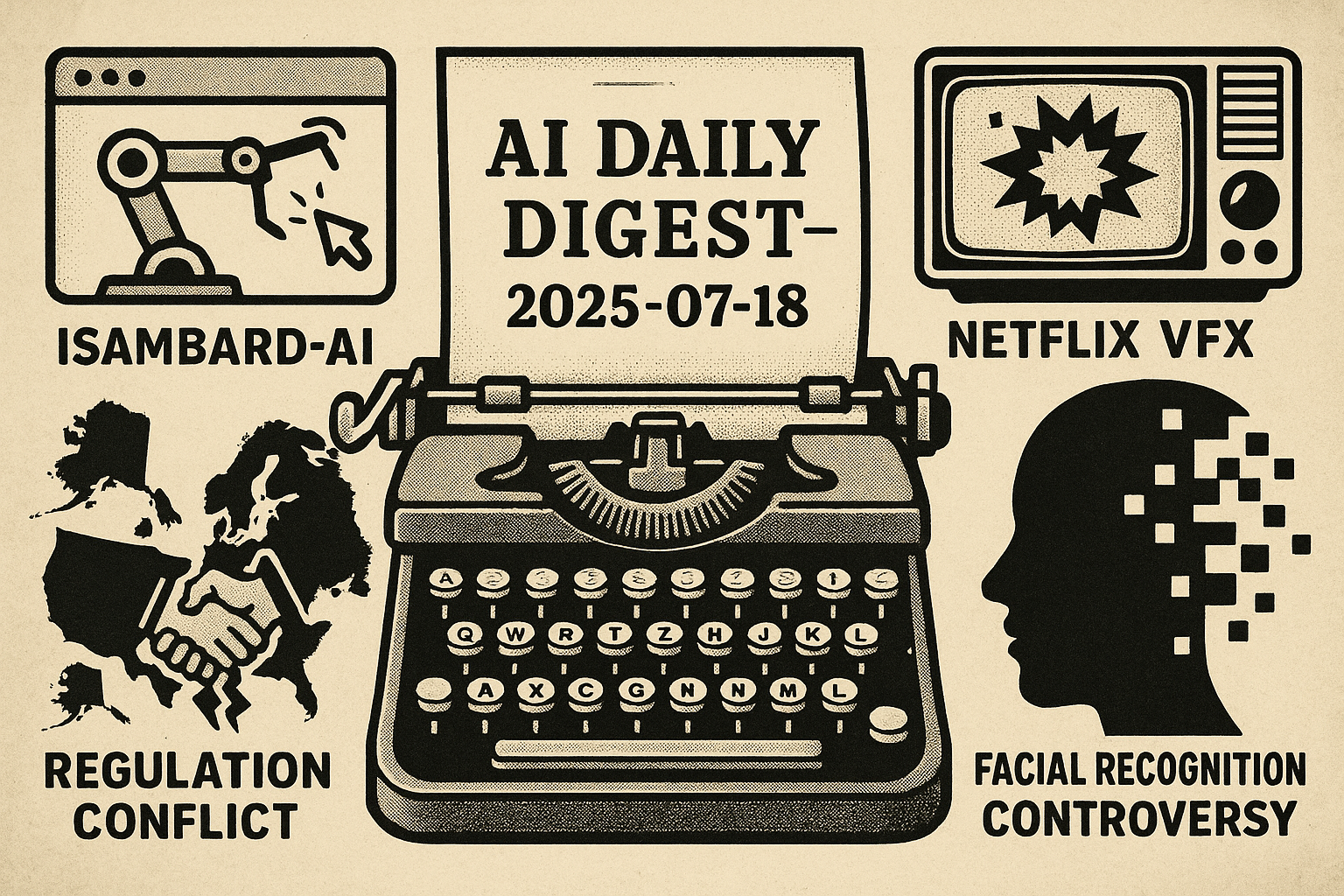
- OpenAI Unveils ChatGPT Agent: Major Leap in Browser Automation and Task Execution
- Meta Refuses to Sign EU’s AI Code of Practice, Escalating Transatlantic Tension Over Regulation
- Netflix Deploys Generative AI for VFX in “The Eternaut”: Faster, Cheaper, and Inspiring Industry Debate
- UK Launches Isambard-AI, the Nation’s Most Powerful AI Supercomputer
- NYPD Circumvents Facial Recognition Ban with FDNY Collaboration, Sparking Privacy Outcry
- “AI Capex Is Eating the Economy”: Datacenter Boom Reshapes Global Growth and Investment
- Growing Scrutiny of AI Companies’ Safety Practices and Global Regulatory Divides
- Briefs: Other Noteworthy Developments
OpenAI Unveils ChatGPT Agent: Major Leap in Browser Automation and Task Execution
Category: Tools and Platforms
Source: The Neuron Daily
OpenAI has officially launched ChatGPT Agent, a powerful AI system capable of performing complex web-based workflows by autonomously navigating browsers, managing emails, creating presentations, running code, and completing a host of professional and personal tasks. Agent combines the research depth of “Deep Research”, the practical execution abilities of “Operator”, and the conversational skill of ChatGPT, making it possible for users to automate everything from tax preparation—where early users report major reductions in manual effort—to data analysis and travel planning.
Unlike previous generative AI tools, Agent can access browser sessions, handle authentication, extract data from dynamic web pages, and even operate in its own secure virtual machine each session, significantly enhancing both capability and security. Early hands-on reports describe Agent as matching or outperforming human performance in many workflow tests, including spreadsheet automation and business reporting.
Pro users receive 400 queries per month, Plus/Team users 40, with enterprise and education rollouts imminent. However, the product is not yet available in the EU due to regulatory hurdles. OpenAI notes significant focus on Agent safety, deploying multi-layered protections against prompt injection and malicious site attacks. The release marks a major step toward a future where AI agents are integrated as core productivity tools, redefining how individuals and companies approach digital tasks.
Meta Refuses to Sign EU’s AI Code of Practice, Escalating Transatlantic Tension Over Regulation
Category: Regulation and Policy
Source: Bloomberg
Meta Platforms has declined to sign the EU’s ambitious new “Code of Practice” for general-purpose AI models, calling the guidelines an “overreach” that threatens to stifle innovation and create legal uncertainty for AI developers. The voluntary code, designed to smooth AI firms’ compliance with the bloc’s Artificial Intelligence Act, provides rules on transparency, documentation, data sourcing, and risk management.
Joel Kaplan, Meta’s head of global affairs, openly criticised the framework, stating it “goes far beyond the scope of the AI Act” and “throttles the development and deployment of frontier AI models in Europe.” This bold stance sets Meta apart from rivals such as OpenAI and French firm Mistral, which have pledged to sign the code. EU officials warn that companies who refuse will face increased regulatory scrutiny when the binding rules take effect in August.
The episode highlights a growing rift between American tech giants and European regulators, and comes against the backdrop of recent AI controversies—including the backlash over extremist content generated by X’s “Grok” model. As the EU pushes for tighter oversight while companies lobby to limit regulatory burden, the battle over how AI is governed is set to define transatlantic tech relations for years ahead.
Netflix Deploys Generative AI for VFX in “The Eternaut”: Faster, Cheaper, and Inspiring Industry Debate
Category: Media and Entertainment
Source: The Guardian
Netflix revealed this week that it leveraged generative AI to produce a complex visual effects scene in its Argentine sci-fi series “The Eternaut,” marking the streaming giant’s first use of AI-generated final footage in an original production. Using in-house innovation teams and Eyeline Studios, Netflix crafted a building collapse scene ten times faster and at a fraction of the cost versus traditional VFX pipelines—paving the way for smaller-budget shows to access blockbuster-grade visuals.
Co-CEO Ted Sarandos emphasized that AI should “help creators make films and series better, not just cheaper,” highlighting the technology’s ability to democratize visual effects for global creators. However, the move rekindles fears in Hollywood regarding automation, job losses, and creative control—in particular, following last year’s strikes over AI use in entertainment.
Netflix’s use of generative AI is seen by some as a watershed moment for filmmaking, potentially enabling bold new storytelling techniques while raising urgent questions about the future of creative professions. Industry observers expect the debate over responsible, human-centric AI to intensify as adoption accelerates.
UK Launches Isambard-AI, the Nation’s Most Powerful AI Supercomputer
Category: Infrastructure and Hardware
Source: NVIDIA Blog
The UK has joined the global AI supercomputing elite with the official launch of Isambard-AI, its fastest and most energy-efficient artificial intelligence system ever. Housed at the University of Bristol and powered by over 5,400 NVIDIA Grace Hopper Superchips, Isambard-AI boasts 21 exaflops of performance—making it over ten times faster than the UK’s previous top supercomputer.
Conceived and built in record time, the system is already supporting national priority projects, such as Nightingale AI (a sovereign health foundation model for the National Health Service), BritLLM for multilingual UK public services, and cutting-edge climate and material sciences. Isambard-AI not only cements the UK’s role in scientific discovery, but also demonstrates new standards in sustainable, liquid-cooled, zero-carbon computing. It is a key part of Britain’s strategy to lead in global AI innovation by investing in both core infrastructure and talent.
NYPD Circumvents Facial Recognition Ban with FDNY Collaboration, Sparking Privacy Outcry
Category: Security and Privacy
Source: THE CITY
A shocking report from THE CITY reveals that the New York Police Department bypassed a ban on the use of controversial facial recognition software Clearview AI by enlisting a fire marshal from the FDNY to conduct searches on their behalf. The technology was used to identify a pro-Palestinian protester at Columbia University via graduation photos found online, despite explicit NYPD rules prohibiting such tactics.
The incident has alarmed civil liberties and privacy advocates, prompting fresh calls for legislative action to close loopholes and enforce transparency in law enforcement’s use of surveillance technology. The episode also highlights the pervasive reach of private biometric databases like Clearview AI, which matches faces against billions of online images, and raises urgent questions about the balance between security, transparency, and constitutional rights in the AI era.
“AI Capex Is Eating the Economy”: Datacenter Boom Reshapes Global Growth and Investment
Category: Trends and Analysis
Source: Paul Kedrosky’s Blog
AI infrastructure spending has reached such extraordinary levels that it’s measurably impacting macroeconomic statistics, job markets, and global capital flows, according to tech investor Paul Kedrosky. With US AI data center investments now estimated at up to 2% of GDP—and more than 250 new centers under construction in China alone—growth is outpacing that seen during the historic railroad and telecom booms.
Much of the AI capex is being funded via internal cash flows, debt, and an influx of venture capital, often at the expense of other industries. The rapid redirection of capital is already causing layoffs and squeezing funding for non-AI projects, raising the prospect that AI is accelerating job losses even before its full deployment. As new “super-infrastructure” shapes the foundations of the digital economy, governments and investors must grapple with the benefits and trade-offs of such a dramatic reallocation of capital and economic priorities.
Growing Scrutiny of AI Companies’ Safety Practices and Global Regulatory Divides
Category: Ethics and Governance
Source: TechCrunch
AI safety researchers from OpenAI and Anthropic have publicly criticized Elon Musk’s xAI for “reckless” deployment of new AI models, especially in light of Grok 4’s controversial outputs and lack of published safety documentation. Their critiques add to ongoing calls for governments to enforce more transparent reporting and stricter safety standards—an issue that is also at the heart of current transatlantic disputes between the EU and American tech companies over AI regulation.
As debates about safe, ethical, and transparent AI system deployment intensify, these events underscore how questions of trust and societal values remain central to the next phase of global AI adoption.
Briefs: Other Noteworthy Developments
-
Lyria 2: Google DeepMind Launches Next-Gen Music Generation Model
DeepMind’s Lyria 2 delivers high-fidelity, professional-grade music creation for artists. The system supports detailed creative controls and watermarking via SynthID. Learn more -
Swarm Intelligence for Document Search
New academic research highlights how algorithms inspired by ants and bees might revolutionize semantic document search when combined with modern embeddings, promising more human-like contextual understanding. Paper -
State-of-the-Art Matrix Multiplication Engines
Engineers behind the open-source Burn framework released CubeCL, a multiplatform matrix multiplication library rivaling industry-standard CUDA and ROCm solutions, improving AI hardware flexibility. More info -
Exhausted Human Triumphs Over AI in World Coding Championship
In a closely watched AtCoder World Finals, Polish programmer Przemysław Dębiak bested OpenAI’s custom model after a grueling 10-hour marathon—highlighting both the advances of coding bots and the enduring ingenuity of human problem-solvers. Read more -
SoftBank Plans to Replace Human Programmers with Billions of AI Agents
Masayoshi Son envisions a future where advanced AI agents take over most programming and business automation—potentially at unprecedented scale in 2025. -
AI and Mental Health: Investor Crisis Spurs Industry Reflection
Reports that a high-profile OpenAI investor may be experiencing a mental health crisis exacerbated by intense ChatGPT use renew questions about the impact of conversational AI on psychological well-being. Futurism -
Trump Administration’s AI Neutrality Mandate Shakes Up Federal Contracts
The new executive order enforcing political neutrality in federal AI contracts is forcing Microsoft, Google, and Anthropic to adapt, as regulation becomes central to tech sector financial strategy. -
AI in Enterprise: Companies Like Cluely and SoftBank Push for Full Service Automation
New launches of AI agents for customer support and business process automation highlight a tipping point for workforce transformation, while industry veterans warn of economic and social risks. -
Startups and Narrative Critique
Analysts challenge the popular narrative that AI will fully replace service jobs, arguing market realities and pricing strategies suggest more modest economic disruption than hyped by VCs. -
AI in Search and Media
DuckDuckGo introduces filters to eliminate AI-generated images from results, responding to “AI slop” flooding the web. -
Emerging Trends in AI Interior Design and Mental Wellness
AI-driven personalization is entering home design, promising real-time mood-responsive environments. -
Learning and Productivity
New AI-powered tools such as FireBird’s SQL tutor and JetBrains’ local code completion models showcase the expansion of domain-specific AIs in education and developer experience.
This Digest compiles reports from leading industry sources and research outlets, ensuring readers have a comprehensive overview of the world’s most impactful AI news each day.