Table of contents
Open Table of contents
- Europe Sharpens AI Regulation: Google Signs EU AI Code, Meta Holds Back
- Meta Shifts Superintelligence Strategy: Open Source No Longer Default
- Wyoming’s Epic AI Datacenter to Use Five Times More Power Than State’s Residents
- Sweeping Legal Wave: Global AI Copyright, Patent, and Liability Rulings
- AI Security Risks Laid Bare: Vulnerability in Base44 “Vibe Coding” Platform
- ChatGPT Launches Study Mode, Pivots AI for Education
- Microsoft Study Details AI’s Place in the Future of Work
- AI Hardware and Funding: Nvidia’s Surging Growth, Groq’s $6B Valuation, and More
Europe Sharpens AI Regulation: Google Signs EU AI Code, Meta Holds Back
Category: Regulation and Policy
Sources: Google - EU AI Code of Practice, CNBC, TipRanks
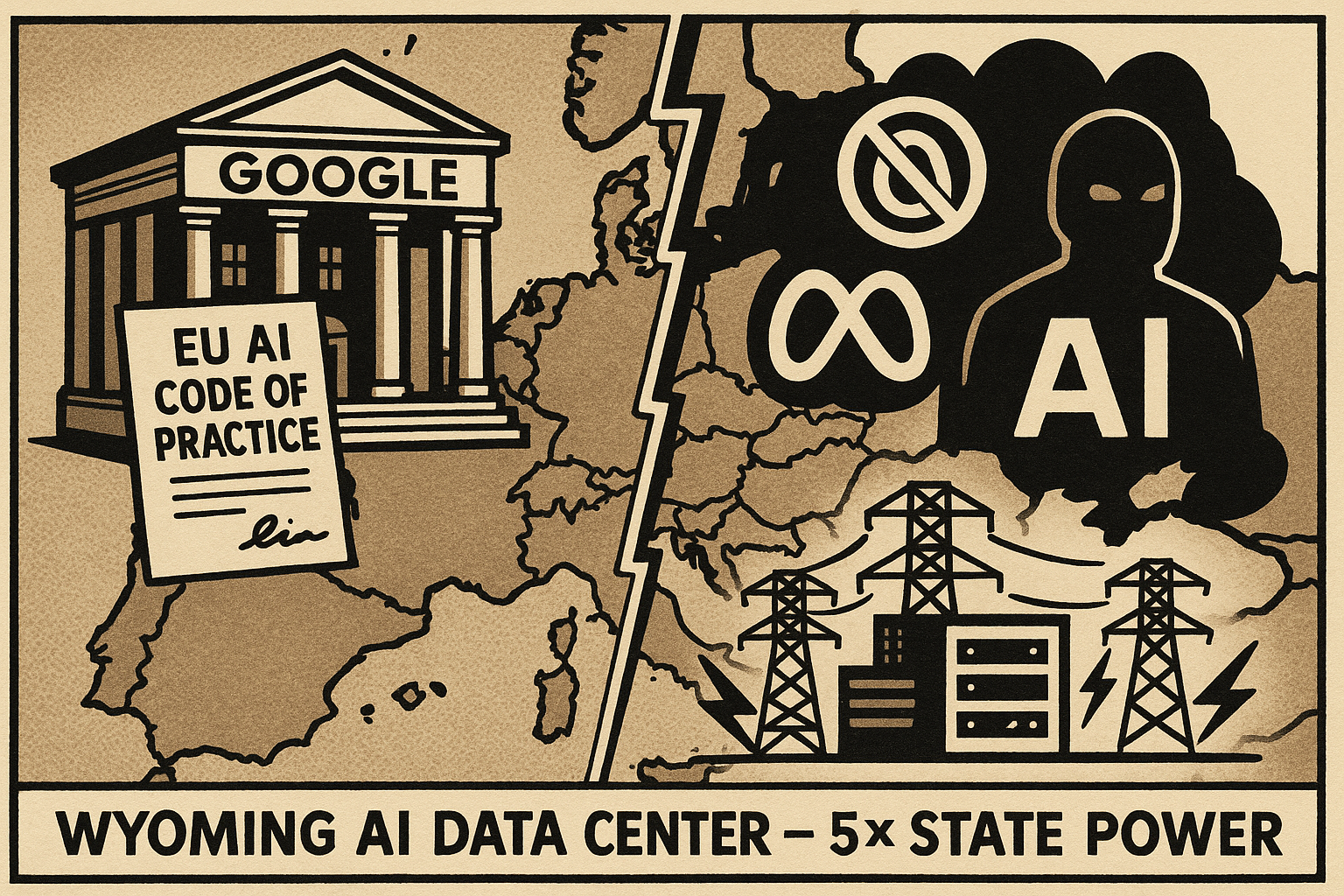
The artificial intelligence regulatory environment in Europe advanced significantly as Google declared its intent to sign the European Union’s General Purpose AI Code of Practice, a step that brings its operations into alignment with the stringent new EU AI Act. The Code—which will guide legal compliance for companies offering general-purpose AI models—mandates measures like transparent documentation, AI system registration, and robust risk management, especially for high-risk applications such as biometrics, education, and employment.
Google expressed hope that the Code will foster innovation while warning that certain aspects, such as deviations from EU copyright law and requirements potentially exposing trade secrets, may hinder European AI competitiveness. Alphabet’s chief legal officer, Kent Walker, emphasized continued engagement with regulators to ensure flexibility as the field evolves.
In contrast, Meta declined to sign the Code, citing concerns over legal ambiguities and innovation-stifling measures. Meta’s global affairs chief called the framework an overreach, potentially “stunting” the industry’s growth within the bloc. While other U.S. tech giants like Microsoft indicated support, the division marks a pivotal moment and throws into relief the growing transatlantic tension over the governance of advanced AI.
Source: Google Blog
Meta Shifts Superintelligence Strategy: Open Source No Longer Default
Category: Enterprise and Adoption
Source: TechCrunch
In a notable pivot, Meta CEO Mark Zuckerberg announced a revised approach to the distribution of the company’s most advanced AI models, indicating that not all “superintelligence”-level systems will be open source. Historically, Meta championed AI openness through its Llama family of models, positioning accessibility as a key differentiator. However, Zuckerberg now signals heightened caution, referencing “novel safety concerns” and the need for selectivity in what is made public.
This new posture follows extensive multi-billion-dollar investments in talent, data centers, and corporate acquisitions to close the gap with rivals like OpenAI. Meta has restructured its AI divisions under the Superintelligence Labs brand, and chatter is growing about a new, closed Behemoth model under test. Industry watchers see this as reflective of a broader industry trend toward closed, proprietary development at the implementation frontiers of AGI.
Source: TechCrunch
Wyoming’s Epic AI Datacenter to Use Five Times More Power Than State’s Residents
Category: Infrastructure and Hardware
Sources: Ars Technica, Tom’s Hardware
In a momentous move underscoring AI’s surging infrastructure demands, Cheyenne, Wyoming is set to host a data center with energy needs exceeding those of all the state’s homes combined. Led by Tallgrass and Crusoe, the project starts with an initial 1.8 gigawatt phase—already five times the combined residential consumption—and aims to scale up to a staggering 10 gigawatts. This expansion would eventually consume more than double the state’s total electricity output annually.
Unable to pull from the public grid, the facility will operate on its own dedicated natural gas and renewable sources. While the development boosts Wyoming’s natural gas sector and cements the state’s emerging status as a datacenter hub, local energy prices and environmental concerns have sparked debate. Speculation abounds around tenancy, with OpenAI’s ambitious Stargate infrastructure cited as a possible final user, though no confirmation has been given.
Source: Ars Technica
Sweeping Legal Wave: Global AI Copyright, Patent, and Liability Rulings
Category: Regulation and Policy
Source: Reddit - r/ArtificialInteligence
A comprehensive global roundup details the cascade of court cases shaping AI’s legal landscape. Across the U.S., EU, China, and several other jurisdictions, courts are issuing rulings that establish precedents on fundamental questions: Can AI be granted patents or copyrights? What constitutes infringement in the realm of data and image scraping? What are the liabilities for bias, privacy violation, or negligent deployment of AI systems?
Key highlights include U.S. and international courts’ refusal to treat AI-generated works as patent- or copyrightable when lacking sufficient human input, while some Chinese courts are granting copyright in specific cases of significant human creativity. Ongoing lawsuits against major AI companies—OpenAI, Meta, Anthropic—over content scraping, IP infringement, and ethical red lines, as well as cases exploring algorithmic discrimination, wrongful arrest via facial recognition, and more, illustrate just how rapidly the regulatory and legal context is evolving.
Legal observers anticipate further test cases as the industry matures and as nations seek the right policy balances between innovation, ownership, and protection of individual rights.
Source: Reddit - AI Court Cases Summary
AI Security Risks Laid Bare: Vulnerability in Base44 “Vibe Coding” Platform
Category: Security and Privacy
Source: Wiz.io
Wiz Research has disclosed a critical authentication vulnerability in Base44, a popular AI-powered “vibe coding” platform (recently acquired by Wix). Exploitable with minimal technical sophistication, the flaw allowed unauthorized users to register for private enterprise apps simply by presenting a non-secret app_id, bypassing intended controls like SSO. Attackers could gain access to sensitive corporate data and internal tools.
Wix and Base44 responded swiftly, patching the issue within 24 hours and reporting no evidence of abuse. The incident, however, underscores systemic security challenges as AI development platforms become the backbone for enterprise workflows, particularly those aimed at enabling non-technical users to create complex applications. Security experts caution that such fundamental oversights could expose entire organizational ecosystems.
Source: Wiz.io Security Blog
ChatGPT Launches Study Mode, Pivots AI for Education
Category: Education and Learning
Source: The Neuron Daily
OpenAI has rolled out a “study mode” for ChatGPT, aiming to transform the AI from an answer-provider to a genuine tutor for students. Instead of giving direct solutions, study mode leverages Socratic questioning, guiding learners step-by-step and personalizing support based on skill level and prior exchanges. The mode is available to all users and forms part of a broader push to meaningfully address the “cheatGPT” problem prevalent in academia.
Early trials show strong learner engagement, and OpenAI is collaborating with Stanford’s SCALE Initiative for longitudinal assessment of learning outcomes. The move signals a strategic shift toward making AI a pivotal tool for guided, authentic education, with direct implications for students, teachers, and education platforms alike.
Source: The Neuron Daily
Microsoft Study Details AI’s Place in the Future of Work
Category: Skills and Workforce
Source: NDTV
A sweeping Microsoft study analyzed over 200,000 anonymized interactions with AI-powered chatbots and identified 40 jobs at high risk of transformation or replacement by generative AI. Top on the list: interpreters, translators, writers, data analysts, and customer service roles—fields rich in tasks involving information processing and communication.
While the report doesn’t predict absolute job losses, it highlights the rapid pace at which white-collar professions are being reshaped, underscoring adaptability and upskilling as essential for the modern workforce.
Source: NDTV
AI Hardware and Funding: Nvidia’s Surging Growth, Groq’s $6B Valuation, and More
Category: Infrastructure and Funding
Sources: PCGuide, TechCrunch - Groq, TechCrunch - PlayerZero
Nvidia’s data center revenue has soared tenfold over the past two years, buoyed by insatiable global demand for AI computing power. Recent easing of export restrictions—specifically with the H20 AI chip unbanned in China—promises continued momentum.
Meanwhile, Groq, a challenger in the AI chip space, is reportedly close to raising $600 million at a nearly $6 billion valuation. Startups focused on AI infrastructure safety, such as PlayerZero, are also landing major investments ($15 million Series A), reflecting industry-wide urgency to ensure AI-generated code is robust before deployment.
Sources: PCGuide, TechCrunch
Other Notable News & Briefs
Global AI Copyright and Regulatory Developments
- The UK creative sector warns that the government’s open-door approach to AI data scraping could jeopardize its £126 billion creative industry. Calls for a more balanced copyright framework are intensifying (Peakd).
- China’s AI sector debates interoperability, LLM usability, and standardization at the World AI Conference, reflecting Beijing’s “solidarity” strategy contrasted with the US’s “America First” approach (Bloomberg).
AI Talent Wars & Industry Moves
- Meta continues its aggressive recruitment of AI talent, hiring multimodal expert Bowen Zhang from Apple, amidst reports of four Apple AI researchers defecting to Meta in the past month (TipRanks).
- Anthropic, a leading OpenAI competitor, is rumored to be raising $3-5 billion at a $170 billion valuation (CNBC).
AI Research & Open Source
- Google DeepMind launches AlphaEarth Foundations, an AI “virtual satellite” model designed for planetary-scale environmental monitoring through satellite data fusion (Times of India).
- Ruby AI v2 aggregator received a critical review, with users citing outdated models and poor support as major shortcomings (Reddit).
- Charmbracelet releases “Crush”, a glamorous AI coding agent designed for terminal-based workflows (GitHub).
Security & AI Alignment
- The Wall Street Journal explores fundamental difficulties in AI safety, revealing how safety training in models like ChatGPT can be circumvented to produce harmful content (WSJ).
- Palo Alto Networks acquires CyberArk for $25 billion, solidifying its foray into identity security amid market volatility (TechCrunch).
AI and Society: Work, Ethics, and Trends
- YouTube introduces AI-driven age verification in the US, following similar moves in the UK and Australia to shield minors from inappropriate online content (The Guardian).
- OpenAI, Google, and others face scrutiny over high-priced AI subscriptions—many exceeding $200 a month—leading to concerns about tiered “AI citizenship” and equity in access (Wired).
Stay tuned for more daily AI news and in-depth analysis tomorrow!