Table of contents
Open Table of contents
- OpenAI, Nscale, and Aker Announce Europe’s Largest AI Data Center: Stargate Norway
- Record-Breaking Meta Q2: Superintelligence Ambitions and AI Revenue Honors
- Regulatory Spotlight: China, the US, and Nvidia’s AI Chips Under Fire
- Google DeepMind Launches AlphaEarth Foundations for High-Resolution Global Mapping
- European AI Regulation Heats Up: Meta, Google, and the Looming EU AI Act
- AI Funding Frenzy: Anthropic Nears $170B Valuation, OpenAI Hits $12B Revenue
- Smarter, Cheaper, Local: No-Code AI Agents and the Growth of Open-Source Platforms
- Meta’s AI Wearables: Not Owning Smart Glasses May Be a “Cognitive Disadvantage”
- OpenAI Revenue and User Base Soar to Historic Highs
- Briefs & Additional Highlights
- Short Summaries – Additional Stories
OpenAI, Nscale, and Aker Announce Europe’s Largest AI Data Center: Stargate Norway
Category: Infrastructure and Hardware
Source: OpenAI
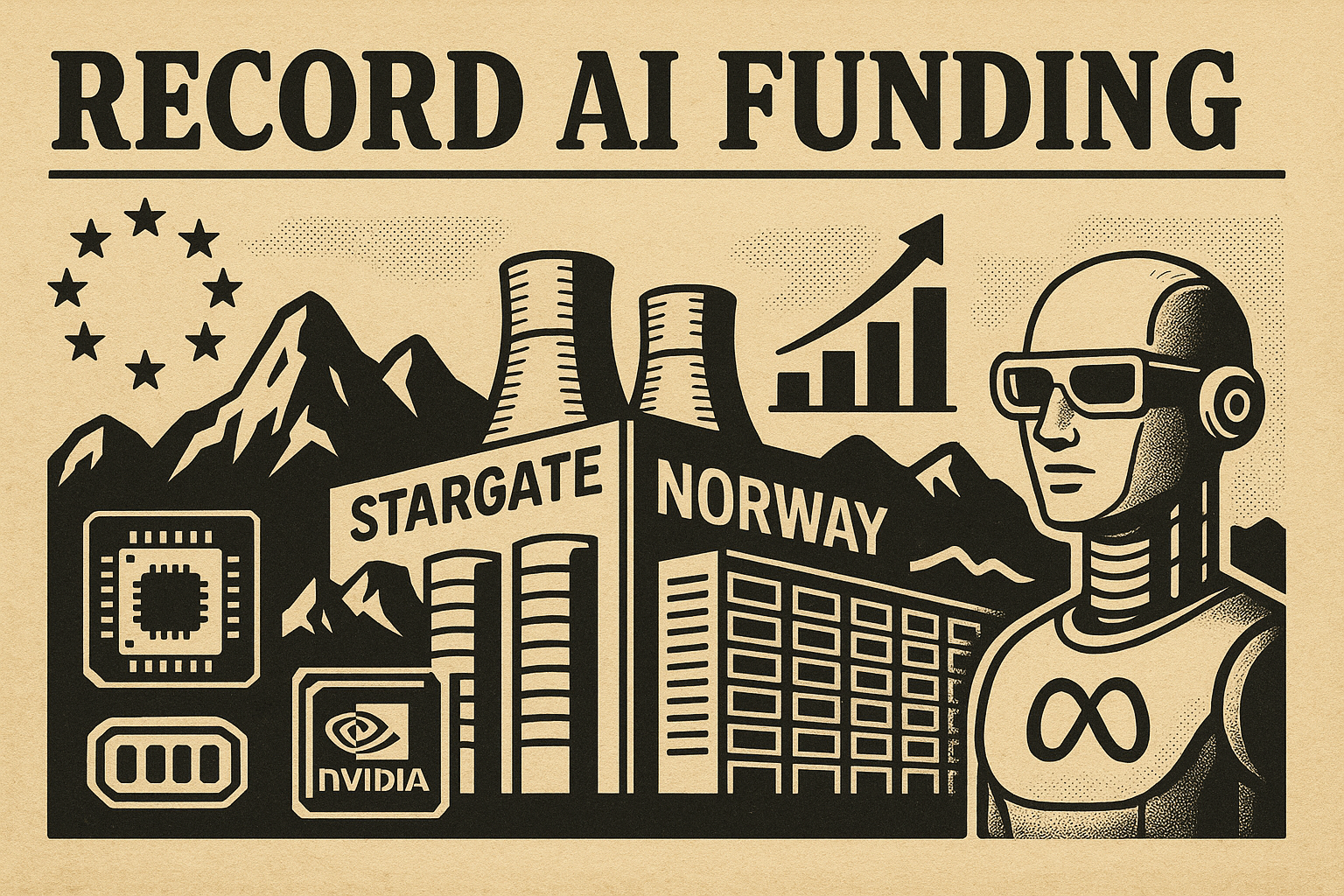
OpenAI has joined forces with infrastructure partners Nscale Global Holdings and Norway’s Aker ASA to launch Stargate Norway—one of Europe’s most ambitious AI infrastructure investments to date. Set to open in Narvik, northern Norway, the facility will deliver 230 megawatts of capacity in its first phase and deploy 100,000 NVIDIA GPUs by end of 2026, targeting a tenfold expansion in future phases.
Stargate Norway is designed to run entirely on renewable hydropower, helping meet Europe’s sovereign AI and sustainability ambitions, while providing crucial compute resources for local researchers, developers, and startups. OpenAI will be the facility’s initial anchor “off-taker” and plans to scale its utilization as demand for locally-based, sovereign compute surges across Europe and the Nordics. The partnership is structured as a 50/50 Nscale-Aker joint venture, with both entities committing $1 billion to the initial buildout and plans for priority access for Norway’s AI ecosystem and public research sector.
This move mirrors OpenAI’s global infrastructure strategy, with similar projects already slated in the UAE and the UK, and reflects a growing trend of AI companies anchoring complex, nation-scale compute capacity as part of strategic national digital infrastructure. Industry observers highlight the region’s abundant hydropower, cool climate, and mature industrial base as decisive factors in the choice of location.
Read more: OpenAI official announcement
Record-Breaking Meta Q2: Superintelligence Ambitions and AI Revenue Honors
Category: Enterprise and Adoption
Source: WIRED
Meta posted a historic second-quarter, with revenue surging 22% to $47.5 billion and net income climbing to $18.3 billion. In a letter to shareholders, CEO Mark Zuckerberg detailed Meta’s ambitious pivot toward self-improving, “personal superintelligence” and revealed the launch of Meta Superintelligence Labs aimed at building AI systems that learn with minimal human input.
Over the last few months, Meta reported initial signs of self-optimization in their AI systems—which Zuckerberg calls “glimpses” of true superintelligence. He underscored Meta’s approach as empowering individuals, focusing on AI “assistants” integrated deeply into daily life (including through AR smart glasses), rather than merely replacing knowledge work.
Massive AI-driven investments are to continue, with 2025 expenses revised up to $72 billion, focusing on AI infrastructure, researcher acquisition (with Silicon Valley luminaries joining the new division), and new hardware including wearables and smartglasses—now viewed as the primary interface for the company’s next generation of AI services. Zuckerberg’s bullish tone sent Meta’s shares soaring over 11% after the earnings call.
Read more: WIRED: Meta’s Plan for Self-Improving, Superintelligent AI
Regulatory Spotlight: China, the US, and Nvidia’s AI Chips Under Fire
Category: Security and Privacy
Source: CNBC
China’s cyberspace regulator has questioned Nvidia on the privacy and national security risks associated with its China-designed H20 AI chips, recently cleared for export after a US ban. Beijing is demanding detailed documentation on “potential vulnerabilities and backdoors,” prompted both by US congressional calls for tracking modules in overseas chips and mounting local concerns over data and infrastructure sovereignty.
The regulator’s inquiry comes as Washington and Beijing increasingly scrutinize foreign technology providers’ compliance with data protection, cybersecurity, and national interests. Nvidia’s H20s, the only US chip explicitly allowed for recent export, are now a lightning rod in the global tussle over AI hardware supply chains, security, and regulatory transparency.
Read more: CNBC: Nvidia H20 chips face Beijing scrutiny
Google DeepMind Launches AlphaEarth Foundations for High-Resolution Global Mapping
Category: Tools and Platforms
Source: Biz Chosun
DeepMind introduced AlphaEarth Foundations, an AI designed to process and embed petabyte-scale Earth observation data (including satellite imagery and LiDAR) to create detailed 10x10 meter global surface maps. The breakthrough allows for faster, more efficient analysis and monitoring of Earth’s surface, aiding climate research, urban planning, and disaster response, while using 16x less storage than conventional systems.
By integrating various modalities into precise, “virtual satellite” embeddings, AlphaEarth’s platform enables on-demand, custom environmental mapping—eliminating the need to wait for specific satellite passes. The technology also positions Google as a primary provider of geospatial AI solutions for food security, deforestation, and water management, delivering tangible impact for scientists and policymakers worldwide.
Read more: Biz Chosun: Google AI’s AlphaEarth Foundations
European AI Regulation Heats Up: Meta, Google, and the Looming EU AI Act
Category: Regulation and Policy
Source: Ars Technica
As the second phase of the EU AI Act approaches, regulatory dynamics are shifting rapidly. Google has confirmed it will sign the EU’s AI Code of Practice, offering transparency on training data and compliance on safety standards. Meta, by contrast, is refusing to sign, citing concerns over limits to innovation and competitiveness—fueling fears that the regulatory split may slow access to top-tier models within Europe and possibly fragment AI product timelines.
These regulatory moves, combined with new national “sovereign compute” projects (like Stargate Norway), highlight Europe’s strategy for responsible AI deployment and data sovereignty in an era of accelerating global AI development.
Read more: Ars Technica: Google confirms it will sign the EU AI Code of Practice
AI Funding Frenzy: Anthropic Nears $170B Valuation, OpenAI Hits $12B Revenue
Category: Startups and Funding
Source: Crunchbase News
Anthropic, the safety-first AI research company behind Claude, is closing a $5 billion round led by Iconiq at a nearly $170 billion valuation, more than doubling its worth in under six months. The raise underscores a feverish atmosphere for top AI labs, with OpenAI itself reported to have reached a $12 billion annualized revenue run rate—$1B per month—on the back of surging enterprise and consumer adoption for ChatGPT.
With continued major inflows from deep-pocketed backers like Amazon, Google, and SoftBank, experts warn both of a speculative “AI bubble” (akin to the dot-com era), even as the wave of capital powers steep leaps in capability and global scale.
Read more: Crunchbase: Anthropic raising $5B at $170B valuation
Smarter, Cheaper, Local: No-Code AI Agents and the Growth of Open-Source Platforms
Category: Tools and Platforms
Source: NVIDIA Blog
NVIDIA and partners are democratizing AI agent creation: the no-code, drag-and-drop Langflow platform—now integrated natively with Ollama and RTX GPUs—lets users build fully-offline, local generative agent workflows for free, offering privacy and cost benefits as compared to cloud AI. With new Model Context Protocol and G-Assist integrations, developers can orchestrate both local and cloud models, while enthusiasts can rapidly prototype multi-agent automations for real-world business and creative use. The shift towards local, open-source, and low-cost generative AI is accelerating across the developer ecosystem.
Read more: NVIDIA: Langflow Enables Local AI Agent Creation
Meta’s AI Wearables: Not Owning Smart Glasses May Be a “Cognitive Disadvantage”
Category: Enterprise and Adoption
Source: Fortune
Mark Zuckerberg doubled down on AI-driven AR wearables, predicting that people without AI-enabled glasses will soon be at a “cognitive disadvantage.” Meta’s strong Q2, bolstered by triple-digit smart glasses sales growth and massive AI infrastructure investment, cements its bet that smartglasses will become the key interface for AI-powered superintelligence and a reimagined “metaverse.” The company’s product roadmap now includes AR glasses with new visual displays, promising to blend the physical and digital worlds and shift how we interact with AI day-to-day.
Read more: Fortune: Mark Zuckerberg says anyone not wearing AI glasses will be at a disadvantage
OpenAI Revenue and User Base Soar to Historic Highs
Category: Enterprise and Adoption
Source: Reuters
OpenAI’s ChatGPT products are now used by over 700 million weekly active users, as the Microsoft-backed company’s annualized revenue doubles to $12 billion in just seven months, according to industry sources. The wave of strong business and consumer adoption, unprecedented cash flow, and continued investment are cementing OpenAI as the dominant force in conversational AI.
Read more: Reuters: OpenAI hits $12 billion in annualized revenue
Briefs & Additional Highlights
- GPT-5 Hype: User logs and developer speculation point to GPT-5 API endpoints appearing in OpenAI’s backend. Community is on alert for a near-term release date. (Reddit)
- Meta Goes All-In on Talent: Aggressive hiring and $100M+ compensation offers to attract AI scientists from OpenAI, Apple, and Anthropic, fueling a fresh wave in the “AI talent wars.” (The Decoder)
- AI Regulation & EU GPAI Act: EU’s incoming General Purpose AI regulation provokes debate: some see it as essential for safety and ethics, others warn of competitive disadvantage. (Ars Technica)
- Consumer Privacy: Google now indexes shared ChatGPT conversations, sparking both privacy concerns and content mining opportunities for brands. (Reddit)
- Gecko Security AI Launch: Startup Gecko Security debuts AI-powered static code analysis tools, using LLMs for discovering deeply contextual vulnerabilities missed by traditional SAST solutions. (Hacker News)
- Anaconda Raises $150M Series C: The popular Python/AI platform cements its leadership as a foundational AI tooling provider for enterprises worldwide. (Anaconda Press)
- Langflow and Local AI Agents: NVIDIA’s integration brings drag-and-drop agent building to local RTX desktops, boosting privacy and accessibility for generative AI workflows. (NVIDIA Blog)
- AI Ethics and Sentience: Community members debate whether we’d even recognize AI sentience if it emerged; the philosophical quandary gets ever more complex as AIs grow in capability. (Reddit)
- New AI Models & Tools: Horizon-alpha “stealthed” model quietly tops creative writing benchmarks on OpenRouter; Open-source “AgentGuard” helps developers halt runaway LLM API costs. (Reddit, GitHub)
Short Summaries – Additional Stories
- Meta’s AI-powered ad recommendations drive 5-6% higher user engagement across Facebook and Instagram.
- Y Combinator seeks “the first 10-person, $100B company” focused on AI-native products.
- Upwork uses Llama models to power Uma, its AI freelance assistant, boosting job-winning rates.
- New Stack Overflow survey: 84% of developers use AI, but only 33% trust it–‘almost right’ code creates significant “productivity tax.”
- Google’s Copilot mode and Runway’s Aleph video model announced as major productivity upgrades for writing and editing.
- Anthropic, OpenAI funding rounds fuel further startup “AI bubble” debate; investors ponder sustainable AI business models.
- Concerns about water, electricity usage by major AI models spark renewed calls for sustainable compute practices.
- Rapid growth in AI-generated content raises alarm about the future of “real” data and knowledge work.
- AI coding agents draw mixed reviews—huge productivity on boilerplate but still require “cleanup” for complex tasks.
- Apple’s talent wars intensify—AI and ML engineers can earn up to $312,200 as Meta poaches top staff.