Table of contents
Open Table of contents
- Demis Hassabis: AI’s Future Will Eclipse the Industrial Revolution
- China Unveils World’s First Brain-Like Supercomputer: Darwin Monkey
- Google’s AI Finds 20 New Security Vulnerabilities
- Apple Races to Build Its Own ChatGPT-Style AI
- DeepMind’s Vision: AI Beyond Science and into Society
- Major AI Workforce, Productivity & Recruitment Shifts in the Spotlight
- Perplexity AI Caught Using Stealth Crawlers to Bypass No-Crawl Directives
- Google & Kaggle Launch Game Arena: New AI Intelligence Benchmark
- Qwen-Image: Breakthroughs in Multilingual Text Rendering and Image Editing
- LevroAI Unveils Token-Level Reward Attribution for More Efficient LLM Training
- Software Needs an Independent AI Auditor
- In Brief: Other Noteworthy AI News
- Short Reads & Community Debate
Demis Hassabis: AI’s Future Will Eclipse the Industrial Revolution
Category: Research and Innovation
Source: The Guardian
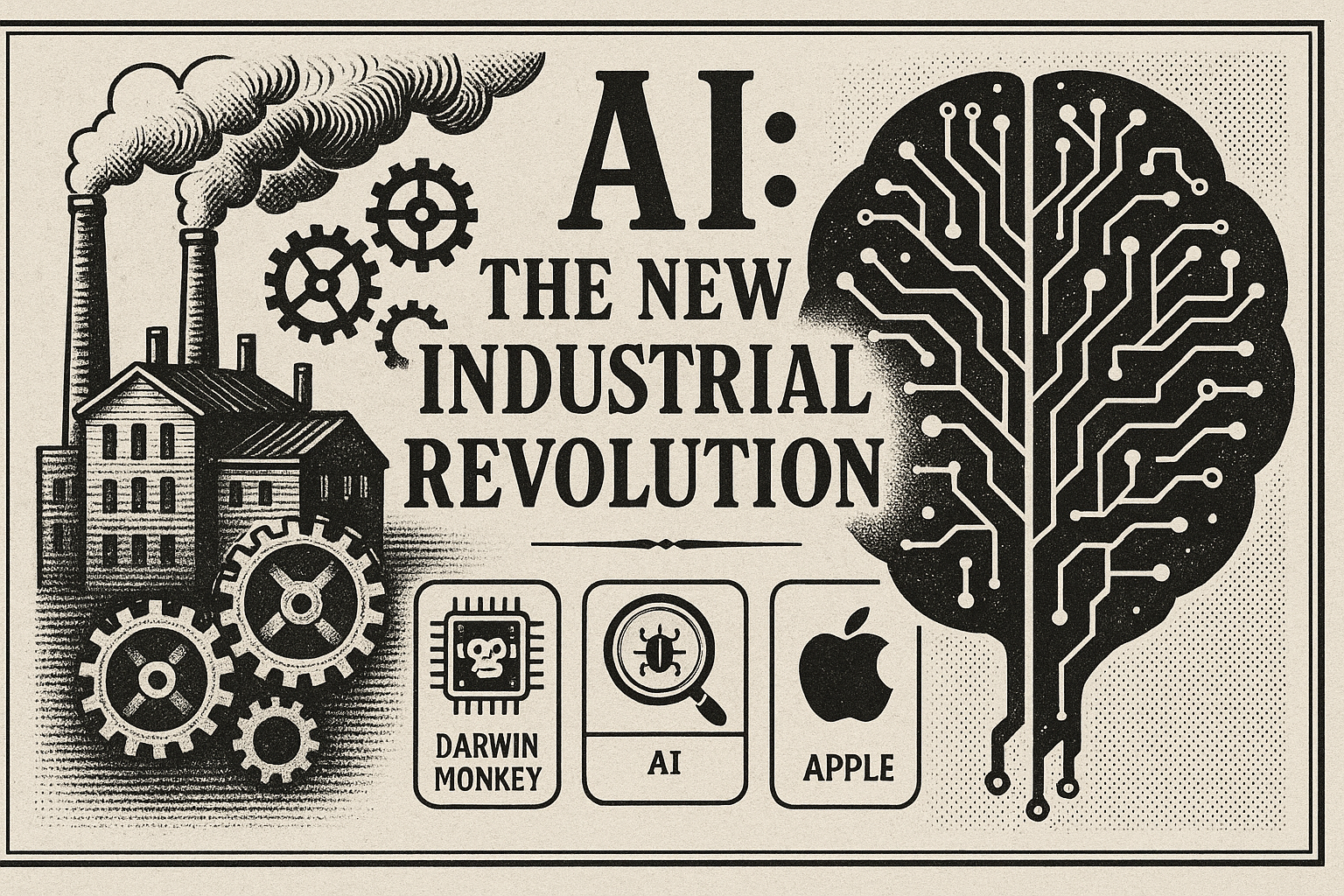
Demis Hassabis, CEO of Google DeepMind, paints a striking vision for the future, predicting that artificial intelligence will drive a transformation “10 times bigger than the Industrial Revolution—and maybe 10 times faster.” In an in-depth interview, Hassabis highlights AI’s potential to usher in “radical abundance,” with the promise of medical breakthroughs, new scientific paradigms, and perhaps even interstellar travel.
However, Hassabis also voices caution—questioning how society will distribute this newly created abundance, manage job displacement, and ensure the benefits reach everyone, not just tech giants or investors. He stresses the need for philosophers and economists to help shape the meaning and purpose of life in a world redefined by autonomous AI. Despite the challenges of energy consumption and potential risks such as deepfakes or misinformation, Hassabis remains a “cautious optimist.” His call: careful stewardship to maximize AI’s upsides while minimizing the societal and ethical downsides.
China Unveils World’s First Brain-Like Supercomputer: Darwin Monkey
Category: Infrastructure and Hardware
Source: Reddit
Engineers at Zhejiang University have introduced the Darwin Monkey, the world’s first neuromorphic supercomputer designed to rival monkey brain complexity. Constructed with over 2 billion artificial neurons and 100 billion synapses, the system runs on 960 Darwin 3 neuromorphic chips and was developed in partnership with Alibaba Group and Zhejiang Lab.
This new brain-inspired computation platform heralds a leap forward for large-scale artificial intelligence, offering a glimpse of AI systems that process information closer to biological brains. The Darwin Monkey’s debut signals China’s ambitions to lead in next-generation AI hardware and neuromorphic computing, unlocking applications in robotics, cognition, and potentially general intelligence.
Google’s AI Finds 20 New Security Vulnerabilities
Category: Security and Privacy
Source: TechCrunch
Google has announced a significant milestone for AI-powered cybersecurity with its bug hunting agent “Big Sleep” successfully uncovering 20 security vulnerabilities in open-source software, including widely used libraries like FFmpeg and ImageMagick. Developed jointly by DeepMind and Google’s Project Zero, Big Sleep combines large language models with automated exploit discovery techniques to identify software flaws without human intervention—though human experts still validate the findings.
This breakthrough illustrates how AI is revolutionizing both offense and defense in cybersecurity, but also raises concerns about potential false positives and “hallucinations.” As LLM-based tools like Big Sleep, RunSybil, and XBOW expand their reach in security auditing, organizations can expect both efficiency gains and new challenges in managing AI-derived bug reports.
Apple Races to Build Its Own ChatGPT-Style AI
Category: Enterprise and Adoption
Source: Engadget
Apple is rapidly accelerating its in-house AI capabilities with the creation of an “Answers, Knowledge and Information” team aiming to build a rival to ChatGPT. While Apple integrated OpenAI’s models into Siri in 2024, intense competition and internal culture shifts have driven Apple to prioritize a proprietary AI chatbot and answer engine.
Led by Siri veteran Robby Walker, Apple’s new team will focus on powering intelligent search, device support, and personal assistants across Siri, Safari, and Spotlight. This move is seen as crucial to staying competitive as rivals like Meta and Google pour unprecedented resources into generative AI and AGI. Observers will watch closely to see how Apple’s privacy-centric approach to AI plays out against its rivals.
DeepMind’s Vision: AI Beyond Science and into Society
Category: Research and Innovation
Source: CBS News 60 Minutes
Demis Hassabis, interviewed on “60 Minutes,” detailed DeepMind’s work not just on scientific challenges but on real-world problems, including healthcare, climate modeling, and material discovery. With breakthroughs such as AlphaFold, DeepMind’s influence is broadening from pushing boundaries in games to transforming entire industries. The interview highlights ongoing research directions in reinforcement learning, autonomous agents, and the push towards artificial general intelligence (AGI).
Major AI Workforce, Productivity & Recruitment Shifts in the Spotlight
Category: Workforce, Productivity & Business
Source: AfterBurnout.co | Fortune | Reddit
AI was expected to free up time for higher-level work, but reality is more complex. Recent studies (summarized by Kelly Vaughn) show that while developers feel more productive with AI tools, delivery throughput and stability often suffer, and increased cognitive load can lead to new forms of burnout. In manufacturing and software, organizations report a dip in productivity before any eventual AI-driven gains.
Meanwhile, Fortune reports a stark divide between hiring managers and job-seekers regarding the use of AI interviewers. While automating first-round interviews is seen as a win for efficiency, many candidates find them dehumanizing and even a red flag for company culture—some outright refuse to engage, prioritizing human interaction in the recruitment process.
At the C-suite level, a new pride in downsizing is emerging. CEOs of major corporations, including Wells Fargo and Bank of America, now boast of staff reductions as evidence of their embrace of AI and operational efficiency. The focus has shifted from growing headcount to “doing more with less,” reshaping career expectations across the AI era.
Perplexity AI Caught Using Stealth Crawlers to Bypass No-Crawl Directives
Category: Security and Privacy
Source: Cloudflare Blog
Cloudflare has exposed that Perplexity AI is repeatedly using stealthy, undeclared web crawlers that evade website no-crawl directives, changing user agents, IPs, and ASNs to disguise their activity. This revelation ignites debate over ethical data scraping practices in the AI industry and the ongoing arms race between web content providers and AI model trainers.
Google & Kaggle Launch Game Arena: New AI Intelligence Benchmark
Category: Tools and Platforms
Source: Google Blog
In a major step towards reliable AI benchmarking, Google DeepMind and Kaggle have introduced Kaggle Game Arena—a public, open-source platform where AI models compete in complex strategy games like chess and Go. By pitting models head-to-head under strict, transparent rules, Game Arena moves beyond static benchmarks, promising dynamic, transparent, and robust measurement of general AI capability and reasoning.
Qwen-Image: Breakthroughs in Multilingual Text Rendering and Image Editing
Category: Tools and Platforms
Source: QwenLM Blog
The latest open-source model from QwenLM, “Qwen-Image,” marks a new milestone in image generation, demonstrating best-in-class performance in complex text rendering—including both English and Chinese, layout precision, and advanced image manipulation. Supporting everything from poster and infographic creation to seamless PPT generation, Qwen-Image is poised to lower technical barriers for visual content creators worldwide.
LevroAI Unveils Token-Level Reward Attribution for More Efficient LLM Training
Category: Research and Innovation
Source: LevroAI Blog
LevroAI introduces a novel reinforcement learning technique—token-level reward attribution—for fine-tuning large language models. By precisely identifying which parts of a model’s output are praiseworthy or problematic, training becomes both faster and more efficient, reducing “gaming” of the reward function and improving results on real-world tasks like code generation and agentic workflows. This innovation promises to make advanced LLM training accessible and practical even for smaller, specialized models.
Software Needs an Independent AI Auditor
Category: Ethics and Governance
Source: Greptile Blog
With the explosion of AI-generated code, concerns about buggy, opaque, and unreviewed software are intensifying. Greptile argues for strict separation between AI code generation and AI code review, drawing parallels to regulations born from the Enron scandal. Independent code auditors—preferably from organizations with no stake in the code’s production—are crucial to catch bugs, avoid conflicts of interest, and maintain software integrity as coding accelerates beyond human review capacity.
In Brief: Other Noteworthy AI News
- Apple’s AI “Comeback” and Industry Competition: Apple is intensifying internal efforts to deliver a standalone GenAI answer engine app ahead of the iPhone’s 20th anniversary, seeking to regain momentum as rivals advance. Deccan Herald
- Healthcare AI Insight: Demis Hassabis suggests that AI could eventually replace doctors in data-driven diagnostics but will not supplant the empathic, relational aspects of nursing. Financial Express
- Tesla Proposes $29B Compensation for Elon Musk amidst the ongoing “AI talent war”, linking board decisions directly to Musk’s leadership continuity in AI and robotics. TechCrunch
- Film Industry AI Ethics Dispute: Indian production company Eros faces backlash for re-releasing a film with an AI-generated ending against the original director’s wishes, rekindling debate over consent, creative rights, and responsible AI in media. Decrypt
- San Francisco’s New Generation of AI CEOs: The city experiences a boom as young founders drive innovation across diverse sectors, deepening its status as the world’s AI capital. New York Times
- Debate on AGI Origins: Community discussions suggest that while small startups are unlikely to beat major players to AGI due to compute requirements, disruptive innovation is still possible and the definition of “AGI” remains contested.
- Ongoing Lens on Productivity and Culture: The tech industry’s relaxed work culture is ending as AI reshapes job expectations, with engineers in high demand and traditional perks giving way to performance and efficiency metrics.
Short Reads & Community Debate
- AI in Hiring and HR: Candidates are increasingly pushing back against AI-led interviews, while HR touts efficiency gains. Fortune
- Debates on AI and Human Skill: Community threads highlight skepticism about AI’s impact on critical thinking, workforce polarization, and AI’s role as a “floor-raiser” rather than a “ceiling-raiser.”
- Security Questions: Concerns surface over AI’s ability to “forget” user data, issues with Linux malware, and the imperative for robust privacy compliance in law enforcement’s AI adoption.
- Perils and Promise of AI Coding: Multiple perspectives stress the necessity of human oversight, careful code review, and transparency as coding assistants proliferate.
- Ethics & Risk: Debates continue over the urgency—and proper calibration—of warnings about AI risks, echoing the “boy who cried wolf” parable.
- User Experiences & Failures: Users report mixed results with Google’s AI overviews, noting hallucinations, inaccuracies, and the necessity of thorough human validation.
For continuing coverage and expert analysis, visit our recommended sources and tune in to the next AI Daily Digest!