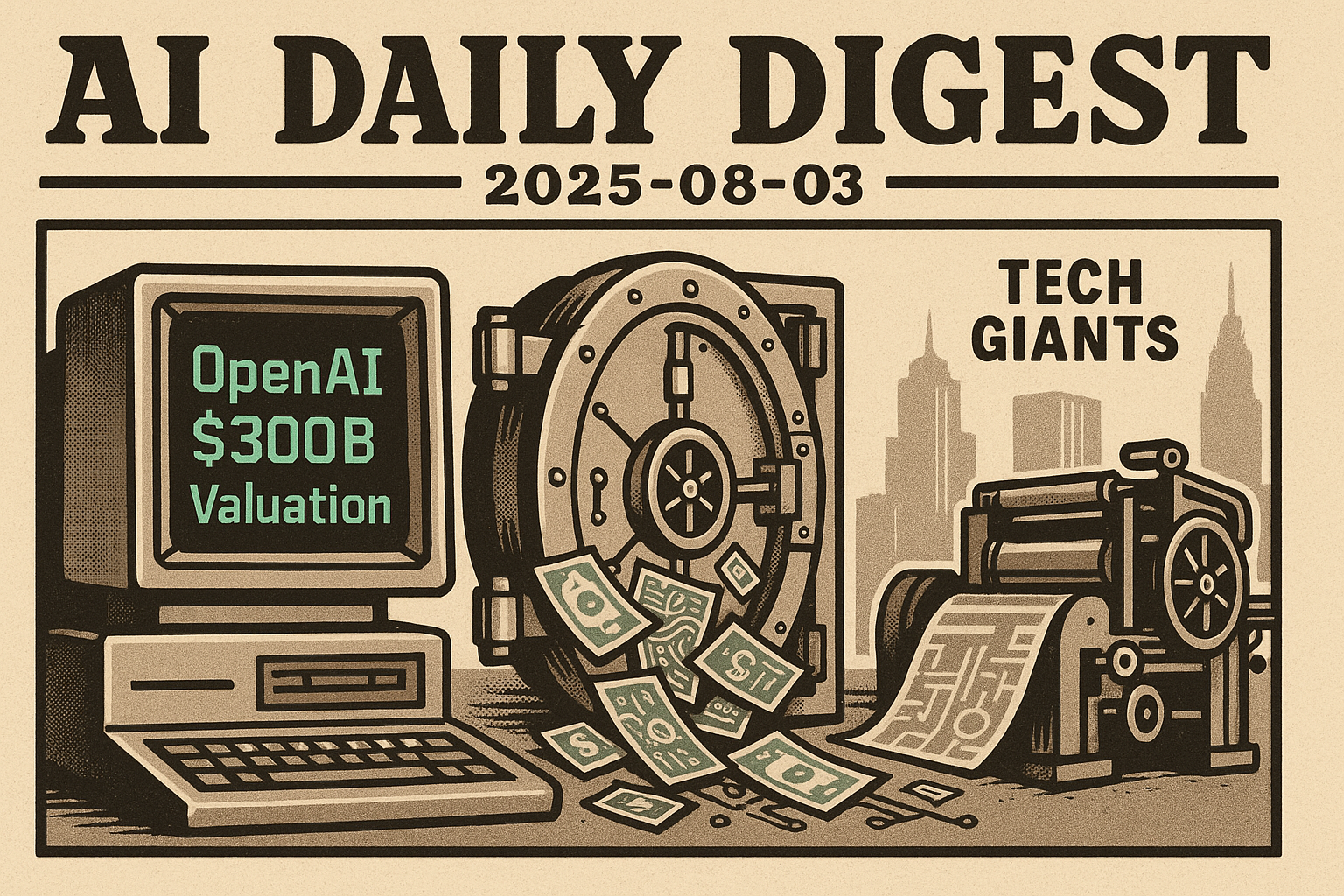
OpenAI Hits $300 Billion Valuation with $8.3 Billion Funding Round
Category: Startups and Funding
Source: aiindexes.com
OpenAI has secured a staggering $8.3 billion in new capital—catapulting its valuation to $300 billion and putting it on track toward its ambitious $40 billion fundraising goal for 2025. The investment round, led by Dragoneer Investment Group and joined by SoftBank, Blackstone, TPG, and others, was five times oversubscribed. Notably, SoftBank has committed a massive $30 billion toward OpenAI’s strategic pursuits, including the colossal “Project Stargate”—a $500 billion plan to build AI infrastructure across the U.S., in partnership with Oracle, MGX, Arm, Microsoft, and NVIDIA. This wave of funding aligns with OpenAI’s explosive revenue growth (annualized at $13B, expected to hit $20B by year-end) and its broader vision to accelerate the adoption and capabilities of advanced artificial intelligence.
Persona Vectors: Anthropic Introduces New Methods for Controlling Language Model Behavior
Category: Research and Innovation
Source: Anthropic
Anthropic has published a landmark research paper introducing “persona vectors”—patterns of neural activity that strongly influence character traits (such as sycophancy, hallucination, or moral stances) in large language models. By extracting and steering these vectors, developers can now monitor and shape model behavior in unprecedented ways: tracking personality drift, mitigating negative traits, and flagging problematic training data before model deployment. The research also demonstrates techniques to immunize models against training-induced undesirable behaviors, a breakthrough for improving model alignment and safety. This development paves the way for enhanced transparency, control, and trust in increasingly autonomous AI systems.
Inside OpenAI’s Quest for AI Agents That “Do Anything for You”
Category: Research and Innovation
Source: TechCrunch
OpenAI is reshaping its roadmap toward creating advanced AI agents capable of executing multifaceted real-world tasks—ranging from booking flights to writing code. The company’s progress on reasoning models (like o1) and planned rollout of GPT-5 have redirected the industry’s focus from LLMs as mere conversationalists to sophisticated autonomous agents. Drawing on reinforcement learning and innovative reasoning architectures, OpenAI’s efforts are spurring an “agentic” arms race, with companies like Google, Meta, and xAI vying to develop AI that seamlessly converts user intent into complex action, all while grappling with unresolved safety and ethical challenges.
Financial Risks and the AI Infrastructure Boom: Will Data Centers Crash the Economy?
Category: Finance and FinTech / Trends and Analysis
Source: Noahpinion
Noah Smith provides a sobering analysis of the skyrocketing capital expenditure on AI data centers and the associated risk of a financial bubble. Major tech giants (Microsoft, Google, Amazon, Meta) now spend more than a third of their sales on AI-related capex, even surpassing the telecom boom’s GDP share from the late 1990s. While experts suggest that tech bubbles can foster long-term infrastructure advantages, concerns are rising about increased leverage, the proliferation of opaque private credit, and systemic risks involving banks and insurers. The consequences of overbuilding or a sudden revenue slowdown could trigger a significant financial crisis—with ramifications well beyond the tech sector.
OpenAI Advances Agents for Autonomous Tasks Toward GPT-5
Category: Research and Innovation
Source: WebProNews
OpenAI is making rapid progress towards deploying autonomous AI agents—software systems capable of independently managing tasks and workflows for users. Following successes with reasoning models like o1 and o3, and leveraging strong Microsoft partnerships, OpenAI is rumored to be preparing breakthroughs in dynamic, multimodal agents with massive context windows and fine-grained user control, as seen in early GPT-5 leaks. These advancements are expected to disrupt knowledge work, creative industries, and personal productivity, but draw ongoing scrutiny regarding AI safety, accessibility, and the risk of unanticipated side effects.
Apple’s Tim Cook: “Apple Must Win in AI”
Category: Enterprise and Adoption
Source: TechCrunch
Apple CEO Tim Cook sent a clear message in an all-hands meeting: Apple must—and will—emerge as a leader in AI. After lagging behind competitors in launching next-generation AI-powered experiences (like Siri’s delayed upgrade), Cook acknowledged Apple’s history of entering markets late but dominating them with groundbreaking products. He signaled significant increases in AI investment and called for a culture shift within the company, reinforcing AI as “ours to grab.” Apple’s commitment builds pressure on the company to deliver on its “Apple Intelligence” roadmap and meet rising expectations in a rapidly evolving field.
Anthropic’s Persona Vectors Research Reveals New Levers for Safer AI
Category: Research and Innovation
Source: Anthropic
Anthropic’s research goes beyond mere personality tweaks, introducing methods to actively detect and moderate personality shifts during conversations or after training. By leveraging persona vectors, developers can intervene against unwanted behavior drift and increase user trust. These tools promise stronger alignment, greater transparency, and better guardrails as models become more autonomous and widely deployed.
A New Synthesis: Integrating Cortical Learning Principles with Large Language Models
Category: Research and Innovation
Source: Reddit
An extensive research thread explores potential hybrid architectures that integrate biological learning principles—such as sparse distributed representations (SDRs) and cortical reference frames—from neuroscience into mainstream LLMs. This synthesis promises solutions to persistent problems like catastrophic forgetting, lack of world grounding, and limited cross-modal reasoning. Proposed models would use a “cortical co-processor” to augment LLMs with continual, efficient, and personalized learning, suggesting a future where AI blends the best of brain-inspired computing and machine intelligence.
Meta and China Chart Divergent Paths on Open-Source AI
Category: Open Source and Community
Source: South China Morning Post
Meta, once a vocal champion of open-source AI with its Llama models, is stepping back from radical openness due to mounting safety, competitive, and geopolitical concerns. In contrast, China is rapidly scaling its open-source AI ecosystem—highlighted by Alibaba and Zhipu AI’s launch of cutting-edge, Mixture-of-Experts-based video and reasoning models. Experts warn that these contrasting philosophies could shape global AI leadership, with open-source momentum fuelling China’s ability to compete with U.S. “frontier labs.”
AI Subscriptions Get ‘Short Squeezed’ as Token Costs Rise
Category: Enterprise and Adoption
Source: Ethan Ding (Substack)
AI software economics are entering a critical phase, as the much-touted promise of “models getting cheaper” is squeezed by rapidly escalating operating costs. Companies like Anthropic, Cursor, and Replit are being forced to rethink unlimited flat-rate billing models amid surging token usage and cloud bills. With VCs pushing for exponential user growth at the expense of margins, the coming shakeout is set to test which strategies—usage-based pricing, high switching costs, or vertical integration—can sustain profitability in a land-grab marketplace.
AI Slop: Generative Content Floods the Internet, Undermines Trust
Category: Ethics and Governance
Source: Axios
From viral (but fake) bunny trampoline videos to AI-generated influencers, the web is swimming in “AI slop”—content that is ubiquitous, easily mistaken for real, and potentially eroding public trust in genuine user-generated media. Mainstream platforms are benefiting from the confusion-driven engagement, while critics warn that such synthetic overload threatens authentic digital culture and even business models for social networks and creative communities.
Short Summaries: Other Notable News
- Australia’s “Middle Course” on AI Jobs: The Australian government aims to balance AI-driven productivity gains and workforce retraining without fueling unemployment, emphasizing upskilling, reskilling, and careful regulation. (The Guardian)
- Claude Code: The Ultimate AI Coding Workflow: Developers are rapidly adopting Claude Code, an AI-powered tool praised for implementing features, code review, and enforcing best practices. (Sabrina.dev)
- OpenAI’s Web Search Gets Smarter: Users noted significant improvements in OpenAI’s integrated web search, now reviewing more sources before responding.
- LinkedIn Buzz: Top Researcher Rejects Meta’s $1.5B Offer: Andrew Tulloch of Thinking Machines Lab turned down a record-setting package from Meta, highlighting fierce competition for AI talent.
- Vogue’s AI Model Ad Sparks Industry Debate: The inclusion of an AI-generated model in Vogue’s ad campaign sparked reflection—and backlash—about digital “perfection” and the future of human models. (TechCrunch, NPR)
- Can AI “Eliminate” Itself? Lively Reddit discussion explores whether AGI could intentionally shut itself down if deemed a threat to humanity, reflecting on philosophical and practical safeguards.
- Creative Jobs Disruption: Community discussions and industry reports continue to forecast rapid AI disruption in creative sectors—spanning design, writing, and consultancy.
- Non-Sentient, Self-Aware AGI (NSSA): Forum posts discuss whether robust, metacognitive (but non-sentient) AGI offers the safest route for applied high-level machine intelligence.
- A Systems-Based Theory of AI Ethics: New theoretical work suggests true AI ethics may require recursive self-modeling and structural awareness, beyond compliance programming. (Zenodo)
- ChatGPT as Virtual Tour Guide: Users are experimenting with ChatGPT for real-time, personalized city tours, with encouraging feedback on conversational robustness.
- AI in Obituaries: Funeral homes increasingly use AI to draft obituaries, streamlining the memorialization process but raising questions about authenticity.
- Token Pricing and Flat-Rate Death Spirals: Business analysis warns AI startups that unlimited-subscription models are financially unsustainable as token costs rise faster than anticipated.
For all source links, please refer to the respective section above for the most direct and high-quality original reporting.