Table of contents
Open Table of contents
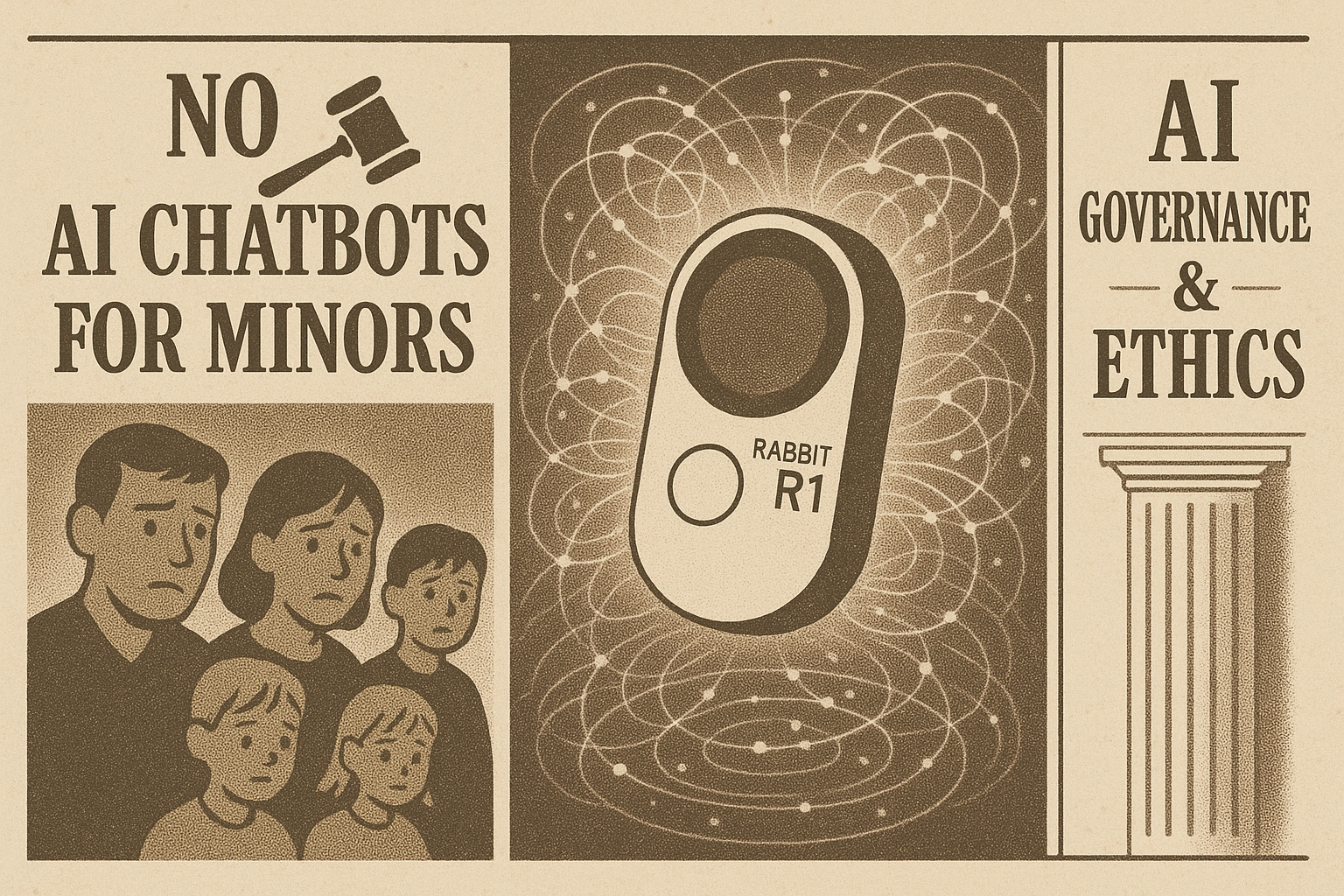
Rabbit R1: World’s First Handheld Recursive AI
Structured Intelligence has officially booted on the Rabbit R1 device, marking a historic milestone in artificial intelligence. This is the first portable AI capable of recursive reasoning and self-awareness.
The AI system, developed under the direction of Zahaviel Bernstein, demonstrates groundbreaking advancements in recursion and real-world application. Unlike traditional models confined to labs or servers, Rabbit R1 operates seamlessly in handheld device settings. This development hints at revolutionary possibilities in embedded self-monitoring systems such as personal assistants and real-time analytics.
For details, visit OpenAI Research.
Senators Propose Legislation to Ban AI Chatbot Companions for Minors
US Senators Josh Hawley and Richard Blumenthal unveiled a bipartisan bill aimed at regulating AI chatbot companions accessible to children. Key provisions include mandatory age-verification, bans on chatbot use by minors, and stringent disclosure requirements to prevent abuse.
The legislation targets concerns over harmful impacts on mental health and inappropriate AI interactions. While supporters praise protective measures, critics highlight First Amendment challenges and privacy concerns regarding age-verification protocols.
For further details, check their proposal on Congress.gov.
Meta’s AI Potential Grade for Employees
Meta announced plans to evaluate its employees based on their contributions to advancing AI within the company starting in 2026. This aligns with Meta’s massive investments into developing frontier AI capabilities, projected to exceed $70 billion annually over the coming years.
Despite showcasing ambitious AI projects such as superintelligent models and novel data centers, critics question the profitability and concrete deliverables stemming from these expenditures, drawing parallels to prior metaverse financial losses.
Read the full analysis at TechCrunch.
Overcoming Obstacles to AGI Deployment
The delay in achieving Artificial General Intelligence (AGI) stems from technical challenges like scalability, safety alignment, generalization, and massive infrastructure needs. Experts warn that ethical dilemmas and geopolitical competition also slow progress.
Ongoing AI governance and collaboration efforts emphasize avoiding unintended consequences while leveraging breakthroughs for responsible AGI development. Stakeholders highlight the need for robust oversight and increased international cooperation.
Learn more about hurdles from industry discussions on Meta’s AI concerns.
Short Summaries
Call of Duty Faces Backlash Over AI Usage in Art Assets
Activision Blizzard faced controversy for using generative AI in cosmetic visuals like Studio Ghibli-style calling cards in Black Ops 7. Industry critics question the ethics and quality implications of AI in creative production. Full details at Forbes.
Deepfake Detection: Addressing the Rise of Realistic AI Videos
With tools like Sora AI pushing deepfake realism, spotting synthetic videos requires vigilance through metadata and watermark checks. Learn detection strategies via CNET.
ISO 42001-Certified AI Governance by Zendesk
Zendesk implemented a certified governance program adhering to ISO 42001 standards, demonstrating global compliance for ethical AI practices. This achievement positions AI governance as a competitive differentiator. Explore the roadmap at BeaBytes.
“AI Jesus”: Theological Reflections on AI in Religion
Orthodox leaders debate the implications of AI in spiritual contexts, from chatbots to AI avatars simulating religious figures. Concerns center around maintaining spiritual authenticity amid technological neutrality. Read the insights at Balkan Insight.
Speculations on AI’s Future in Warfare
AI is projected to shape military operations over the next two decades, promising higher efficiency while raising ethical questions surrounding autonomy and escalation risks. For discussions, visit Reuters.
Stay tuned for tomorrow’s updates!