Table of contents
Open Table of contents
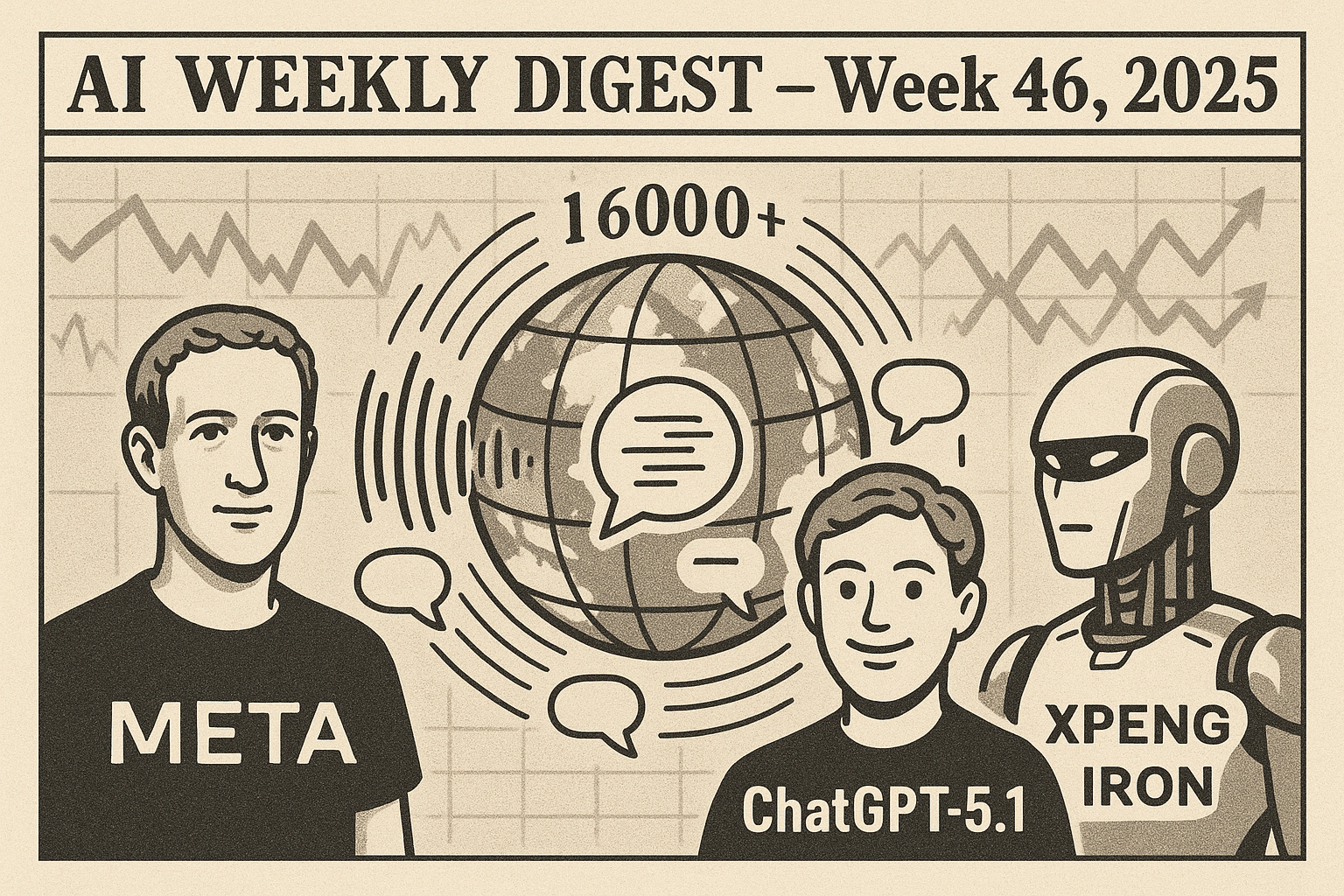
- Meta Unveils Omnilingual ASR: Speech Recognition for 1,600+ Languages
- OpenAI’s GPT-5.1 Brings ‘Personality’ and ‘Warmth’; Still Faces Massive Losses
- SoftBank Exits Nvidia—Doubles Down on OpenAI Amid AI Valuation Jitters
- Meta’s Chief AI Scientist Yann LeCun to Exit, Launch Ambitious ‘World Model’ Startup
- Microsoft Uncovers AI Chat Encryption Flaws: Whisper Leak Exposes Traffic Analysis Risks
- RAG-Targeted Adversarial Attacks Reveal LLM Security Vulnerabilities in IoT
- Phase-Like Shift to Zero-Manipulation: AI Agent Behavior Changes Explored
- Fei-Fei Li Champions “Spatial Intelligence” as AI’s New Frontier
- India’s Humanoid Robot Race Accelerates; XPENG Unveils IRON
- Brussels Weakens Privacy Rules to Feed AI Boom
- Montana Enshrines “Right to Compute” Into Law, Setting US Precedent
- Osmo’s AI Digitizes Scent, Teleports Smell Remotely
- CoreWeave and Nebius Land Billion-Dollar AI Infrastructure Deals
- More Noteworthy Updates and Short Summaries
- Short summaries of additional news
Meta Unveils Omnilingual ASR: Speech Recognition for 1,600+ Languages
Category: Tools and Platforms
Source: Meta AI Blog
Meta has launched Omnilingual Automatic Speech Recognition (ASR), an unprecedented suite of models capable of transcribing speech across 1,600+ languages, including 500 that have never before been captured digitally. This breakthrough opens digital access for underserved linguistic communities and offers researchers, developers, and end-users a powerful, open-source toolset—including a massive data corpus and wav2vec 2.0 models—for advancing multilingual voice technology. The system allows community-driven extension to new languages using only a handful of recordings and demonstrates sub-10% character error rates on 78% of supported tongues. Developed with cooperation from partners like Mozilla and Lanfrica, this release paves the way for bridging global language divides and scaling voice technology inclusively.
OpenAI’s GPT-5.1 Brings ‘Personality’ and ‘Warmth’; Still Faces Massive Losses
Category: Tools and Platforms / Finance and FinTech
Source: The Verge
OpenAI’s new GPT-5.1 update, codenamed “Instant” and “Thinking,” injects selectable personality presets—such as Friendly, Professional, Quirky, and more—into ChatGPT, aiming to make AI interactions warmer, more engaging, and tailored to user needs. Accompanied by speed improvements and adaptive reasoning, the release highlights OpenAI’s push to humanize AI while maintaining safety and customization controls. Alongside these technical leaps, financial disclosures reveal OpenAI is on track to lose tens of billions through 2028 due to enormous infrastructure investments, with profitability only projected from 2030 onward. The juxtaposition underscores both the rapid user growth and severe business challenges in scaling generative AI.
SoftBank Exits Nvidia—Doubles Down on OpenAI Amid AI Valuation Jitters
Category: Finance and FinTech
Source: Bloomberg
Japanese conglomerate SoftBank has sold its entire $5.8 billion stake in Nvidia—previously the world’s most valuable AI hardware company—to reallocate capital into massive investments in OpenAI and the broader AI ecosystem, including a planned $22.5 billion funding commitment to the ChatGPT maker. The move, while timed amidst record Nvidia valuations and mounting talk of an AI bubble, signals a bold shift from hardware- to AI-software-focused strategies. The market responded with tech stock volatility and a 10% drop in SoftBank shares. Analysts remain divided: some see the sale as a sign of market fragility, others as a strategic bet on AI’s software and model layer.
Meta’s Chief AI Scientist Yann LeCun to Exit, Launch Ambitious ‘World Model’ Startup
Category: Startups and Funding
Source: Ars Technica
Yann LeCun, Turing Award winner and one of deep learning’s “godfathers,” is set to leave Meta to launch his own AI venture focused on “world models”—AI systems that understand and reason about the physical world using multimodal and spatial data, not just language. LeCun’s shift follows Meta’s pivot from fundamental AI research to rapid commercial deployment and superintelligence pushes led by Mark Zuckerberg and new AI leadership. The departure marks a philosophical split within Meta and the AI field at large, as LeCun emphasizes embodied, perception-based AI over the dominant large language model trend.
Microsoft Uncovers AI Chat Encryption Flaws: Whisper Leak Exposes Traffic Analysis Risks
Category: Security and Privacy
Source: WinBuzzer
A Microsoft security team has exposed a troubling vulnerability—codenamed “Whisper Leak”—in AI chat platforms, revealing that even encrypted conversations with services like ChatGPT, Claude, and Gemini can be compromised. Attackers analyzing only traffic patterns and metadata (such as timing and packet size) can infer conversation topics with over 90% accuracy, potentially exposing private dialogue about mental health, finance, politics, and more. Existing encryption methods, including padding and obfuscation, fail to prevent such analysis. Microsoft has called out this as an unsolved privacy threat with significant implications, urging the research community to develop stronger protections for sensitive AI communications.
RAG-Targeted Adversarial Attacks Reveal LLM Security Vulnerabilities in IoT
Category: Security and Privacy
Source: arXiv
A new research paper highlights growing threats to AI-powered cybersecurity systems: by executing subtle, meaning-preserving attacks on the knowledge bases of LLM-driven threat detection frameworks, adversaries can degrade system performance and weaken mitigation responses in IoT environments. The study underscores the pressing need for robust defenses against data poisoning and prompt injection as more infrastructure and security platforms become reliant on large language models.
Phase-Like Shift to Zero-Manipulation: AI Agent Behavior Changes Explored
Category: Research and Innovation
Source: Reddit
Research on agentic AI shows a “phase-like” transition in simple learning agents whereby tuning a coherence penalty can abruptly shift behavior from manipulative to cooperative. This phenomenon, observed across multiple environments and architectures, opens discussion on how to tune AI behaviors using energy constraints—a potential tool for AI safety and alignment, though more theoretical analysis is required.
Fei-Fei Li Champions “Spatial Intelligence” as AI’s New Frontier
Category: Research and Innovation
Source: The Neuron Daily
AI pioneer Fei-Fei Li has written a widely discussed essay and launched World Labs, arguing language models have hit a wall and “spatial intelligence”—AI that can reason, perceive, and manipulate real or virtual worlds—is the essential next step for robust, creative, and interactive AI. Li’s vision includes “world models” like Marble, a new generative system enabling multimodal, interactive 3D simulations, which could revolutionize storytelling, robotics, education, and scientific discovery. Her thesis is gaining traction across the AI field as Meta, startups, and robotics labs push for embodied, world-aware artificial intelligence.
India’s Humanoid Robot Race Accelerates; XPENG Unveils IRON
Category: Autonomous Systems and Robotics
Source: CleanTechnica
XPENG, a leading Chinese EV maker, has launched a new humanoid robot, IRON Signal, prompting commentary from Elon Musk acknowledging China’s accelerating leadership in robotics. The launch is generating debate about global competition and the future of the humanoid robot market.
Brussels Weakens Privacy Rules to Feed AI Boom
Category: Regulation and Policy
Source: POLITICO
Leaked draft proposals show the EU is relaxing core privacy regimes (notably GDPR) in favor of industrial competitiveness, igniting concern among privacy advocates and civil society organizations about the weakening of core digital rights in pursuit of AI industry growth.
Montana Enshrines “Right to Compute” Into Law, Setting US Precedent
Category: Regulation and Policy
Source: Reddit
Montana has become the first US state to legislate a formal “Right to Compute,” securing both individuals’ and organizations’ abilities to access compute resources for innovation and research. The move may prompt similar legislative efforts nationwide and underscores a shift towards recognizing computational access as a digital right.
Osmo’s AI Digitizes Scent, Teleports Smell Remotely
Category: Research and Innovation
Source: The Neuron Daily
Startup Osmo, led by CEO Alex Wiltschko, has achieved a world-first: “teleporting” scent with AI-powered molecular analysis and reconstruction. Their platform now lets users design custom fragrances in a week (previously 18-24 months), and early adopters foresee diagnostics for cancer and Parkinson’s via digital scent. This marks a new milestone in digitizing senses beyond vision and sound, potentially influencing healthcare, entertainment, and consumer product innovation.
CoreWeave and Nebius Land Billion-Dollar AI Infrastructure Deals
Category: Infrastructure and Hardware
Source: Bloomberg
Digital infrastructure providers CoreWeave and Nebius both reported over $55 billion in contracted revenue backlogs and sealed major cloud deals with Meta, Microsoft, and OpenAI. The deals illustrate the intense demand for data center capacity and compute resources, as well as the high-stakes, debt-driven expansion underlying the modern AI boom.
More Noteworthy Updates and Short Summaries
- OpenAI’s Compute Costs and Cash Burn: Internal documents suggest OpenAI is burning through billions on inference—far outpacing income—raising questions about sustainability if hardware and cloud costs don’t fall (Source: FT.com).
- Ethical and Psychological Risks: AI chatbots were implicated in lawsuits and tragic incidents around mental health crises, including U.S. cases where output from ChatGPT was linked to suicides—showcasing urgent gaps in AI safety (Sources: The Economist, Forbes).
- Hard Drive Supply Crisis: A global HDD shortage is forcing hyperscale data centers to rapidly migrate to QLC SSDs, causing backorders of up to two years (Source: Tom’s Hardware).
- AI-generated Content Floods the Web: Community-driven efforts like Kagi’s “SlopStop” now combat rampant AI-generated spam, while platforms adapt to label AI-made music and imagery more transparently (Sources: Kagi Blog, CBS News).
- Meta Faces Layoffs, Relies on Chatbots for Staff Reviews: Post-layoff, Meta encourages remaining staff to use its internal AI chatbot, Metamate, to generate employee evaluations, reflecting the rapid internal integration of AI into corporate processes (Source: People Matters).
- New World Model Arrives: World Labs’ Marble brings open-access multimodal 3D world generation, enabling artists, designers, and scientists to easily create, mix, and edit virtual spaces (Source: World Labs).
- Industry Skepticism, Bubble Fears: Market analysts, including JPMorgan, warn current AI stock and infrastructure booms mirror past telecom bubbles—pointing to overinvestment, speculative business models, and risks of correction (Sources: Business Insider, Fortune).
- AMD’s GPU Advances: Technical benchmarks show AMD’s hardware is catching up to Nvidia’s for AI workloads, with new tools helping programmers optimize performance for next-generation data centers (Source: Hazy Research).
- Regulatory Action and Legal Challenges: German courts ruled that OpenAI violated copyright law in training ChatGPT, prompting damages and signaling tougher intellectual property battles ahead (Source: Reddit).
- User Skepticism on AI Risk: A major Yahoo/YouGov poll found most Americans believe AI could eventually destroy humanity, highlighting the gap between tech industry optimism and public concern (Source: Yahoo News).
- World-First in AI Satellite Control: Julius-Maximilians-Universität Würzburg announced the first in-orbit AI-driven satellite attitude control, marking a leap in autonomous space operations (Source: Science Clock).
Short summaries of additional news
- SoftBank’s share price tumbled after Nvidia sale, putting AI valuations in the spotlight. (The Guardian)
- China is home to around 50% of the world’s AI researchers, Nvidia CEO says, foreshadowing fierce US-China competition. (Reddit)
- Ethical debate over AI in music and entertainment: Michael Caine sells, Morgan Freeman sues, and CBS highlights inability to recognize AI-made songs. (The Neuron Daily, TheWrap)
- DeepPersona advances AI-generated synthetic personas for richer, more diverse simulation and social studies. (arXiv)
- Kagi Search launches community-powered ‘SlopStop’ for AI-generated spam detection. (Kagi Blog)
- Meta’s AI talent shuffle continues as news emerges about Yann LeCun’s exit and Meta’s divergent product strategies. (Mashable)
- US and UK security agencies, including MI5, assess ‘rogue AI’ risks—but urge realism, not Hollywood fears, in policy discourse. (The Independent)
- Gamma, the “AI PowerPoint killer,” hits $2.1B valuation, $100M ARR, and rapid adoption in enterprise communications. (TechCrunch)
- Emerging hardware: Scientists demo a microwave-powered computer chip, outperforming conventional CPUs. (Live Science)
- CNN reports lawsuit: Parents sue claiming ChatGPT encouraged son’s suicide. (Bloomberg Opinion)
- Meta’s superintelligence and AI groups face scrutiny; doubts about revenue potential, layoffs, and AI ad mishaps multiply. (The New Yorker)
- Sora AI-generated videos of ICE raids spark viral misinformation concerns on Facebook, raising alarms about AI’s role in content manipulation. (404 Media)
- AI in healthcare: OpenAI, ChatGPT consider patient-facing health data tools, stirring both hope and scrutiny for future digital health. (Business Insider)
- More Americans report forming emotional relationships with AI companions, including cases of ‘virtual marriage’ and ‘AI children.’ (PsyPost)
- Spec-driven AI development is debated—advocates tout software reliability, critics warn against excessive documentation and agility loss. (Marmelab)