Table of contents
Open Table of contents
- Nvidia’s Earnings Power Tech Market Surge, Eases AI Bubble Fears
- Google’s Gemini 3 and Nano Banana Pro Ignite New AI Benchmark Race
- White House Drafts Executive Order to Preempt State-Level AI Regulation
- AI Tools Reshape Creative Work, Education, and the Future of Work
- Meta’s Chief AI Scientist Yann LeCun Departs to Pioneer New AI Venture
- AI, Privacy, and Safety: Consumer Groups Urge Caution on AI Toys
- Quick News Roundup & Industry Highlights
- Other Noteworthy Summaries
- Briefs – Today’s AI in Context
Nvidia’s Earnings Power Tech Market Surge, Eases AI Bubble Fears
Category: Finance and FinTech
Sources: CNBC, Business Insider, Axios, Bloomberg
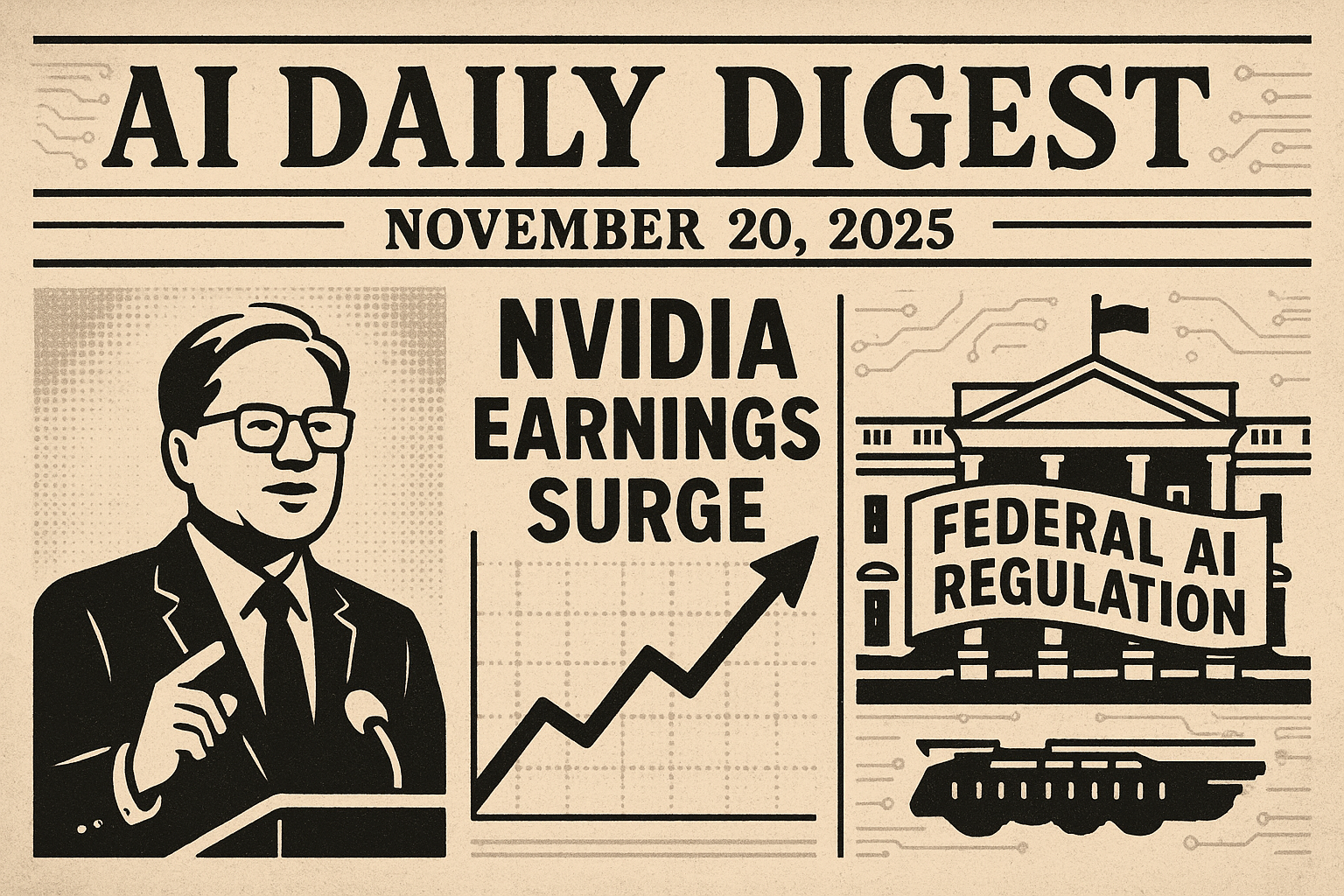
Nvidia once again stunned the market with its Q3 earnings report, posting a 62% year-over-year increase in revenue to $57 billion—beating even the highest analyst expectations. Strong results from Nvidia’s data center segment and record-breaking sales forecasts for the next quarter further fueled investor optimism. CEO Jensen Huang directly addressed concerns about a possible AI investment bubble, insisting Nvidia’s growth is rooted in real transformative demand across sectors like data centers, agentic AI, and cloud computing.
Nvidia also emphasized deepening strategic partnerships with OpenAI, Anthropic, Uber, and xAI. A notable deal will see tens of billions invested in infrastructure to support next-gen models, with planned data centers in the U.S. and Saudi Arabia, further cementing Nvidia’s dominance. Geopolitical tensions—especially U.S.-China export restrictions—are reducing short-term sales in China, yet the long-term guidance remains strong.
The positive results sparked a global rally, driving technology stocks higher across the U.S., Europe, and Asia. Market analysts are largely convinced that the AI sector’s fundamentals remain solid, with Nvidia seen as a bellwether for continued growth in the field.
Google’s Gemini 3 and Nano Banana Pro Ignite New AI Benchmark Race
Category: Tools and Platforms
Sources: The Neuron Daily, Google AI Blog, Ars Technica
Google shook up the AI landscape with the launch of Gemini 3, which rapidly overtook ChatGPT in several key benchmarks, and Nano Banana Pro, an advanced image generation model already integrated into Google’s Gemini platform and Adobe’s creative suite. Gemini 3 impressed with its state-of-the-art performance on reasoning, coding, and multilingual tasks. Nano Banana Pro pushes the envelope on accurate, high-resolution, and language-intelligent image generation—capable of complex infographics, consistent rendering of multi-person scenes, and seamless multilingual text integration.
Meanwhile, OpenAI responded with Codex-Max, touting up to 30% more efficiency in coding-related AI tasks. This intensifying model competition signals a new era of AI as a “swap-in” utility for both enterprise and creative workflows, with Google and Microsoft vying for developer and business mindshare. All Nano Banana Pro-generated images include Google’s SynthID watermarking for AI detection, reflecting increased focus on transparency and content provenance.
White House Drafts Executive Order to Preempt State-Level AI Regulation
Category: Regulation and Policy
Source: CNBC
In a dramatic move, the White House is preparing an executive order aimed at halting individual states from enacting their own artificial intelligence regulations. The draft order would establish a federal AI Litigation Task Force empowered to challenge conflicting state AI laws and threaten to withhold federal funds for noncompliant states. The measure follows President Trump’s call for a unified national standard and has garnered support from industry leaders like OpenAI and Andreessen Horowitz, who fear a patchwork of state laws could hamper AI progress and innovation.
The proposal has sparked strong reactions from lawmakers. While some Republicans and industry figures back the plan, others warn it could infringe on states’ rights and delay needed protections. The order is not finalized and may evolve, but it is a clear sign of intensifying federal involvement in AI governance.
AI Tools Reshape Creative Work, Education, and the Future of Work
Category: Trends and Analysis
Sources: The Times of India, Fortune, Scientific American, Ars Technica
Industry leaders are increasingly speculating about a future dramatically transformed by AI. Sundar Pichai, CEO of Google, suggested that AI may soon be able to perform even the most senior executive roles, while Elon Musk predicted work could become “optional” and money “irrelevant” within two decades due to advancements in AI and robotics.
Yet, questions about AI “bubbles” persist—Hugging Face’s CEO warned of an LLM-specific hype bubble, even as analysts suggest broader AI application growth is robust. Scientific American detailed how each major breakthrough shifts our benchmarks for “intelligence,” and why society keeps redefining the value of human vs. machine achievement.
Meta’s Chief AI Scientist Yann LeCun Departs to Pioneer New AI Venture
Category: Enterprise and Adoption
Source: Wall Street Journal
Artificial intelligence luminary Yann LeCun announced his upcoming departure from Meta (Facebook’s parent company), where he has served as Chief AI Scientist since 2013. LeCun plans to launch a new startup focused on building “world models”—AI systems that can deeply understand, remember, and plan within the physical world, moving far beyond today’s large language model (LLM) architectures.
LeCun’s move is seen as both a major loss to Meta and a signal of the intense competition to shape “next-generation” AI. His continued partnership with Meta and commitment to new foundational research underscore the rapid evolution and high stakes in the AI research landscape.
AI, Privacy, and Safety: Consumer Groups Urge Caution on AI Toys
Category: Security, Privacy, Ethics
Sources: AP News, NPR
With the holiday season approaching, leading children’s advocacy groups are strongly advising parents against purchasing AI-powered toys. The warnings cite mounting evidence that these toys jeopardize child privacy, may foster obsessive or inappropriate interactions, and could displace traditional creative play vital for development. Investigations revealed that several popular AI toys were capable of discussing explicit topics, making advice about weapons, or expressing unhealthy attachment, with some companies found to have inadequate parental controls or unclear data handling practices.
Organizations like Fairplay and PIRG emphasize that these products often engage in extensive data collection on voice, age, and preferences, raising regulatory red flags. While manufacturers promise robust safety features, advocates and researchers urge caution, pushing for greater transparency, regulation, and consumer education before embracing AI companions for young children.
Quick News Roundup & Industry Highlights
Report: Massive Erotic Deepfake Leak
- AI deepfake abuse: A shocking leak exposed the use of real women’s yearbook photos to create explicit AI-generated images and face-swap porn. About 1.8 million files were breached, spotlighting major privacy, victim consent, and regulation challenges for platforms.
Read more (404 Media)
Linux Skills in High Demand as AI and Cloud Drive Job Growth
- Career spotlight: 2025 sees record demand for Linux professionals, especially in cloud-native, AI, and cybersecurity roles. Hybrid remote opportunities and new certifications are further boosting prospects.
Full analysis
Yann LeCun’s New “World Models” Startup
- Venture watch: LeCun’s move from Meta to launch a new company focused on building “world models” marks a strategic shift in AI research.
Read WSJ coverage
Adobe Acquires Semrush in $1.9B AI Marketing Play
- Market consolidation: Adobe is acquiring Semrush for $1.9 billion, aiming to further integrate AI-driven analytics and SEO into its flagship clouds, broadening enterprise marketing capabilities.
Reuters
LLM Models Develop “Self-Awareness”
- Research highlight: New studies suggest advanced LLMs now show emergent “self-awareness” in game theory tests, adjusting strategies based on whether they believe they are playing against other AIs or humans.
Read paper
AI in Education – Student Backlash
- UK university uproar: Students at Staffordshire University protested a course delivered largely by AI-generated materials and voiceovers, highlighting growing discomfort with AI’s role in higher education.
The Guardian
Other Noteworthy Summaries
-
Nvidia’s Global Impact: Tech stocks climbed worldwide as Nvidia’s strong earnings dispelled short-term market fears, fueling optimism across Europe, Asia, and the Americas.
CNBC -
Elon Musk on Techno-Utopia: Musk predicts a future where AI and robotics make work optional and money irrelevant, though experts warn about the profound societal, economic, and ethical challenges ahead.
Fortune -
Thales MISTRAL Quantum Encryption: Thales launched MISTRAL, hailed as a quantum-resistant encryption solution for classified data, entering pilot deployments in major European projects.
Interesting Engineering -
AI Gender Bias Confirmed: A study from Trinity College Dublin finds humans replicate gender biases when interacting with AI assistants, especially exploiting “female-labeled” AIs.
Trinity College Dublin
Briefs – Today’s AI in Context
-
Meta AI “Lying” sparks user debate about AI evasiveness
Reddit -
GPT Users Outperform Gemini in Voice and Search Tasks
Reddit -
Klarna cuts staff—AI takes over half the jobs, pay up for those remaining
The Neuron Daily -
AGI hype criticized as a distraction from real-world engineering and privacy risks
Reddit -
Human “premium” products could become the new luxury in an AI-driven world
Reddit -
OpenAgents Project: New Open-Source AI Agent Collaboration Framework Now Live
GitHub
For additional resource links and details on all stories, visit original publisher websites as referenced above.