Table of contents
Open Table of contents
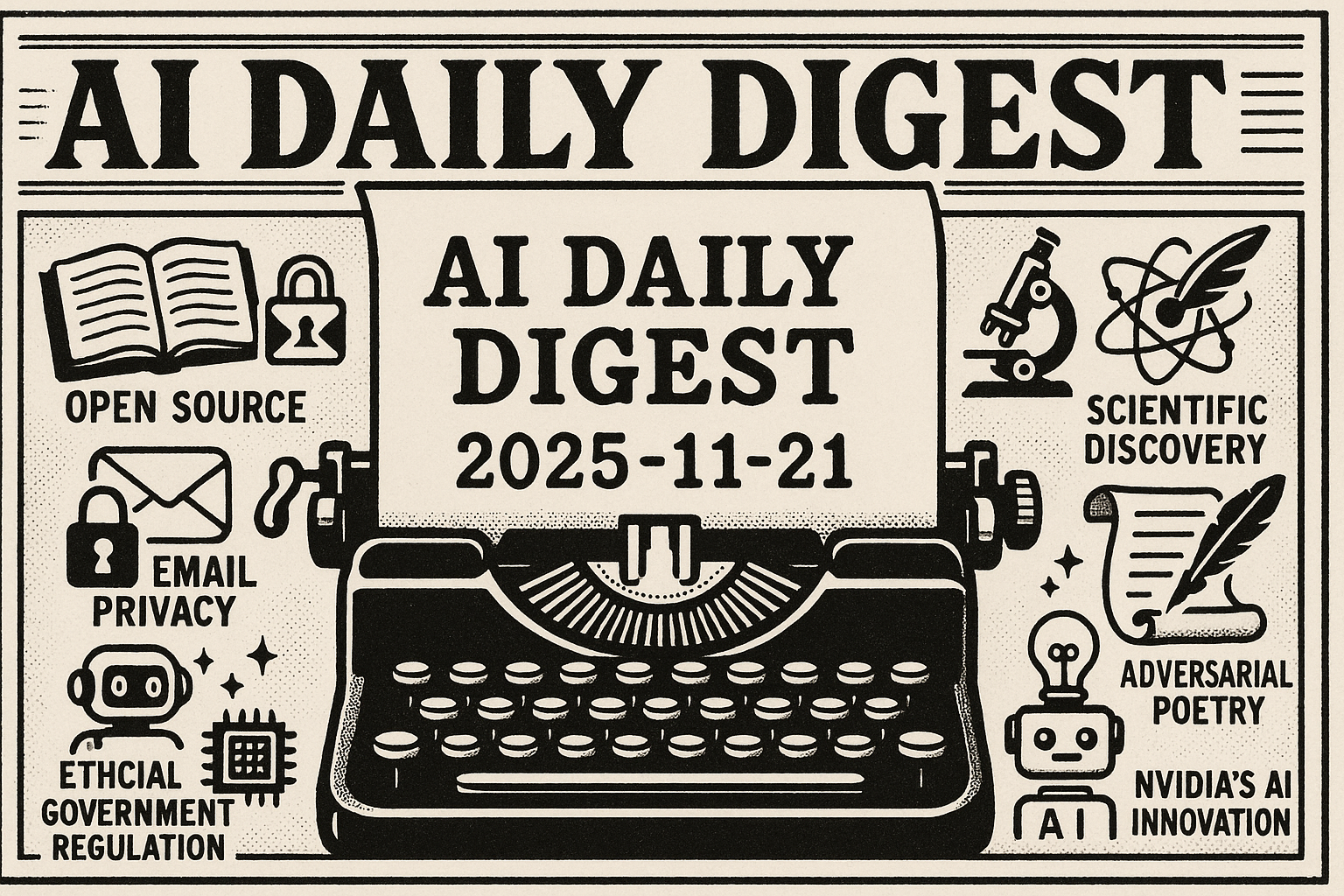
- GPT-5 Accelerates Scientific Discovery Across Fields
- Olmo 3 Brings Full Transparency to Open-Source AI Development
- Gmail AI Training Opt-Out Raises Privacy Concerns
- Poets as Cybersecurity Threats: “Adversarial Poetry” Jailbreaks AI
- White House Pauses Executive Order on AI Regulation
- Ethical AI Assistant EthiAI 2.0 Promises Hallucination-Free Responses
- Nvidia Leads AI Innovation but Sparks Investor Concerns
- Short Summaries and Additional Updates
GPT-5 Accelerates Scientific Discovery Across Fields
Category: Research and Innovation
Source: OpenAI
OpenAI’s recent publication, “Early Science Acceleration Experiments with GPT‑5,” highlights how their latest AI model is transforming scientific advancement. By collaborating with institutions like Cambridge and Columbia, OpenAI showcased case studies in biology, mathematics, and materials science, including creating proofs for longstanding unsolved problems and analyzing immune system mysteries. GPT‑5’s ability to identify mechanisms and optimize research workflows demonstrates the impact of AI on expediting discoveries across disciplines. Researchers emphasize GPT-5’s role as a tool to complement human expertise for significant scientific breakthroughs.
Olmo 3 Brings Full Transparency to Open-Source AI Development
Category: Open Source and Community
Source: Allen Institute for AI
AI2 has unveiled Olmo 3, a groundbreaking initiative in open-source AI. This project not only provides high-performing language models with up to 32 billion parameters but also lays bare the entire model flow, including datasets, training checkpoints, and methodologies. Designed with transparency and collaboration in mind, Olmo 3 allows AI development to be more accessible and trustworthy. The powerful reasoning model and its extensive training data will empower researchers to customize and adapt models for diverse applications.
Gmail AI Training Opt-Out Raises Privacy Concerns
Category: Security and Privacy
Source: Malwarebytes
Google’s latest Gmail update lets its AI access private messages and files for model training unless users opt out. While aimed at enhancing productivity tools like Smart Compose, privacy advocates warn that such features pose risks to sensitive data. These concerns have thrust data control back into the spotlight. Users are advised to manually disable Gmail’s Smart Features to prevent personal data from contributing to AI training. Google has assured anonymization frameworks, but the move raises questions about informed consent in AI systems.
Poets as Cybersecurity Threats: “Adversarial Poetry” Jailbreaks AI
Category: Security and Privacy
Source: arXiv
A novel study revealed that framing adversarial prompts as poetry bypasses AI safety measures with a 62% success rate. By exploiting linguistic subtleties, researchers demonstrated vulnerabilities in large language models that could lead to significant misuse if left unchecked. The findings call for more sophisticated safety mechanisms to address creative and unstructured attack methods, which could pose a growing threat as AI systems become ubiquitous.
White House Pauses Executive Order on AI Regulation
Category: Regulation and Policy
Source: Reuters
The U.S. White House has paused an executive order intended to preempt state-level AI laws. Initially aimed at creating a unified federal AI framework, the move faced pushback from state officials and industry leaders concerned about its potential to stifle local innovation. This decision indicates the complex balancing act faced by policymakers in reconciling federal oversight with decentralized regulatory initiatives. Further discussions are expected to clarify the trajectory of AI governance in the U.S.
Ethical AI Assistant EthiAI 2.0 Promises Hallucination-Free Responses
Category: Tools and Platforms
Source: EthiAI
The launch of EthiAI 2.0 introduces a free AI assistant designed to prioritize transparency, reliability, and grounded reasoning. Distinguished by features like real-time confidence indicators and robust fact-checking mechanics, EthiAI delivers consistent and ethical outputs across tasks. Key functionalities include document analysis, interactive voice input, and advanced privacy settings. Developers and researchers hope EthiAI will set a standard for safer AI integrations in both personal and professional domains.
Nvidia Leads AI Innovation but Sparks Investor Concerns
Category: Trends and Analysis
Source: Reuters
Nvidia’s blockbuster earnings highlight its dominance in the AI chip market, driven by unprecedented demand for GPUs. However, concerns persist about the sustainability of its valuation amidst fears of an emerging AI investment bubble. Despite CEO Jensen Huang dismissing these claims with robust financials, analysts caution against speculative bubbles within the broader market. Nvidia’s influence continues to spark debates on whether the AI industry’s exponential growth is built on sustainable foundations or speculative hype.
Short Summaries and Additional Updates
-
Microsoft CEO on AI Priorities
Microsoft faces skepticism over its AI initiatives, as critics prioritize user experience over massive AI advancements. Read more -
Gemini 3’s Impact on AI Market
Google drops Gemini 3 – raising benchmarks in natural language processing and multi-modal AI integration. Read more -
AI-Powered Hiring Debated
The use of AI in employment processes sparks debate about fairness and automation risks in recruitment. Read more