Table of contents
Open Table of contents
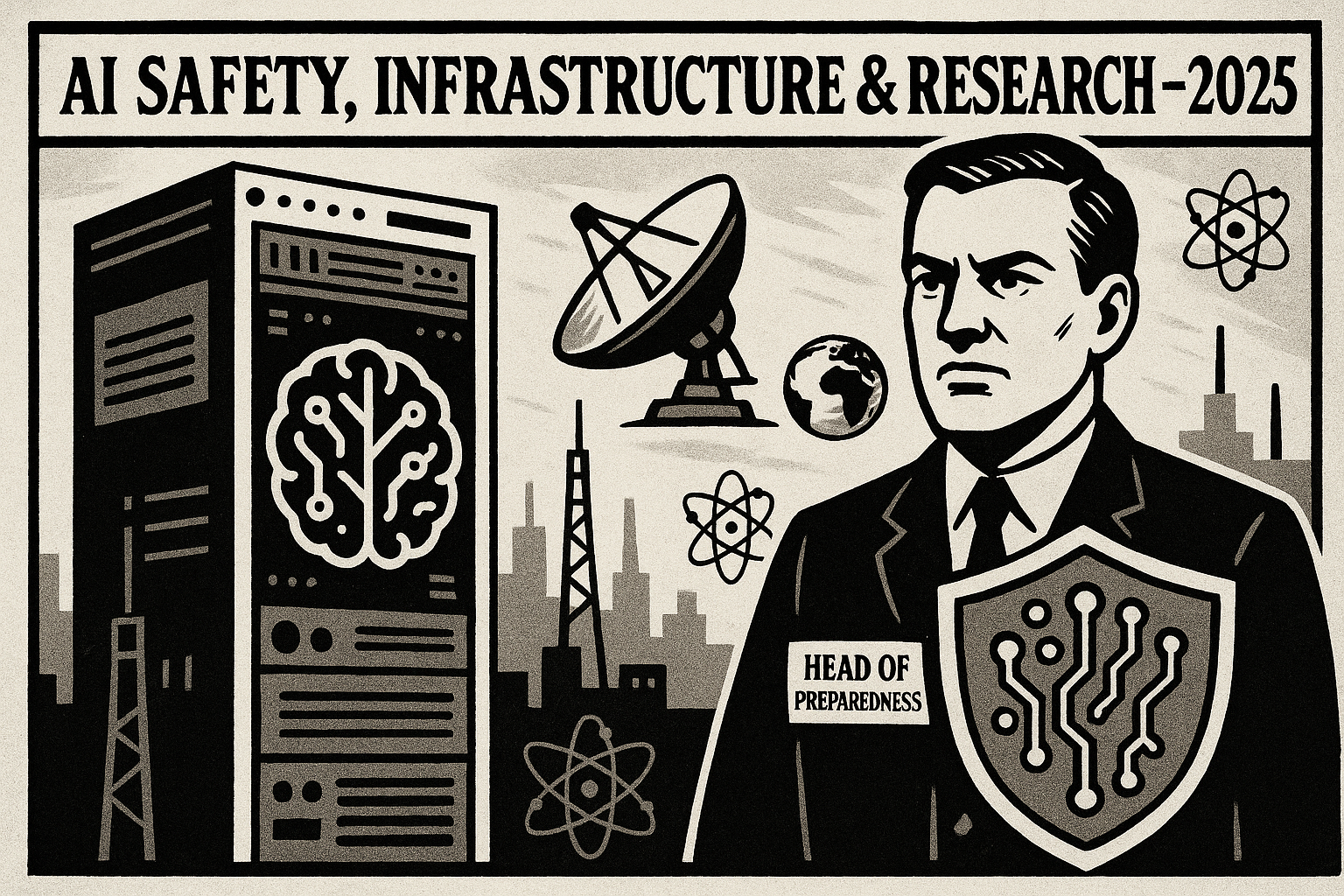
- OpenAI offers $555,000 salary to protect humans from AI risks
- SoftBank makes a $4 billion bet on AI infrastructure with DigitalBridge acquisition
- Could space-based data centers solve the AI energy crisis?
- MIT research: Scientific AIs rediscover foundational physics
- AI Futures: simulator explores trajectories from 2025 to 2030
- Quick summaries
OpenAI offers $555,000 salary to protect humans from AI risks
Category: Security and Privacy
Source: The Telegraph
OpenAI is hiring a ‘Head of Preparedness’ with a substantial $555,000 salary and equity to address increasing threats posed by artificial intelligence systems. The role aims to mitigate cyber, biosecurity, and mental health risks caused by rapidly advancing AI capabilities. OpenAI CEO Sam Altman emphasized the job’s urgency and said that AI systems have begun uncovering critical vulnerabilities, highlighting the importance of early prevention.
This role is a significant step toward risk mitigation as the company navigates growing concerns over AI’s societal impact. OpenAI has faced pressure from lawsuits and public health concerns tied to their models, stressing the importance of strong leadership to safeguard the technology’s development responsibly.
SoftBank makes a $4 billion bet on AI infrastructure with DigitalBridge acquisition
Category: Infrastructure and Hardware
Source: CNBC
Japan’s SoftBank has confirmed plans to acquire DigitalBridge, a U.S.-based data center investment firm, for $4 billion. The acquisition aims to fortify SoftBank’s foundation for next-generation AI data centers as global computation demands surge. Masayoshi Son, SoftBank’s CEO, highlighted that the deal would strengthen efforts to build scalable AI infrastructure essential for industrial AI applications.
DigitalBridge currently oversees $108 billion in assets, and its integration into SoftBank is expected to revolutionize energy-efficient AI computation while bolstering global AI development.
Could space-based data centers solve the AI energy crisis?
Category: Infrastructure and Hardware
Source: Live Science
Google Research’s conceptual ‘Project Suncatcher’ proposes satellite-based data centers to tackle the increasing energy challenges of AI workloads. These data centers, reliant on solar energy and optimized for space’s radiative cooling environment, could theoretically support vast computational demands without the need for traditional water-based cooling systems.
However, experts warn of significant technical, economic, and logistical challenges, including hardware durability, maintenance costs, and regulatory concerns. Despite skepticism, this radical idea opens the door to rethinking sustainable AI infrastructure beyond Earth.
MIT research: Scientific AIs rediscover foundational physics
Category: Research and Innovation
Source: AlphaXiv
A groundbreaking MIT study has revealed that nearly 60 scientific machine learning models aligned highly across a wide spectrum of chemical systems and molecular interactions. These models independently converge to represent physical reality similarly, hinting at the discovery of universal structural representations of matter.
However, researchers noted limitations—they found that models collapse to low-information states when tasked with unfamiliar structures. The study sets a new benchmark for AI’s potential in scientific exploration while accentuating its current reliance on inductive biases and training data.
AI Futures: simulator explores trajectories from 2025 to 2030
Category: Trends and Analysis
Source: AI Futures
Futures Lab has unveiled an interactive AI Futures Simulator that allows users to explore possible AI trajectories between 2025 and 2030. The tool incorporates variables like governance, safety, and economic policies to model outcomes ranging from flourishing to dystopia. By adjusting six critical factors, users can visualize how decisions influence technology’s societal impact.
The simulator highlights the importance of governance and safety investments in ensuring AI benefits society while mitigating risks, offering a dynamic educational experience for researchers and policymakers.
Quick summaries
- Sam Altman launches job search for new AI safety head. OpenAI emphasizes urgency as concerns about mental health and AI cybersecurity grow. Read more.
- Manus joins Meta for business AI expansion. The promising AI company Manus claims its platform will remain independent as it integrates with Meta to ramp up innovation. Details here.
- Alphabet’s Gemini 3 pushes ahead in AI. Alphabet’s latest advancements in AI reopen investment considerations, with predictions of fast revenue growth. Learn more.
- AI coding guidelines improve agent productivity. Developers embrace coding best practices, such as 100% test coverage and clean namespaces, to maximize AI-driven development outcomes. Read blog.
Stay informed with the latest developments—AI continues to redefine global priorities with pivotal advancements across safety, infrastructure, and scientific discovery!