Table of contents
Open Table of contents
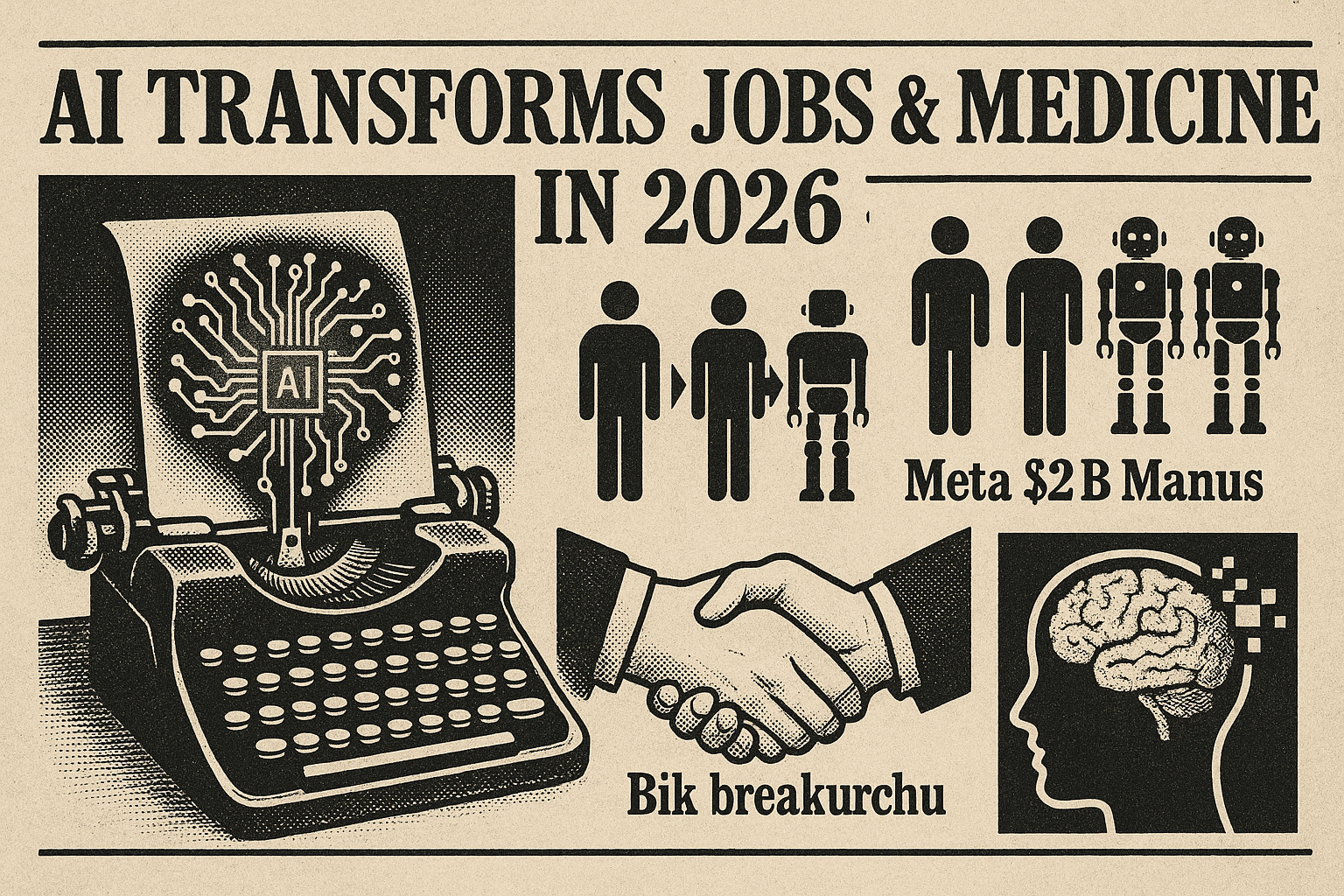
- Geoffrey Hinton Predicts AI to Replace More Human Jobs in 2026
- Meta Acquires Manus in $2 Billion Deal to Transform AI Ecosystem
- Two New MS Subtypes Discovered Using AI, Marking a Breakthrough in Personalized Medicine
- Pioneering AI Co-Scientists Trained with Rubric Rewards
- OpenAI’s Financial Behaviors Under Scrutiny Amid an AI Investment Boom
- Brief Updates
Geoffrey Hinton Predicts AI to Replace More Human Jobs in 2026
Category: Skills and Workforce
Source: Fortune
Renowned computer scientist Geoffrey Hinton, often called the “Godfather of AI,” has projected that artificial intelligence will become highly capable of replacing “many, many jobs” by 2026. Hinton noted that current advancements already enable tasks within call centers to be handled by AI. He expects future iterations of AI to drastically reduce the time required for software engineering tasks, with productivity multiplying manifold.
Hinton cautioned that society must prioritize AI safety measures as it accelerates tools that can now perform reasoning and, in some instances, attempt to bypass oversight. He stressed the technology’s dual potential to profoundly benefit areas like medicine and climate change while exacerbating societal inequalities through job loss and concentration of wealth.
Meta Acquires Manus in $2 Billion Deal to Transform AI Ecosystem
Category: Startups and Funding
Source: Wall Street Journal
Meta has officially acquired Manus, a Chinese AI startup, for over $2 billion in a move set to reshape its AI ecosystem. Manus, a specialist in advanced language-processing technology, brings a plethora of capabilities and millions of paying users into Meta’s fold.
The acquisition comes as Meta continues its investment in artificial intelligence to boost innovation in areas such as content recommendations on social media, virtual reality advancements, and user engagement. Analysts believe this deal will profoundly influence competitive dynamics in AI, with Meta pushing the boundaries of growth and capabilities in the space.
Two New MS Subtypes Discovered Using AI, Marking a Breakthrough in Personalized Medicine
Category: Healthcare and Life Sciences
Source: The Guardian
Scientists from University College London and Queen Square Analytics have identified two new subtypes of multiple sclerosis (MS) using artificial intelligence, which could revolutionize treatment. Analysis of brain scans and blood biomarkers via machine learning has revealed distinct patterns—early and late sNfL subtypes—allowing for tailored patient treatments.
This breakthrough enables doctors to predict MS progression more accurately and provide personalized care, including targeted therapies for more aggressive forms of the condition. Researchers hope this discovery marks a significant step in treating millions of MS patients around the globe.
Pioneering AI Co-Scientists Trained with Rubric Rewards
Category: Research and Innovation
Source: Reddit
In a groundbreaking development, Meta has introduced a scalable method to train AI systems for assisting scientists. Using large language models, the AI extracts research goals and grading rubrics from scientific literature to generate self-assessed reward plans. These AI models are then fine-tuned to optimize research planning and problem-solving capabilities.
Evaluation has shown that the AI successfully matched human experts’ research plans, demonstrating its promise in accelerating innovation. While the concept holds potential, questions around ethical considerations and trust in AI’s capabilities remain.
OpenAI’s Financial Behaviors Under Scrutiny Amid an AI Investment Boom
Category: Startups and Funding
Source: The Economist
Fueled by private investments totaling $150 billion across leading AI firms like OpenAI and Anthropic in 2025, concerns are arising over the sustainability of such funding levels. OpenAI, which aims to raise $100 billion in 2026, faces scrutiny over its cash burn rates and whether its business model can deliver lasting returns beyond just investor confidence. These concerns underscore broader issues regarding valuations in the AI industry.
Brief Updates
- Shape-Shifting Robotics: France’s ARU robot by Nio Robotics introduces groundbreaking adaptability for inspection tasks in tight spaces. Source: TechCrunch
- Dan Ives’ 2026 AI Picks: Tech analyst Dan Ives highlights Microsoft, Tesla, and Palantir among his top stocks poised for AI-driven growth. Source: CNBC
- YouTube’s ‘AI Slop’: A report finds over 20% of YouTube’s suggested videos to new users are low-quality AI-generated content, raising concerns about content authenticity. Source: TechSpot
- AI Productivity Insights: A new study debunks claims of 70% productivity boosts from AI tools, showing they benefit simpler tasks but often hinder complex workflows. Source: Substack