Table of contents
Open Table of contents
- California Ushers in Landmark AI Safety Law to Lead Global Regulation
- Hollywood and Global Industry in Uproar Over AI “Actor” Tilly Norwood
- OpenAI’s Sora 2 and “ViralGPT”: AI Video Generators Bet Big on Social, Copyrights, and Commerce
- Claude Sonnet 4.5 Launches, Raising the Bar for Agentic AI Coding
- AI Agents Are Reshaping the Future of Work and Commerce
- AI’s Impact on Jobs Remains Modest—For Now, U.S. Market Stable Despite Hype
- AI World Models: Tech Giants Double Down on the Race for Machine “Superintelligence”
- $300M+ Rush to Build “AI Scientists” and Next-Gen Research Labs
- Microsoft, Meta, and Amazon Double Down on AI Infrastructure and Chips
- OpenTSLM: Stanford-Led Team Launches Foundation Model for Time-Series AI
- Meta Will Analyze AI Chats for Ad Targeting; Privacy Concerns Mount
- AI in Gaming and Virtual Worlds: Realtime Agents and Generative 3D
- In Brief: Other News and Emerging Stories
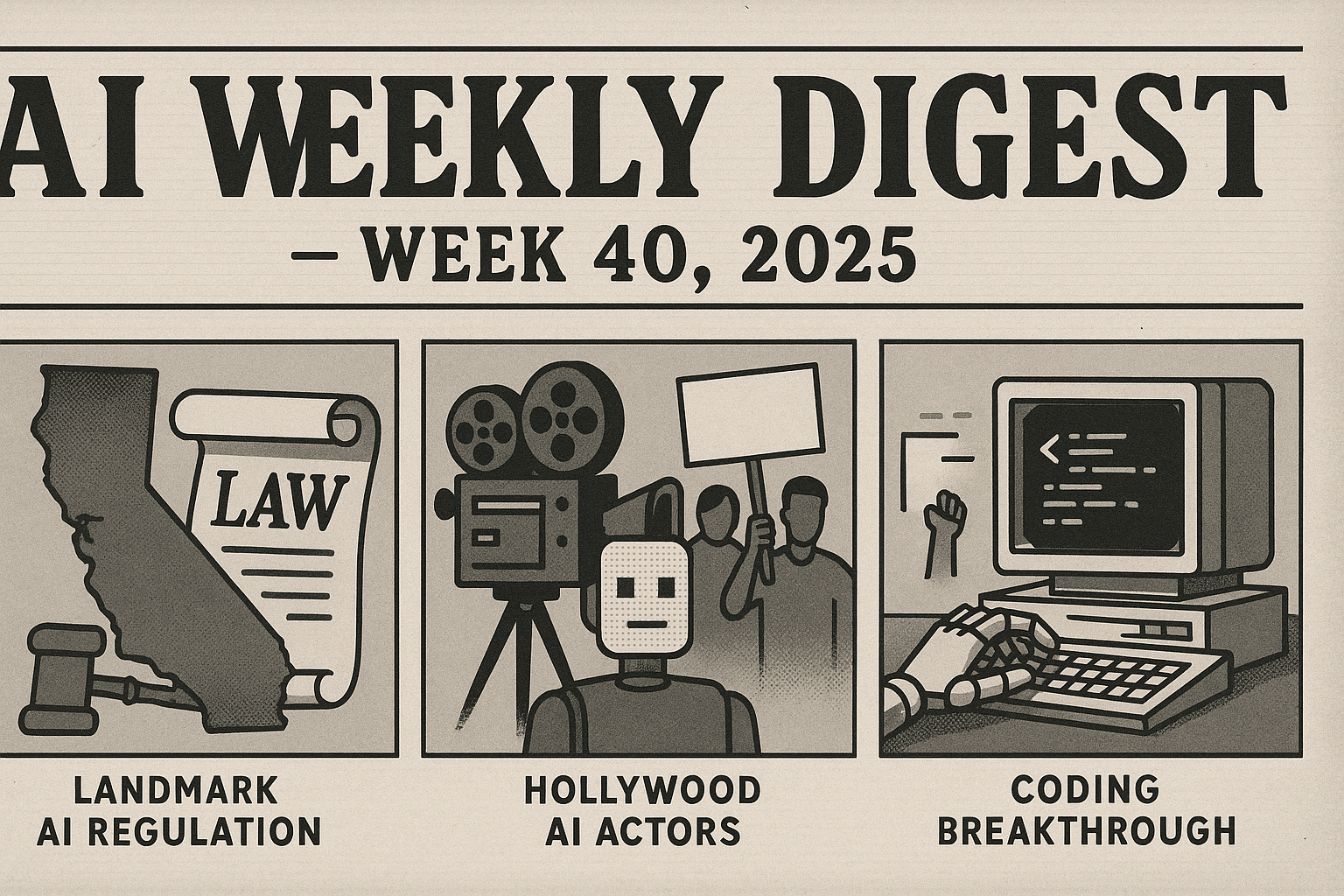
California Ushers in Landmark AI Safety Law to Lead Global Regulation
Category: Regulation and Policy
Source: NBC News
California has become the first state to enshrine an expansive AI safety and transparency framework with Governor Gavin Newsom signing the SB 53 “Transparency in Frontier AI Act.” The new law compels AI companies to publish safety protocols, perform risk and impact assessments before deploying new models, and regularly report critical safety incidents such as major cyberattacks or deceptive behaviors. Major AI developers in the state—including OpenAI, Meta, Google, and Anthropic—now face requirements to disclose internal safety measures and incident reports. The law also launches CalCompute, a state cloud cluster to support safe AI innovation, and introduces whistleblower protections for AI employees. Analysts expect the act to become a policy reference for national and international AI governance, balancing public trust with supporting tech innovation in the world’s AI capital.
Hollywood and Global Industry in Uproar Over AI “Actor” Tilly Norwood
Category: Media and Entertainment, Ethics and Governance
Source: Variety
The unveiling of AI-generated “actress” Tilly Norwood by creative tech studio Particle6 at the Zurich Film Festival sparked immediate and impassioned protest from the entertainment industry. SAG-AFTRA, the actors’ union, issued a forceful condemnation, stating that Tilly is not a true actor but a synthetic character trained on performances “without permission or compensation” and fundamentally devoid of human emotion and experience. High-profile stars and union leaders, including Emily Blunt, Whoopi Goldberg, Mara Wilson, and union president Sean Astin, publicly decried agency interest in representing Norwood, calling the move a threat to livelihoods and the artistic value of human actors. Industry figures warn that adopting AI performers could undermine performer protections won in the 2023 strikes and challenge the future of creative labor.
Meanwhile, Tilly’s creator Eline Van der Velden defended the digital character as a new “creative paintbrush,” akin to animation or CGI, not a human replacement. Despite the backlash, tech visionaries insist the debate marks the opening of a complex new chapter for art, labor, and technology, reminiscent of prior paradigm shifts in film and music.
OpenAI’s Sora 2 and “ViralGPT”: AI Video Generators Bet Big on Social, Copyrights, and Commerce
Category: Creative Technologies, Ethics and Governance, Retail and eCommerce
Source: Wired
OpenAI rolled out Sora 2, its AI video generator, and new social media experiences mimicking TikTok. Users can now remix, share, and even “star” in AI-generated videos using the new “cameos” feature, while OpenAI eyes ad monetization and social commerce within these feeds. However, Sora drew sharp scrutiny after it was revealed to use copyrighted content from entertainment studios by default, giving owners the ability to opt out. This copyright-by-default approach raises pressing questions about fair use and creator rights in the age of synthetic media.
Simultaneously, OpenAI debuted “Instant Checkout” within ChatGPT, letting users directly purchase items from merchants like Etsy and Shopify inside chat—an ambitious move set to rival Google for AI-driven e-commerce. The open-source Agentic Commerce Protocol behind this technology could reshape digital shopping, but also intensifies the debate over AI-driven marketplace control and transparency.
Claude Sonnet 4.5 Launches, Raising the Bar for Agentic AI Coding
Category: Tools and Platforms, Research and Innovation
Source: Anthropic
Anthropic released Claude Sonnet 4.5, their most capable mid-sized model to date, outperforming rivals from OpenAI and Google on key coding and multi-step reasoning benchmarks. Sonnet 4.5 brings significant upgrades in code comprehension, agentic autonomy, and context/memory management—demonstrated by its ability to stay focused for over 30 hours of continuous, multi-step tasks. New upgrades include a native VS Code extension, improved terminal experience, context editing, and memory tools for developers to build longer-running, more robust agents.
Crucially, Anthropic touts improved alignment and safety, citing reductions in sycophancy, power-seeking, and harmful outputs, addressing mounting concerns of AI agency and risk. Users and experts report the new model substantially boosts productivity, reliability, and user outcomes in software, research, law, and beyond.
AI Agents Are Reshaping the Future of Work and Commerce
Category: AI Agents, Enterprise and Adoption, Retail
Source: OpenAI, Paid (PR Newswire), Simon Willison’s Weblog
From OpenAI’s new agent-driven shopping to the Paid platform’s $21 million round for “AI agent economy” infrastructure and community experiments with “agentic loops,” the agent model is rapidly moving into the mainstream. Paid’s CEO and investors estimate that autonomous AI agents could unlock up to $19 trillion in value by 2030—if commerce and monetization frameworks adapt to digital labor.
Developers and enterprises are focusing on “designing agentic loops”—strategies for creating, testing, and monetizing autonomous agents that iteratively pursue complex goals (like debugging code, running businesses, or managing sales)—with safety and operational guardrails. Enhanced developer tools and research suggest the agent paradigm is transforming digital workflows across industries.
AI’s Impact on Jobs Remains Modest—For Now, U.S. Market Stable Despite Hype
Category: Skills and Workforce, Trends and Analysis
Source: The Guardian
A new Yale study found no significant disruption in the U.S. jobs market due to AI since ChatGPT’s viral debut in late 2022. Despite widespread anxiety and headlines about large-scale job losses, the data shows the occupational mix and overall employment levels remain stable and change is not yet accelerating. While isolated layoffs and automation headlines grab attention, broader impacts have been sluggish, echoing the historical pattern of technology adopting gradually. Researchers conclude that while the long-term impact of AI remains unpredictable, fears of an immediate job “apocalypse” are unsubstantiated, at least for now.
AI World Models: Tech Giants Double Down on the Race for Machine “Superintelligence”
Category: Research and Innovation
Source: Financial Times, Futunn
An intensifying “race for superintelligence” is underway as Google DeepMind, Meta, Nvidia, and other leaders shift their research focus towards “world models”—AI systems that integrate video, robotics, and dynamic simulation data to comprehend, reason, and plan in the physical world. Researchers and executives believe world models will enable the leap from “book smarts” (language and text manipulation) to “street smarts” (spatial awareness, physical reasoning, adaptation), representing a crucial step toward Artificial General Intelligence (AGI). Recent breakthroughs include scalable training environments, 3D scene synthesis, advanced robotics, and simulation tools, though insiders caution that commercial applications may take up to a decade to fully materialize.
$300M+ Rush to Build “AI Scientists” and Next-Gen Research Labs
Category: Startups and Funding, Research and Innovation
Source: Maginative, Observer, KnowTechie
Periodic Labs announced a massive $300 million seed round, among the largest-ever in scientific AI, to build “AI scientists” and fully autonomous laboratories for accelerating discovery in physical sciences. Founded and staffed by a who’s-who of AI veterans from OpenAI, DeepMind, and Google, Periodic Labs’ goal is to create systems that not only analyze web data but design and run real physical experiments—closing the “data generation” gap in AI model development. The project has drawn backing from tech giants, ex-OpenAI talent, and visionaries like Jeff Bezos and Eric Schmidt. If successful, “AI scientists” could transform materials science, pharmaceuticals, and energy innovation.
Microsoft, Meta, and Amazon Double Down on AI Infrastructure and Chips
Category: Infrastructure and Hardware
Source: CNBC, GuruFocus, About Amazon
A flurry of billion-dollar deals and product launches is transforming global AI infrastructure. CoreWeave, an AI-focused cloud provider, signed a $14 billion contract with Meta (Facebook), following a $6.5 billion expansion with OpenAI. Microsoft announced aggressive plans to shift its data centers to custom AI chips, aiming to reduce dependency on Nvidia and AMD, while also launching new Echo devices with AI-driven sensor fusion and edge processing under “Alexa+.” These developments underscore both the escalating investment in AI hardware and the thirst for more efficient, sovereign, and application-specific compute architectures.
OpenTSLM: Stanford-Led Team Launches Foundation Model for Time-Series AI
Category: Research and Innovation
Source: OpenTSLM
A multinational research group from Stanford, ETH, Google, Meta, and others announced OpenTSLM, the first open-source “time-series language model” (TSLM), as a new class of AI capable of reasoning natively over temporal, real-world signals. Unlike traditional models that handle mainly text, TSLMs can ingest and explain time-series data—from heartbeats to price charts—with much higher accuracy and efficiency. OpenTSLM’s modular architecture is expected to unlock new applications in healthcare, infrastructure, and next-gen AI agents that interact with—and predict—continuous real-world events.
Meta Will Analyze AI Chats for Ad Targeting; Privacy Concerns Mount
Category: Security and Privacy
Source: The Register
Meta announced that it will begin parsing user conversations with AI assistants across Facebook, Instagram, WhatsApp, and Messenger in order to further personalize content and advertising—potentially boosting engagement and revenue. Privacy advocates warn the move could reduce transparency and make ad attribution more opaque, as Meta harvests extensive data from user-AI conversations. Sensitive topics are supposedly exempt, and limited user controls are available, but critics say the new policy (outside of the EU/UK/Korea for now) may further erode data privacy and user trust on social platforms.
AI in Gaming and Virtual Worlds: Realtime Agents and Generative 3D
Category: Media and Entertainment, Autonomous Systems and Robotics
Source: Tech Xplore, Reddit
AI is rapidly advancing in gaming, with new tools for generating customizable 3D worlds, as well as voice-to-voice real-time agents that respond and adapt to players. MIT and Toyota’s “Steerable Scene Generation” technology creates massive, diverse virtual scenes for robot and AI training, while real-world games are exploring NPCs that remember, react, and evolve within each player’s story. These trends promise immersive, dynamic experiences in gaming, robotics, and simulation—but also present new design, ethics, and safety challenges.
In Brief: Other News and Emerging Stories
Summarized news snippets, max 1 sentence each:
-
Y Combinator AI Bubble: Investors warn of hype and overvaluation as Y Combinator becomes a hotspot for AI startups, raising bubble concerns.
Inc. -
Opera Unveils Neon AI Browser: Opera joins the “agentic browser” race with Neon, targeting power users and competing with Perplexity AI, Brave, Microsoft, and Google.
TipRanks -
Apple Prioritizes Meta-Like AI Glasses: Apple pauses Vision Pro headset refresh to focus resources on developing competitive AI smart glasses.
Bloomberg -
Amazon Launches Alexa+ Devices: Amazon introduces four new Echo devices optimized for its AI assistant Alexa+, boasting advanced local AI processing and sensor fusion.
About Amazon -
Microsoft Bundles AI and Office Suite: Microsoft 365 Premium now includes integrated AI features for consumers, challenging ChatGPT Plus and marking a major productivity shift.
Microsoft Blog -
AI “Scientist” Vision Attracts $300M: Periodic Labs, backed by OpenAI and DeepMind alumni, raises $300M to build autonomous experiment-driven AI researchers.
Maginative -
Friend.com’s AI Pendant Campaign: “Friend.com” launches massive AI wearable ad campaign, triggering both viral attention and societal debate over digital intimacy.
Fortune -
AI Outperforms Humans in Coding Competition: OpenAI’s latest AI beats every human team at the world’s hardest coding contest, ICPC, a milestone in programming automation.
The Neuron -
Yoshua Bengio’s Extinction Warning: Deep learning pioneer Bengio warns of existential risks if hyperintelligent, self-preserving AI emerges without safety guardrails.
Fortune -
Computational AI Models Advance 3D Understanding: CVPR 2025 honors VGGT, a transformer model reconstructing 3D worlds from 2D images at unprecedented speed.
Reddit
For more stories and deeper insights, visit our website and full digest archives.